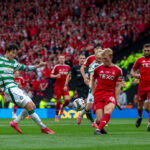

3) The Josh Meekings Scandal And The Handball That Wasn’t Seen, Then Was, But Wasn’t A Handball At All

The Josh Meekings scandal of last season bore all the striking hallmarks of the Dougie McDonald affair, and should have ended the same way; with heads rolling in the dust and the SFA in full-scale retreat after being caught in an official cover-up.
In the aftermath of Dougie-Gate, the SFA had proposed bringing in microphones and headpieces for all its match officials in the top flight. The officials had them that day, and something was communicated between Alan Muir, the goal-line official, and the referee Steve McLean, but we’ve never found out exactly what that was.
The SFA’s official line, and which Celtic refused point blank to accept, is that “nobody saw anything.” There were no fewer than six designated SFA officers in the stadium that day, and by the official record they are the only people in Hampden who didn’t see the incident.
At the time, Celtic had a one goal lead. Had this incident been spotted the red card would have been shown to Meekings and, had we scored the penalty, we’d have been two in front against ten men; a scenario which would only have ended in our winning the tie. Instead, we lost Fraser Forster to a red card, Inverness scored from the resultant penalty and went on to win the tie.
Yet the incident itself would have been dismissed as one of those bad decisions, and allegations of cheating might never have arose, but for the SFA’s utterly incoherent, and at times blatantly contradictory, attempts to “explain it away” after the match.
Celtic’s request for an explanation was clearly motivated by more than just pique at the result; we had reasonable grounds to suspect that something had gone on that wasn’t quite right. What happened in the days afterwards confirmed that suspicion in spades.
The first version of events we got was that either the third official (behind the goal) or the ref had seen the incident and communicated to the other that it was either not a handball or that it was not a deliberate one. That we’re still unsure of which it was tells you a lot right away; the release of the audio discussion between the two of them has long been sought, but has never been made available to the public. This was never going to wash, as the TV footage made it abundantly clear that any look at the incident, from any angle, would have made a penalty the only logical outcome.
So the SFA clarified the position by coming up with this garbage about nobody seeing it. That this was contradicted by TV evidence making it clear that there had been some kind of communication between the third official and the ref was ignored.
The SFA were so determined, however, to make that explanation stick that they then tried to take it to it’s natural conclusion; if no-one actually did see the incident, and it had only been brought to their attention via TV evidence, they were quite entitled to ban the player on the basis of that evidence later on. And that’s just what they tried to do.
Yes, they would have deprived Meekings of a cup final place just to support the credibility of their own nonsensical and transparently fictitious tale.
Inverness reacted in fury, supported all the way by an announcement from Celtic that the decision was ridiculous. The Highland club then threatened to take legal action over the matter if the player’s ban was upheld. The SFA, realising they could no longer support the lie in that fashion, then over-turned the ban completely … using, as their cover, another transparent fiction; that after studying the TV evidence they couldn’t support a charge of intent.
As if all this wasn’t ridiculous enough, when details of the refs report, as given to Inverness’ lawyers became public (as was inevitable) what was in there confirmed all our worst fears about a cover-up and a tissue of lies on top of it.
The match report overturned the stonewalling strategy completely. Now, according to this official document, the incident had been seen after all … and the discussion we knew had taken place was explained away as Muir telling the ref the ball hit the player on the head.
In the aftermath to the game, John Fleming had briefed the press and told them none of the officials had seen the incident. He said that as the referee’s supervisor, at a time when he would have actually read or seen the match report as written by his refs. Yet that “same” match report, which was handed to Inverness’ legal team, told a completely different story to that, and one that would never have stood up to scrutiny in light of the TV footage.
The number of questions raised by that report could fill a book. Foremost amongst them was this; if the refs match report following the match actually said what they told Inverness it did, why in the Hell did the SFA think it had a case to charge him over the incident on the grounds that none of their officials had actually witnessed it?
The more you studied the affair, the clearer it became that someone had lied, they had tried to cover this with more lies and as the noose tightened they poured even more lies on top of that.
What makes this story unique, and more disquieting, is that at some point in the proceedings FIFA got involved in it, and it was that organisation that told the SFA it had no right to discipline Meekings. Jim Boyce, one of their Vice Presidents of Refereeing, told them the decision wouldn’t stand up and that it set a dangerous precedent. The SFA were asked to explain themselves over it. The Scottish media reacted to that in outrage, telling the world body to keep their noses out.
The upshot of it all was that Meekings was cleared to play in the final, and after a while the issue was allowed to die a death without blood spattering the walls.
As I said at the time, though, the scandal remains a major one and, aside from the consequences to Celtic, its worst victim almost ended up the player himself who the SFA were quite happy to make “the scapegoat for God knows what, to protect God knows who.”
We still don’t have those answers today.