
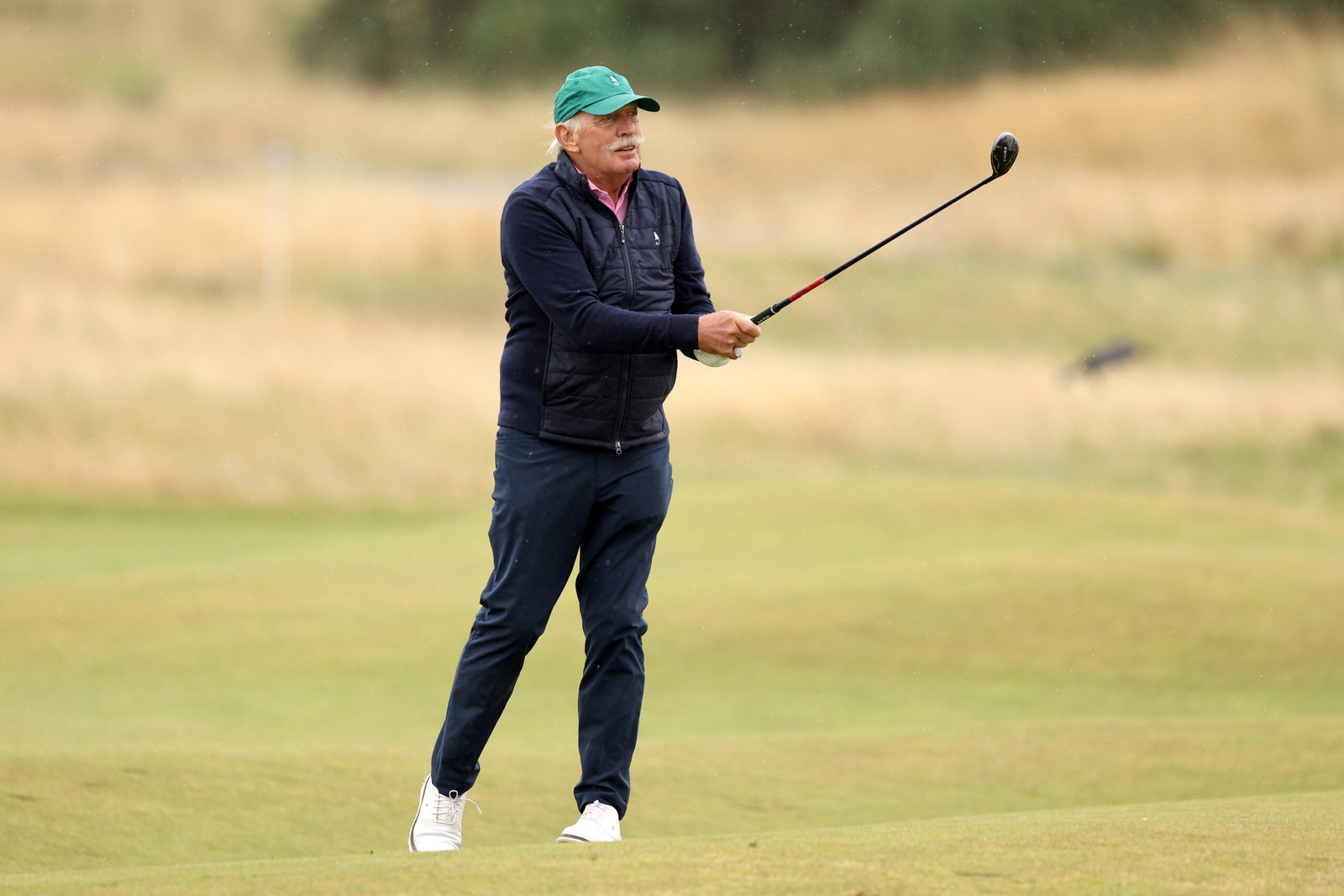
ST ANDREWS, SCOTLAND - OCTOBER 06: Dermot Desmond plays his second shot on the 15th hole during day four of the Alfred Dunhill Links Championship 2024 at the Old Course at St Andrews on October 06, 2024 in St Andrews, Scotland. (Photo by Warren Little/Getty Images)
As things around Celtic continue to heat up, there’s suddenly a lot of talk about the role of Dermot Desmond.
That in itself isn’t new, but the manner of the talk is, and that’s what makes this different. For years, supporters grumbled about him at the margins, but few saw him as central to our problems. That’s changing. As the pressure builds, as the board shows no sign of renewal or even of outlining a phased transition, Desmond is about to face a level of scrutiny he’s largely been spared.
Let’s be 100 per cent clear about one thing: the directors who have presided over this mess will have to go. That much is certain.
Desmond, though, is a tougher prospect. He owns roughly 34 to 35 per cent of Celtic. That makes him the largest single shareholder. He isn’t about to sell, and, in practical terms, it is impossible for the support to amass enough stock to render him irrelevant. But his influence is outsized in comparison to the actual shares he holds. That disparity — between his stake and his sway — is why people who never gave him much thought are beginning to do so now.
From almost the moment he got involved, Desmond has been treated as if he were Celtic’s owner. That fiction has suited many people.
It certainly suited Peter Lawwell, whose own power was magnified when combined with Desmond’s. It suited the club’s hierarchy to play along with the idea of a benevolent benefactor who would push out the boat for managers and signings. And it even suited parts of the support, who found comfort in believing that when big decisions needed to be made, a wealthy overseer would make them.
The truth is less comforting. Desmond should have remained a background figure, influencing occasionally, stepping in only when absolutely necessary.
Had he done that, he might have lasted indefinitely, handing over his stake to his children in due course without much controversy. Instead, his involvement has grown more obvious. His interference in the boardroom has become more pronounced. That’s not something we simply surmise; it’s evident from the words of managers and others who have confirmed that Desmond calls the shots.
For years he got away with it because people cast him in one of two roles: the benevolent overseer, keeping a watchful eye but not meddling, or the benign leader, largely harmless in his interventions.
But if you look back honestly, his involvement has never been either subtle or benign. His influence stretches back to the Martin O’Neill era. It was Desmond, alongside chairman Brian Quinn, who oversaw the shift towards austerity after O’Neill’s initial years. And it was that board which appointed Peter Lawwell as chief executive in October 2003, an appointment that shaped two decades of Celtic.
These things are matters of record. They are documented in company statements and board minutes. Yet their implications have rarely been explored. The support was content to give Desmond the benefit of the doubt so long as the club appeared to be “running right.” The problem is, when you stop to ask what that actually means, the whole edifice starts to crumble.
Running right cannot mean simply balancing the books and winning domestic trophies. Running right, in the context of Celtic, should mean operating as a first-class institution. By that standard, we are miles short.
We have cash in the bank, but no vision for how to use it. That money could have been invested in Celtic Park infrastructure — a redeveloped main stand, a hotel, a museum, Celtic-branded bars and restaurants, leisure facilities to expand the footprint and make matchdays a genuine event.
These things would bring in long-term revenue and strengthen the club’s identity. But the will isn’t there. The vision isn’t there either.
There were various ways it could have been achieved. Joint ventures with commercial partners. Strategic tie-ups. Creative financing. None of it has been pursued with any seriousness because Celtic has become a small-c conservative club, averse to risk, locked in a mindset where the only priority is keeping the cash pile intact. That is not the behaviour of a growth-orientated football institution; it’s the behaviour of a company run by accountants rather than dreamers.
It’s not fashionable to say this, but Celtic is not well run.
We are competently run. That’s not the same thing. Competence delivers you functioning accounts and domestic titles in a weak league. Vision delivers you the kind of institution that thrives beyond its borders, one capable of punching above its weight in Europe and maximising every possible stream.
Our financial footprint is tiny compared to what it could be. People hide behind Scotland, blaming geography and TV deals. That’s a shield for small thinking. What they really mean is that their imagination is the constraint. They don’t know how to prise Celtic out of the current chains that bind us. Yes, we are in Scotland. But that should not be a life sentence on ambition.
This brings us back to Desmond, and the nature of his power.
The UK Takeover Code is clear: a mandatory bid for a company is triggered when a shareholder acquires 30 per cent or more of voting rights, either alone or with “persons acting in concert.” The Code defines a concert party as those who cooperate, formally or informally, to obtain or consolidate control.
In 2005, when Celtic undertook a rights issue underwritten by Desmond, the club sought a “Rule 9 waiver” from the Takeover Panel. That was standard procedure: if the underwriting pushed him over 30 per cent, he would otherwise have been forced to make a full bid. Shareholders approved the waiver and the Panel allowed it.
That episode matters because it underlines the scale of Desmond’s position. He is not the legal “owner” of Celtic. He is the largest shareholder. He and the club specifically sought to exempt him from any requirement to buy enough shares to give him total control. His stake is powerful, but it does not confer that. Yet in practical terms, he operates as though it does.
His relevance is greater than the numbers suggest. And this is where the scrutiny he faces now is different from before. Supporters are beginning to ask whether his de facto control exceeds what is normal or healthy for a shareholder at that level.
In other clubs, even those with dominant individual investors, there are checks and balances. There are institutional investors, fan representatives, or broader corporate governance mechanisms that limit any one person’s sway.
At Celtic, the lines are more blurred.
Desmond has been able to project the image of an owner without actually having to acquire the obligations of one. That duality has let him sit in the shadows when it suited him, and step into the light when it didn’t.
The questions supporters are asking now are simple: is that acceptable? Does it serve Celtic? For years, the answer was “it doesn’t matter,” because we were winning domestically and the finances looked sound.
But when you measure Celtic against its true potential — when you look at the lack of vision, the lack of strategic investment, the failure to turn advantage into lasting strength — the flaws are glaring.
That is why Dermot Desmond is under the spotlight now in a way he has never been before. It isn’t just about the size of his shareholding. It isn’t even about his wealth or his status. It’s about the nature of his influence, how he uses it, and whether it has held Celtic back rather than propelled us forward. For a long time, supporters tolerated it. Increasingly, they won’t.
Because Celtic isn’t just another club. It’s an institution with untapped global potential. And the hard truth is that under Dermot Desmond’s watch, we have been competently run, but not well run. We have been financially cautious, but not strategically bold. We have been conservative when we should have been visionary.
So the question is no longer whether Dermot Desmond will ever sell his shares. The question is whether his role, his influence, and his style of control are acceptable in a modern football club.
Whether they exceed the norms of shareholder influence. And whether Celtic, as an institution, can ever reach its true potential while one man holds that much sway without ever having to carry the title — or the full responsibilities — of being the owner.
Celtic shareholders have never challenged him on these issues because no-one cared to. All that has changed. People are taking a hard look at Desmond now. That’s changed the rules. Hell, that’s changed the game … and he might not like where we’re going with it.





James, Desmond and his cronies have lost their Mojo where Celtic are Concerned, they have been in the job far too Long, they have no solid vision anymore. Celtic as an institution needs some fresh new minds that can take us that next step. The old grey guys at the helm only look forward to their bumper Bonus at the cost of a weakened team on the pitch. Everything in life moves on they should too. If they love Celtic as they profess then they should do the decent thing and hang their hats up. We need new younger collective minds taking charge and push Celtic to their potential.
100?%
Is it the case that any great deal of the other shares are held by small shareholders whose shares are down the back of figurative sofas. This has the effect of magnifying DDs holding and effectively giving him the control and the autonomy he enjoys. You can safely assume all DD shares, together with those of the board sit at the ready for any vote deployment. Will the current schism make any of the non-execs rise up and do their jobs. Don’t bet on it.
For the supporters, I believe there is a meeting tonight. Unity of purpose and an orchestrated campaign can make a difference but a leader and a voice needs to emerge to unify behind a well articulated and agreed course of action. One which will have sponsors and golfing buddies asking questions
Spot on !
James I might be a bit thick but is duty of a board of directors of a PLC not to look after the interests of all the shareholders? This board seems to look after the interests of one shareholder surely that’s not right!
One of the worst scenarios for me is that the hierarchy will offer BR a get out of jail (pay off/over compensate his final year contract) with a NDA as the caveat and him in their twisted minds as the patsy! TBH couldn’t never see BR selling his soul to the ghouls this way but these emotional deficit intelligent and unimaginative retards will take a punt IMO
They definitely will Aodhain – But he might not sign it this time (He May well have done at the beginning as Lawwell is smart enough on these matters)…
But if offered now he might not, and hopefully he’s as pig headed as his strategy in non changing of tactics v Sevco and doesn’t sign the fuckin thing…
And reveals ALL !!!!
“But his influence is outsized in comparison to the actual shares he holds”.
That’s it right there ? Finally James? I’ve been waiting on someone picking up on this glaring fact ? The man owns because of it’s complexity 34-35% of shares and he wields power like a man who owns 100% of all shares. That’s a false economy! And false economies tend to collapse with just a hint of strain.
It’s far time we treat Mr Desmond accordingly. Strip him of this myth and deal with the fact he owns 34-35% and that’s where we begin with facts not fiction where this board has been living far to comfortably for far to many years.
Another excellent article James. Very well put. And i must admit i personally have been guilty over the years of seeing DD as ‘The Big Chief’ when he is nothing of the sort. Ignorant thinking on my part. Thanks for the clarity and calling a spade a spade.
Your article says it all about the myth of DD.
The gross under achievement, dearth of vision and zero ambition by those puppets of his on a board, of which he has a majority shareholding, is criminal!!!
Despite the domestic dominance, Celtic undoubtedly, is a global brand with an ever faithful fanbase, that should always be able to make its mark in European competition.
As you say, the only way forward is hiring the very best out there on merit, and being highly professional in everything we do, rather than setting for the mediocrity of this shower !!
“Mediocrity knows nothing higher than itself; but talent instantly recognizes genius”
“Great spirits have always encountered violent opposition from mediocre minds”
Let the winds of change begin ! HH
rather than settling for the mediocrity of this shower !!