
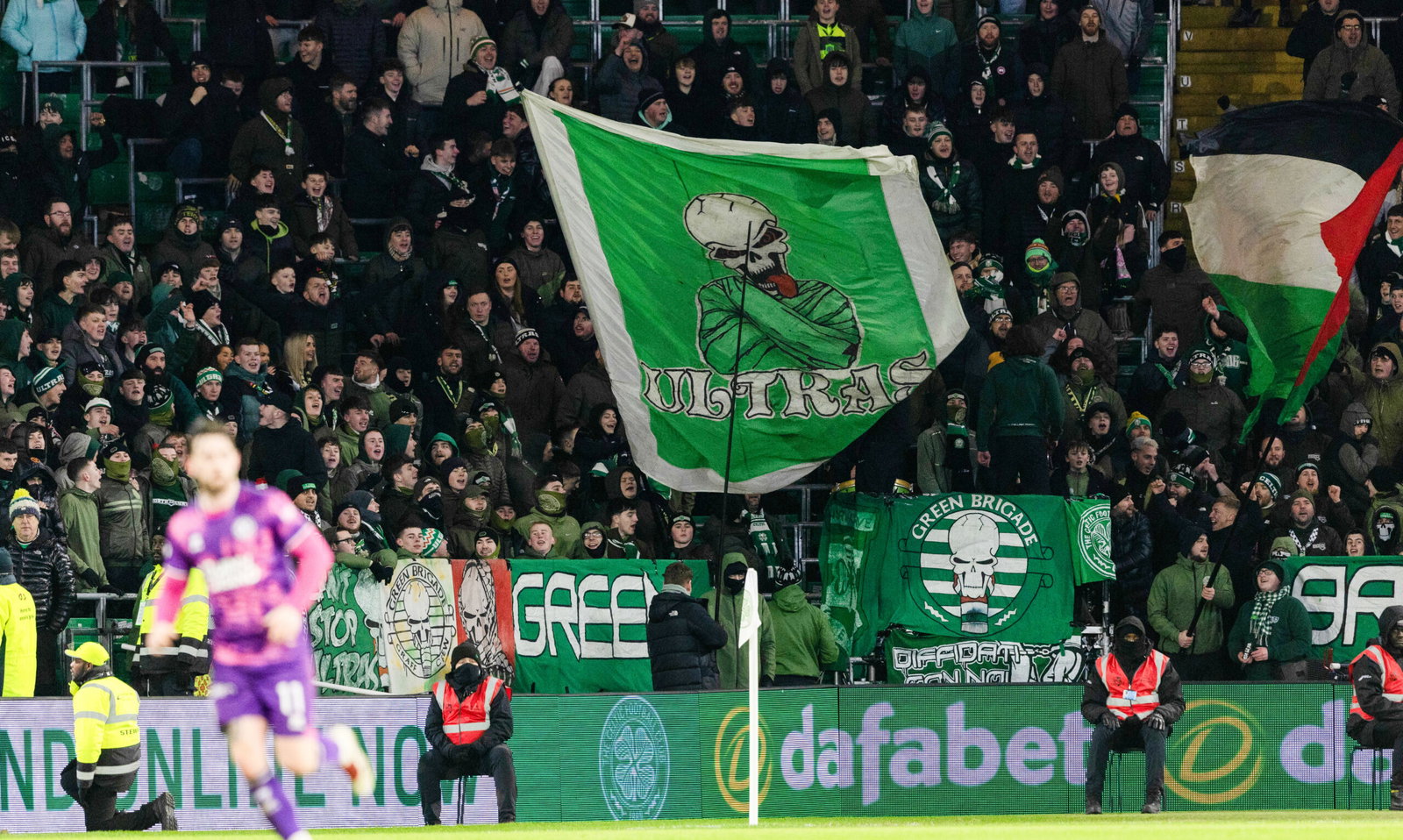
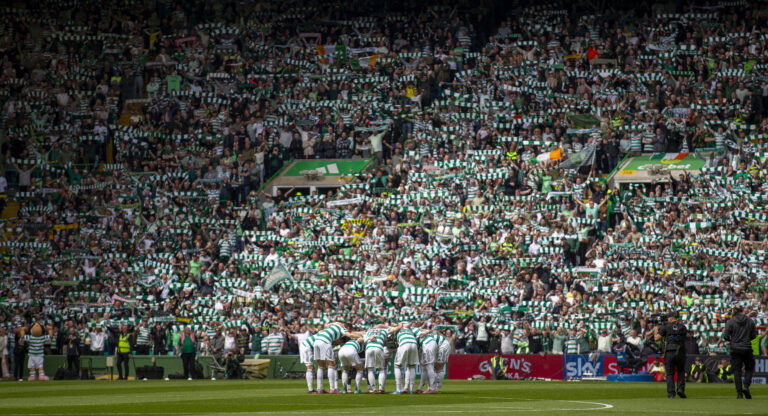
GLASGOW, SCOTLAND - JANUARY 08: Celtic fans during a William Hill Premiership match between Celtic and Dundee United at Celtic Park, on January 08, 2025, in Glasgow, Scotland. (Photo by Craig Williamson/SNS Group via Getty Images)
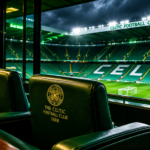
I’ve always believed that some stadiums host football, and some carry something far heavier. When I think about Celtic Park, I don’t just see a pitch and four stands. I see memory and migration. I see belief layered into brick and steel.
This isn’t a neutral space that occasionally drifts into politics. Instead, it is a place where football and identity have been intertwined from the very beginning.
That is why conversations about keeping politics out of football feel simplistic to me.
At Celtic, history is not a side note. It is the foundation. You cannot separate the club from its origins, its community or the conviction that shaped it. When you step inside Celtic Park, you feel that immediately.
Nothing about it feels accidental. Everything about it feels intentional.
Celtic Park is where these things become real. Football there is never simple. It is emotion, frustration, joy and unity. Triumph and struggle. It is thousands of voices singing You’ll Never Walk Alone.
For supporters across the world, Celtic Park is Paradise, a gathering place for belief as much as for football.
Just as importantly, the stadium carries history. It holds the memory of legendary players and managers. It contains triumph and hardship, faith and resistance, identity and belonging. Inside those stands, people do not come to be judged.
They come to stand together. And that, in turn, raises a deeper question.
Is Celtic Park a football ground that hosts political expression, or a political space that happens to stage football?
In Glasgow, particularly in the East End, football and politics have never been separate.
At Celtic Park, belief exists on many levels: religious, cultural and political.
As a result, many supporters identify with traditions of solidarity, anti-establishment thinking and social justice.
The club’s origins are central to this. Brother Walfrid founded Celtic to support Irish immigrants living in poverty. From the beginning, the club stood for community and dignity. That legacy still shapes how many supporters see it today.
Celtic began as a vehicle for helping people, without asking who they were or where they came from. Because of that, openness remains central to its identity. For many fans, wearing green, white and gold means more than supporting a team. It represents culture, heritage and belonging.
Because of that history, Celtic has always felt different.
At Celtic Park, Irish flags and symbols are a regular sight. They reflect pride in the club’s roots and in the Irish diaspora that helped build it. The Irish Tricolour itself carries a clear message: green for the Gaelic tradition, orange for the Protestant tradition and white for peace between them.
For many supporters, these symbols do not express division. Instead, they express history, identity and remembrance.
That wider tradition of solidarity appears in other ways as well. Palestinian flags, for example, are often visible inside Celtic Park. For many supporters, this reflects empathy for people facing conflict, displacement or hardship. Groups such as the Green Brigade have also backed charitable initiatives, including fundraising for humanitarian causes and supporting community football projects abroad.
For those supporters, Celtic Park becomes a place where belief is visible and where people feel able to express what matters to them.
However, this reality is not without controversy. Governing bodies regularly call for neutrality. That raises an important question.
Neutral compared to what? To history? To poverty, migration and discrimination?
In that context, asking Celtic Park to be politically silent can feel like asking it to forget why it exists.
At the same time, the reality within the support is more complex than it sometimes appears.
Not every fan wants politics in football. For some, Celtic Park offers an escape from the pressures of everyday life. They want ninety minutes focused only on the game.
For others, it remains a place of expression.
As a result, tension exists within the support itself. Fans debate banners, songs and symbolism. Some believe political expression strengthens the club’s identity. Others worry it risks narrowing that identity or creating division.
Acknowledging that disagreement does not weaken the argument. On the contrary, it strengthens it. It shows that the culture is not imposed or choreographed. It is lived and argued over, and because of that it evolves.
That is what makes Celtic Park a political space in the truest sense. Not because it follows a party line, but because conviction is visible there. Supporters bring their full identity with them, not just their season ticket.
That identity becomes most powerful in the atmosphere.
The singing is not background noise. It carries memory, of migration, hardship, faith and resilience. It is not a performance for television, it is a declaration.
This is identity made audible.
That sense of meaning connects directly to the club’s founding story and to the East End community it grew from. The history has not faded into branding. It still lives in the stands.
Of course, not everyone outside the club sees it that way.
For some observers, Celtic’s scale and identity make the club appear political by default. Its Irish roots, its cultural history and the visibility of supporter expression all shape that perception.
From the inside, however, it feels less like politics and more like continuity.
Belief at Celtic Park does not feel manufactured. It feels rooted. Historical. Organic.
When the songs rise and the crowd moves as one, the stadium does not feel like a venue trying to send a message. It feels like a place remembering itself.
That is why the conversation about politics and Celtic Park never truly disappears.
Football there does not exist in isolation from the wider world. It reflects it. Sometimes that creates discomfort. Sometimes it creates friction. Yet it also creates meaning.
You do not have to agree with every banner or every message. But if you spend time in that stadium, one thing becomes clear.
This is not just a venue.
It is conviction in concrete form.
And that is why Celtic Park remains controversial for some. Not because belief appears there, but because belief has always been there.
Modern football often prefers polished branding and carefully managed neutrality. Celtic Park was never built on detachment. It was built on purpose. It grew from community. That sense of meaning still echoes through the songs, the debates and the identity of the support itself.
Communities are never uniform. They are layered, complicated and sometimes divided. However, asking Celtic Park to empty itself of conviction would mean stripping away the very thing that makes it unique.
Because when the noise rises and the history feels close enough to touch, one truth becomes impossible to ignore.
Celtic Park is not just a football ground.
It is a place where memory and belief refuse to disappear.
The mere existence of Celtic is a political statement.
A constant reminder to an old establishment of their forefathers horrific crimes of genocide,crimes they want to hide from the world.
Yes, practically all other clubs have their own cherished history for their particular regional tribe and Celtic has its own.There are many clubs who also grew out of horrific circumstances, be they from the fascist invasions of WW2 and Partizan groups who fought them in former Socialist countries or other teams who grew out of the ashes of hundreds of years of slavery and imperialism.
Celtic though wasn’t the first it was the second, the first would be Hibernian of Edinburgh
Just as the shining example of the Irish people fighting and winning against the largest empire the world had ever known was a blueprint for other revolutionary and anti-imperialist peoples to rise up.
The formation of Hibernian was the spark for the starving Irish escaping imperial genocide in the starving 40s (1840s)to fight back for their people in the very land that created the genocide.The Glasgow Irish followed suit and built a team to care for not only starving oppressed Irish immigrants but starving oppressed Scots to.
Celtic was a little more open than Hibernian to all oppressed people and continues that incredible heart warming and crucial role to this day.
I have a similar love for many anti- fascist anti-imperialist clubs around the world.
I just realized that we play them in a few hours and we MUST win ,no ifs no buts.
COYBIG
Ps.Good Sunday morning read.
Thanks PJ.
You absolutely nailed it. Thank you
Paulina, your articles just get better and better and your insight into the Celtic psyche is so, so accurate. You understand us more than fans who have rolled up to Celtic Park all of their lives. They feel it f course, it is part of their fabric, but they could not describe their passion and emotions as eloquently as you have done.
Well done Paulina, we are very thankful to have you in our ranks.
Excellent article yet again Paulina. Delivered at a time when many people maybe need to be reminded of these facts.
Being anti establishment is Celtic. No matter how some people nowadays would like to use that tag as an insult to the Celtic fan base. It will never be an insult but a something to be proud of .
Wheres that h un bas tard notconvinced…make crass comments about people with disabilities while giving the impression he’s a respectable member of society…your a cretin of the highest order ma man and a stinking hu n intae the bargain..
Hi Paulina, it’s great to read your articles here on the Celtic Blog!
There was a viewpoint you wrote that stood out to me: “That wider tradition of solidarity appears in other ways as well. Palestinian flags, for example, are often visible inside Celtic Park. For many supporters, this reflects empathy for people facing conflict, displacement or hardship.”
I’m a Celtic supporter that comes from both a Northern Irish Catholic and Jewish background. I struggle not with the politics at Celtic Park but at times what comes across as the cruelness within the politics. The Green Brigade for me often comes across as their way or the highway with their political views and as someone with part of my heritage and because of the ultra groups influence, I often feel like I don’t belong at Parkhead or apart of the Celtic support. It’s not that their Pro Palestinian (as your example provides) but it’s how their banners and Pro Palestinian messages are voiced that make me uncomfortable. For a club open to all, their brand of politics (some I agree with and some I don’t) there is at times a lack of nuance and cruelness within some of our messaging that can make it challenging for someone like me who is left wing and from who comes from a similar Ulster Catholic Irish background as many within our support. Thanks for letting me share!
Oh ffs – this angry, self-loathing, left-wing political nonsense is utterly ridiculous!
Celtic are not, never have been, and never will be political! Our history is one of humanitarianism and social justice; neither of which are political!
This modern day, woke obsession with politicising our club is self-defeating, backwards-thinking and a betrayal of our history.
Excellent article again Paulinha and thank you !
Where is there any ‘self loathing’? Or ‘political nonsense’?
Left wing ?
Yes of course.
What do you think ‘humanitarianism and social justice’ are ?
Woke is a buzz word for being kind to each other and progressive not ‘backward’ thinking.
And where is this ‘betrayal of our history’?