
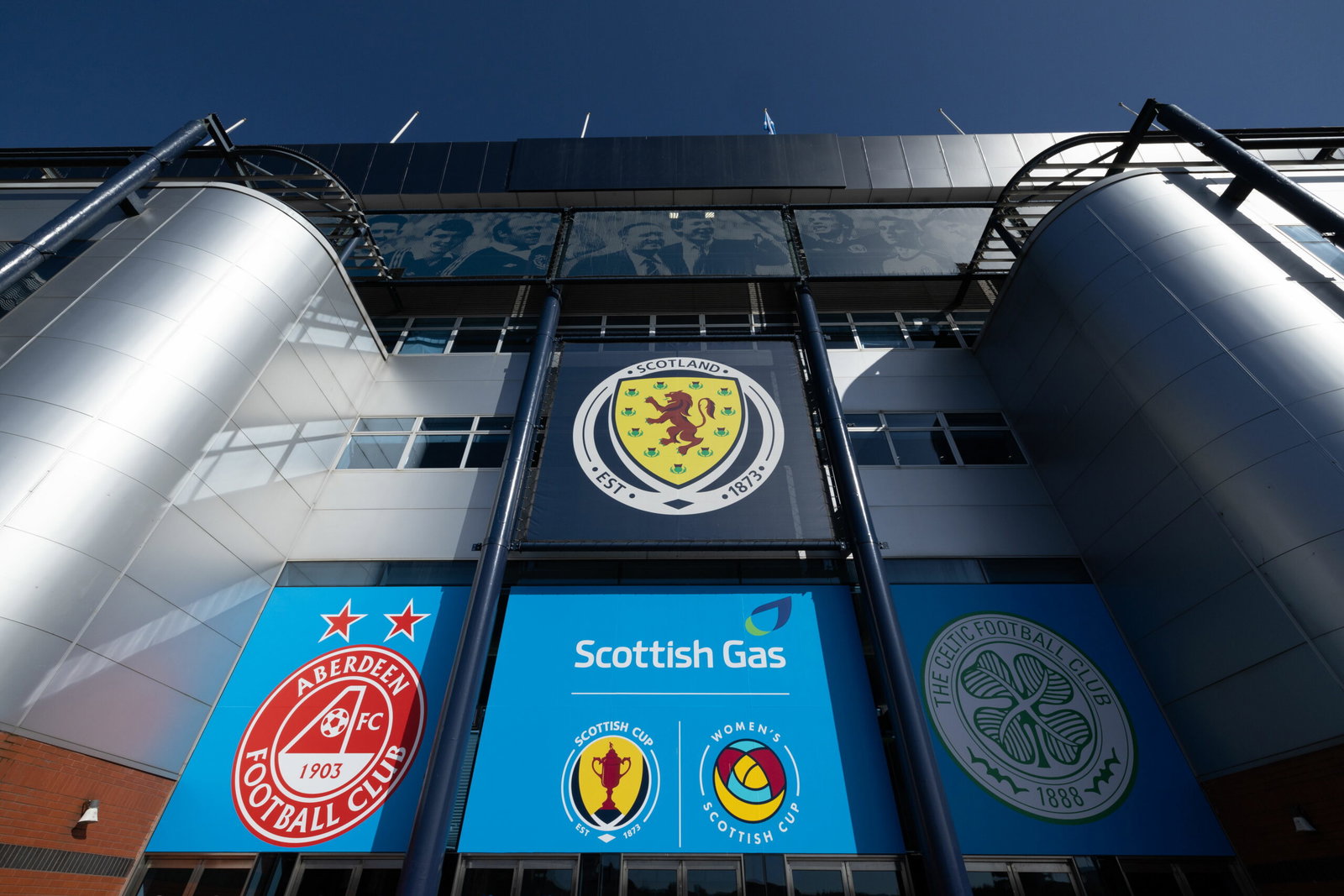
GLASGOW, SCOTLAND - APRIL 20: An External Stadium View during a Scottish Gas Scottish Cup semi-final match between Aberdeen and Celtic at Hampden Park, on April 20, 2024, in Glasgow, Scotland. (Photo by Craig Foy/SNS Group via Getty Images)
I held off on writing this piece for a couple of days. I’m coming to it now because Paulina raised the issue this morning in her excellent article on trust in the system. There’s another point from her piece that I want to come back to later. For now, I want to focus on the system itself, and on trust in it. I also want to look at Celtic’s press release following the Trusty appeal hearing.
Let’s start with the appeal.
I wrote at the time that the original decision was a scandal. It remains a scandal. The more you examine it, the worse it looks. There are so many problems with it that it’s difficult to know where to begin.
Some have said it sets a precedent. It doesn’t. It sets a precedent that will be ignored. What it actually does is undermine the credibility of the system here in Scotland and damage the reputation of the SFA beyond our borders. It makes a mockery of the league and the national association that governs it.
We know VAR causes problems everywhere. It isn’t popular in most countries. Yes, its defenders argue that it corrects more decisions than it gets wrong. But increasingly, officials use it to review and overturn incidents that don’t even fall within its intended scope.
One of the most embarrassing aspects of this case, and one Martin O’Neill has rightly taken to a wider audience, is simple: officials used VAR to overturn an on-field decision without any clear justification.
VAR was always supposed to intervene only when a referee made a clear and obvious error.
There was nothing clear about this. There was nothing obvious about it.
The decision was shameful. The rejection of the appeal was worse.
Which makes Celtic’s response all the more frustrating, because once again the club is focusing on the wrong target.
Celtic are calling for a review of VAR.
VAR is not the problem. VAR was never the problem.
The issue is the people using it and the system that governs it.
The issue is a structure that lacks transparency, accountability and basic safeguards.
Paulina mentioned John Reid, and I’ll return to him later, but I remember his response after the Dougie McDonald controversy. He made it clear that he did not want to see that official involved in another Celtic match and that the club would not hesitate to take matters beyond Scotland if necessary.
Reid did not bluff. That’s what gave his words weight.
He also spoke openly about the need for reform. He recognised that Scottish football might have to confront an uncomfortable truth: the system was neither clean nor credible, and only genuine structural change could protect the game itself.
That’s the point Paulina made. These institutions are failing to safeguard their own legitimacy. Like the Celtic board, they are undermining the very structures they exist to protect.
This is bigger than Celtic fans distrusting individual referees. It goes to the heart of whether anyone can have confidence in the SFA or the SPFL.
Because we are an outlier.
We are the only major European association that still refuses to do something basic: formally register and manage declared affiliations or links between officials and the clubs they oversee.
I’ve heard all the arguments against that. None of them stands up.
The only consistent logic is self-protection, even when that protection damages the credibility of the system.
And when a system prioritises protecting itself over delivering fairness, it isn’t broken.
It’s rotten.
That distinction matters.
If something is broken, you fix it, but if something is rotten, you have to cut it out.
And that’s a far more difficult task.
The first step is acknowledging the rot. That’s the mental barrier no one seems willing to cross.
We’ve seen this pattern before. Institutions avoid difficult conversations until events force the truth into the open. The Stephen Lawrence Inquiry is a clear example. The issues within the Metropolitan Police were widely understood long before they were formally recognised. It took a national shock to force real scrutiny.
That scrutiny ultimately strengthened the institution.
Scottish football needs the same kind of reckoning.
Root-and-branch reform of the SFA would strengthen the game, not weaken it. But it will only happen if the issue is dragged into the light. Every time a controversy like this occurs, there is an opportunity for a John Reid-style response.
Instead, we get language about reviewing VAR.
We all know the real issue.
We know what it means when the same officials keep appearing in the biggest matches. Everyone in the country knows who they are, where they come from and what the perception around them is.
Only here do we pretend that none of this matters.
I’ve said before that if corruption does not exist in Scottish football, it is not for lack of opportunity. We have created the perfect conditions for it. The stakes are enormous. The financial difference between first place and anything else this season could approach £50 million.
In any other industry, there would be rigorous safeguards around decisions carrying that level of consequence.
Here, we have ambiguity and silence.
Back in 2022, in a very different context, I wrote something that feels just as relevant now:
“Scottish football is like a tiny town where everyone knows everyone else intimately. The wife-beaters drink with the preachers. The fraudsters sit with the bank managers. The man who murdered his wife shares a pint with the schoolmistress. The barman keeps pouring for the not-yet-acknowledged problem drinkers and tells them they’ve earned it after a long day.
The wheel keeps turning because although everybody knows, nobody ever says it outright. Nothing is secret, but everyone behaves as if there are no secrets to tell. It’s a community built on mutual silence. A place where if you never acknowledge something, maybe it didn’t happen at all.”
One day, we’ll break out of that mindset.
But only when someone calls it what it is.







James, this is the wrong time to concentrate on the officials and VAR. The football team is by far the biggest issue. There is no way the board can make a big deal of this just now while we are capitulating. We become a laughing stock in the wider football world. We have so many advantages in scottish football and we are so successful domestically because of money. Uncomfortably, we have thrived on capitalism, being far richer than everybody else.
You maybe dont remember when we got to a european cup final on the toss of a coin. That was unfair and wrong and Jock Stein called it out. He did it at the right time when we prospered from the toin coss and he was influential in changing the rules.
Thats how we should operate now regarding officialdom. We should concentrate on this when we are winning.
Spot on James. I wrote at the time and questioned how a ref can stand & watch an incident and decide it’s only worthy of a talking to. Then VAR intervenes and WANTS it looked at further.
As you say none of us need to be told that VAR is the issue when we know that it is the operatives.
Enough said !
Until we get Celtic officials in the mould of J Reid or F McCann, taking these officials to task, then we’ll still be debating these issues ad nauseam! HH
This ‘declaration of interests’ idea has a very big and not so obvious problem.
So what do we do once officials declare their team of choice? They are then prevented from officiating at any games involving the team they support. Then what?
Outcomes can still be strongly influenced that would benefit their team.
For example, say i’m a football referee and i’ve declared Celtic as my team. Celtic play St Mirren next weekend in a game that could see Celtic winning the league.
Tonight i’m officiating at a game involving Hibernian & St Mirren. What’s to stop me from making sure St Mirren are weakened for the weekend by sending off a player or two?
Yes, we should have declarations but i believe we should also have accountability, scrutiny of performance and make the officiating a full-time job. Part-timers should never be making decisions that impact a professionals livelihood.
I agree Richard. I’ve often said it’s not just the games involving the team they support, but also the games which affect their closest rivals, and other games affecting the chances of success of those teams, as in the example you gave. But the trouble here, also, is that in our little nonsecular corner of the globe every catholic official will be tagged as a ‘closet’ Celtic fan, and conversely, every (or most) Protestant officials will be tagged as ‘closet’ rangers fans. It’s just in the nature of the beast here.
Administered properly VAR could be a step forward in the pursuit of fairness in football, administered by dishonest referees, who have an allegiance or connection with one of the teams involved in the game, then it is a recipe for a corrupt game.
For the people who administer the sport in Scotland not to acknowledge this, is refusing to recognise what would be obvious to any fair minded person.
Celtic FC should have been compiling statistics over a long period and taking it to the SFA and UEFA, but no, our board are too lazy to look after the club’s on or off field interests.
They’re far too busy attacking and banning their own fans.
VAR is the best thing ever…
Unfortunately we also have the best ever cheats working the fucking monitors !