
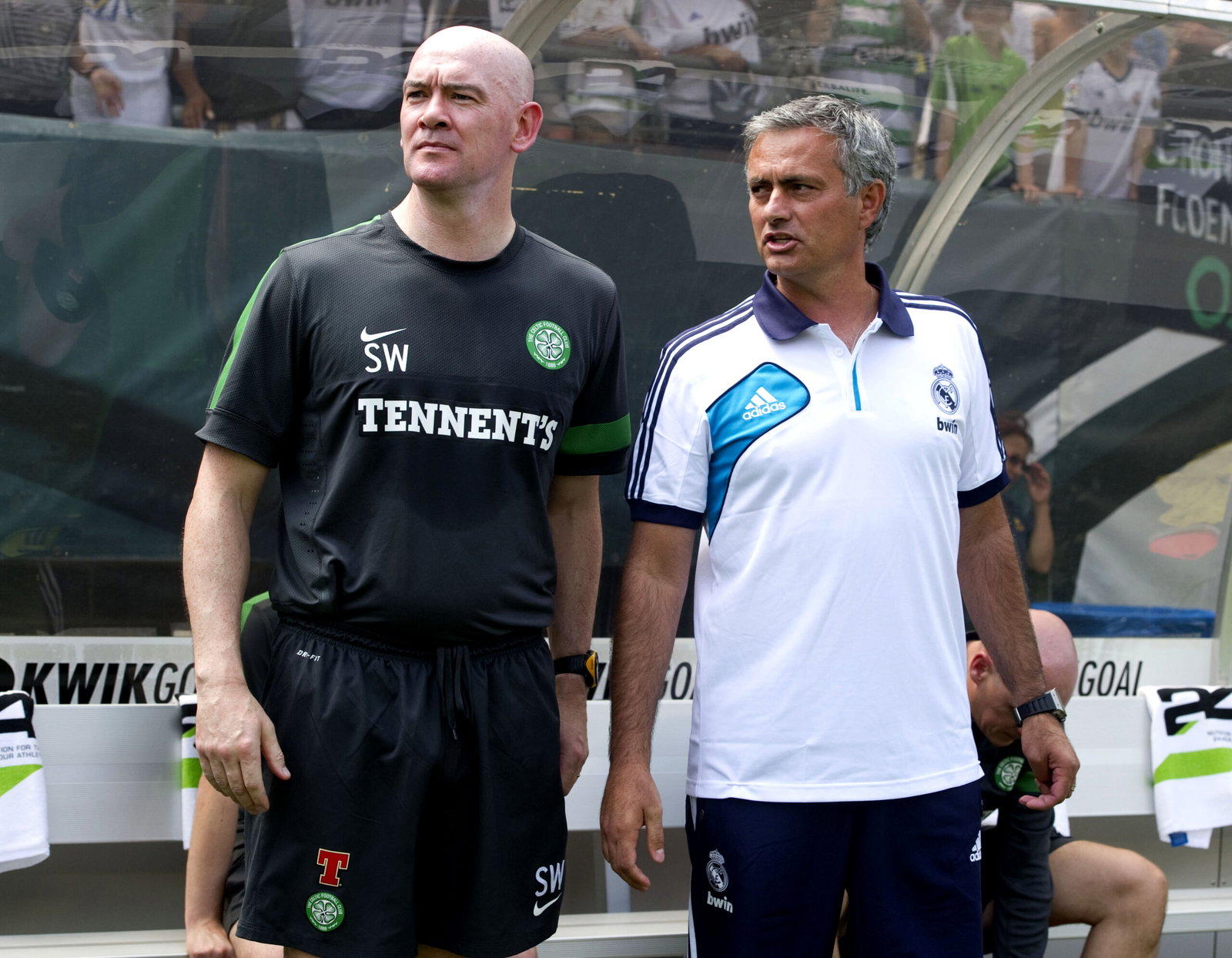
11/08/12 FRIENDLY.REAL MADRID V CELTIC (2-0).LINCOLN FINANCIAL FIELD - PHILADELPHIA.Real Madrid manager Jose Mourinho (right) with Celtic's goalkeeping coach Stevie Woods. (Photo by Alan Harvey/SNS Group via Getty Images)
It’s funny that, at a time when Celtic is again and again being linked with the mad fantasy of appointing José Mourinho, that he should be so close to home.
Because he is.
If someone told you that every manager outside Glasgow was doing José Mourinho, you’d probably laugh at them. The budgets don’t match. The players don’t match. The tactical sophistication certainly doesn’t match. It sounds like one of those grand theories football fans invent when results stop making sense.
And yet, when you look at the Scottish Premiership right now, that’s exactly what’s happening.
Not the personality or the theatre. Not the Champions League pedigree.
The philosophy.
In his great Guardian article The Devil & José Mourinho, written more than ten years ago now, Jonathan Wilson laid out the blueprint of the man who has won so much in the game and courted so much controversy at the same time. And when you see it written down, it becomes clear that this philosophy has arrived, almost fully formed, in Scotland.
Let your opponents have the ball. Sit back and slow the game down. Let them carry the responsibility. Let them feel the fear.
Mourinho didn’t stumble into this approach. When Barcelona under Guardiola became the dominant force in European football, possession football became the sport’s religion. Control the ball, control the game. Most coaches tried to copy it. Rodgers himself is one of its keenest students and most notable proponents.
Mourinho, however, did the opposite. As Wilson wrote, he consciously set himself up as the anti-Barcelona. If the game said possession meant superiority, he would reject it. His key insight was brutally simple.
Possession increases exposure to error.
Every pass is a decision. Every attacking phase is a chance to lose the ball. The more you have it, the more opportunities there are for something to go wrong. So he flipped the logic of modern football. Let the opponent take the risk and make the decisions. Let the pressure build.
And crucially, the psychological element mattered as much as the tactical one.
If the game stays tight, possession becomes a burden. The favourite knows they’re supposed to win. Every missed chance increases the tension. The crowd gets restless. The tempo drops. Players start choosing the safe option instead of the right one. Eventually, the team with the ball becomes the team playing with fear.
Does that sound familiar? It should, because when Celtic play games in this league now, it is exactly the system everyone adopts.
That philosophy works best against stronger sides, in low-margin matches, and in situations where reducing the number of decisive moments gives the underdog a chance. Shrink the game. Reduce the chaos. Wait for the mistake.
And now look at how most teams play against Celtic.
They don’t press high any longer or try to build through midfield. They don’t try to dominate territory. Instead, they sit deep, narrow the pitch, play long early to avoid the press and reset their shape at every opportunity. They accept twenty or thirty percent possession without the slightest flicker of concern.
In other words, they’re not trying to beat Celtic. They’re trying to frustrate us.
Anyone who has watched Celtic through the 2025–26 season knows that it works. This is Mourinho’s idea, stripped down and applied across an entire league, and it will be what deprives us of the title unless our manager, Martin O’Neill, stops playing the game the opposition wants.
We are being ground down by a system explicitly designed to counter the way we play.
That is why I reject completely the nonsensical “bottle” theory, the one which says this club has wilted under pressure. It shows a complete misunderstanding of the real picture.
We’ve heard it from pundits, from social media, from the usual suspects in the press. Apparently Celtic and the club from Ibrox are cracking under the pressure of Hearts. Apparently this team can’t handle the run-in.
This is one of the most moronic discourses in recent Scottish football history.
Celtic have won 14 of the last 15 titles. We have been in pressure situations constantly. Under Ange, we started badly and didn’t go top until the New Year. Last season we fell behind and were told the momentum was gone. Every year there are periods where every match is described as must-win.
Pressure is not new at Celtic. Pressure is the constant. This team hasn’t suddenly developed a psychological weakness.
However, here’s the uncomfortable truth.
Pressure is part of what we’re seeing, just not in the way they mean. It isn’t because the players are bottling it. Rather, it’s because the way Celtic are playing is creating pressure in every single match, and it’s a kind of pressure that has nothing to do with mentality.
For years, our dominance came from making games big. High tempo. Relentless pressure. Chances created early and often. Even when the score was 0–0, the game felt one-way.
Now the pattern is very different.
Instead, we see slow circulation and endless recycling. There are fewer clear chances. Opponents are allowed to remain comfortable, even as the clock ticks. The crowd grows edgy, and that anxiety feeds into players choosing safety over risk.
We’re dominating the small game. No question about it. Look at our possession stats. But possession alone means nothing. It’s what you do with it that counts.
When there are only three or four real moments in a match, one mistake becomes decisive. One missed chance feels huge. One defensive lapse changes everything. Superiority becomes probability instead of certainty.
That isn’t bottling.
That’s what happens when you play predictable, slow football against teams whose entire plan is to remove chaos from the match. They are happy to let you have the ball, to take your time, to wait for gaps that rarely appear. It’s football played on percentages. Celtic rely on creating enough chances to force a mistake. The opposition simply try to deny us long enough for our own discipline to break.
And this is where the harsher reality comes in.
This is the weakest Celtic squad in years. We’ve lost key players and not replaced them with sufficient quality. We lack pace in key areas. We lack unpredictability. Celtic no longer has the players who can break a game open on their own.
As a result, we are slow and predictable. Too often, we are dreadful to watch, and the rest of the league knows it.
Every team that once feared Celtic now knows exactly how to play against us. Sit deep. Stay compact. Wait. Hibs did it comfortably at the weekend. Others have done it all season.
They’re not worried about being overwhelmed.
They’re waiting for the mistake.
That’s Mourinho football.
And right now, we’re playing exactly the kind of game it was designed to beat.
So what’s the cure?
It isn’t a new formation or some tactical revolution. Instead, it’s about changing the size of the game.
Celtic need to play faster, not just have more possession. Move the ball quicker. Play forward earlier. Switch play with speed. Stretch teams properly. Commit more players ahead of the ball. Attack second balls aggressively. Accept a little more risk.
Because the biggest mistake Celtic can make right now is trying to control games that the opposition are deliberately trying to slow down.
For years, Celtic made the game bigger than anyone else in Scotland could live with.
Now, however, the rest of the league is trying to make the game as small as possible.
If we want to dominate again, we don’t need to out-think Mourinho.
We need to stop playing his game.






Scales is our practioner of Mediocrity. No vision ,slow and ponderous .The safe predictable, go nowhere pass….Trusty is weak. And Schmeichel has know confidence in Either.
Ironically, as he’s a CB, Scales is one of our better passers. Nothing that splits a defence but 30 yarders that go FORWARD and usually find their target. By way of contrast our so-called creative med-fielders like Hatate short pass backwards and sideways yet regularly give the ball away.
A very perceptive article – and another thing that doesn’t help matters is that we play teams three or four times a season, sometimes as many as six depending on cup draws. Everything thus becomes far too predictable and plays into the Mourinho anti-football playbook.
I think we need a completely individual type of manager and one who has his own high standards which he will set about instilling in squad. One that will look at the squad in a fresh way and determine who is giving value for money.
Maloney said that they would not be changing much from Rodgers style but just tweaking a little.
We need someone to come in with their own ideas and set about establishing Celtic as a non-stop attacking machine. If you have a large squad you can do this by rotating the players both in team selection and the use of substitutes.
Someone can drop people who are not performing with out hesitation and for the benefit of the team. Look at the situation with MON and
Schmeichel.
Someone with vision and avoids being influenced by the stale senior players who basically have their own interests at heart.
I have said this before but big Jock looked at the worst inside right in the league, pulled him back into the midfield and created, in Bobby Murdoch, one of the finest in the history of the game.
Could Araujo be a better midfield than what we put up with at the moment.
We need someone who can stir things up as we ain’t getting any help from the board.
Maybe MON just needs to grow a pair.
Let me rephrase that last sentence. “Not be so nice”.
James, your idea on how to win games has one huge major problem. For it to work we would need to start with a captain who can play like that. Calmac has become one of the most boring/safest players imaginable. Constant sideways and backwards passing. Then runs around pointing and telling others where to play their moves.
More than anything else, we need to get a new permanent manager in first and foremost. And we need him in the door as early as humanly possible. But in a World Cup year, and with the board we have, i don’t see that happening. We will end up with Nancy mark ll.
It astounds me how others cannot see it. CMG has been the common denominator in the demise of Celtic as a force to be reckoned with. The Scottish fans wouldn’t put up with it so MacGregor claimed to give up international football to concentrate on Celtic.
I believe he has as many “only fans” as Celtic have and that is the problem.
Two facts to consider.
1. When he was out with the facial injury for a while, Celtic were rampant.
2. MON changed 10 players except CMG in the team recently and nothing actually changed.
Sometimes the majority are wrong and notice how there is never any talk of bids for him during the transfer windows. He will finish career at Celtic if he hasn’t finished them first.
“Then runs around pointing and telling others where to play their moves.” It pisses me off SOOOO much. I find myself shouting “why don’t YOU make the pass?”.
It all came home to roost on Sunday unfortunately !