
I have been thinking about Celtic in architectural terms. Not because I have suddenly developed a fascination with property programmes or because I am planning to spend the rest of the weekend discussing rooflines, cladding and load-bearing walls, but because I think about team building in those terms; I am the “manager as architect” guy.
And in thinking about it in those terms I think I have actually found a perfect metaphor not for the manager but for the club itself, and it fits almost too perfectly.
At the heart of it is a question; is Celtic nothing more than a McMansion?
A McMansion is basically a house built to look far more impressive than it really is. They became hugely popular in America from the 1980s through the early 2000s, when developers realised there was a market for enormous suburban homes with grand entrances, fake columns, huge windows, elaborate rooflines and all the visual trappings of wealth, even if the actual design was incoherent and the materials underneath were cheap.
They were sold as symbols of success, big houses for people who wanted everyone driving past to know they had made it. After the 2008 crash, they fell badly out of fashion as people started looking harder at the waste, the running costs, the poor construction and the fact that many of them were essentially style over substance.
The McMansion was often magnificent from the front, but they were much less impressive when you walked round the back, and because they were built cheap they were not always built to age particularly well.
Tell me that does not sound familiar.
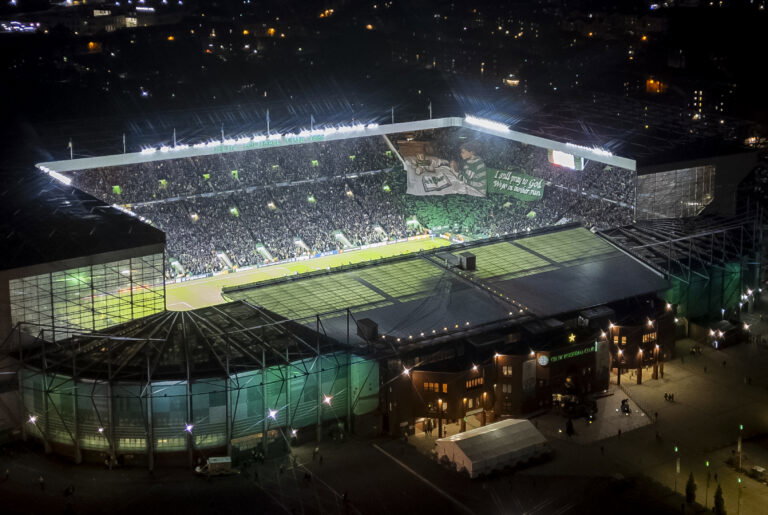
Because Celtic’s front elevation looks magnificent. We have that cracking facade; The Celtic Way leads up to the stadium with that impressive front door. The specs read great. Sixty thousand seats, a global support, European Cup history, championship banners, huge revenues, commercial partnerships, corporate hospitality, cash reserves and a stadium recognised around the world. On paper, and from the outside, this is one of the great football institutions. The photographs look fantastic, the brochures look fantastic and the accounts look fantastic. But walk round the back.
Recruitment. Squad planning. Succession planning. European preparation. Executive accountability. Modern football expertise. The integration between the academy and the first team. The relationship between recruitment and the manager. The ability to identify obvious weaknesses and actually fix them before they cost us.
None of it is built to last. Suddenly you can see the breeze blocks.
That is Celtic’s problem. With us, it’s not as straightforward as saying that it’s all an illusion, because the façade is not fake. The wealth is real, the scale is real, the support is real and the history is real. What is false is the assumption that all of that automatically means the institution underneath has been built to the same standard.
It hasn’t. That is what the last few years have exposed over and over again. Celtic is not badly resourced. Celtic is badly constructed.
There is a difference, and it explains almost everything.
How can a football club this wealthy repeatedly look so unprepared? How can a club with these financial advantages repeatedly fail against teams operating with a fraction of our resources? How can a club this dominant domestically reach major European games with obvious holes in the squad?
How can Celtic know for months that it needs a left-back, a defensive midfielder, greater depth in key positions and better succession planning, and still arrive at the moment of truth without those things properly addressed?
Because wealth is not the same thing as quality of construction. A McMansion proves that perfectly. You can spend a fortune building a house and still build it badly. You can have something that looks structurally sound, but that underneath is accumulating all sorts of problems. And as people who walk into McMansion’s for the first time either as wannabe buyers or even guests have verified, you can step inside the main foyer and immediately feel that something is not quite right.
Because the McMansions were built by architects whose main purpose was to make them look impressive. But houses were not traditionally built for that purpose. They were built for the sake of comfort. They were built to be lived in. They were not designed to be expressions of wealth, filled with rooms for which you had to invent uses. They were built out of solid materials. They were not showy or overly elaborate.
And Celtic has become the footballing equivalent of that; a nice frontage, the appearance of a solid foundation but nothing connected, nothing coherent, nothing actually designed around the primary function it was envisaged for.
Look at the recruitment process. An absolute shambles. No one part compliments the rest. You spend £8 million on a right sided attacking midfielder when want the club cries out for is a central ball-winner you then have to nickel and dime for. You spend £11 million on a striker but your left back prospect is someone else’s academy player on loan.
Don’t get me wrong; we needed the right sided attacking midfielder and we needed the big quality striker. But this is not a transfer policy with an underlying logic behind it. Nobody looked at a dozen positions needing filled and decided to prioritise what got the whole job done. The McMansion is built with the same design philosophy.
Is there a blueprint here? Is someone following a plan?
Recruitment should fit the manager. The manager should fit the football philosophy. The academy should feed into the first team. The first-team strategy should fit European ambitions. The financial strategy should support all of it. Succession planning should exist before key players leave rather than three months afterwards.
Every part should connect to every other part. That is what architecture is.
At Celtic, far too often, the pieces look as though they have simply been attached wherever somebody found space. A Georgian column beside a fake Tudor roof underneath a Spanish balcony, and then somebody stands back and asks why we are not impressed by the square footage. Like with the McMansion, you can stand inside it and even as you admire some of the individual features you know that it just seems wrong.
Here is what Celtic does constantly. We sign commercial deals which look good on paper but which are narrowly focussed around local markets instead of global brands. We base transfer business around upfront costs rather than long terms benefits. We advertise ourselves as a stepping stone club instead of one building for a brighter future. We promise Celtic can be a launchpad instead of selling it as a destination.
And everywhere we’re shoving square pegs into round holes. Everywhere we can shave a few quid off something we do it, even if that means filling the whole club with cheap options rather than bringing in the best, paying a premium and building something to last.
An academy that costs five times as much annually pays for itself if it produces just a couple of top first team players every half dozen years … but we won’t meet the upfront cost so we hire cheap and slap on the drywall to make it look substantial. And what does that do? We end up with something cheap to run but never produces anything of value so all that churn and all that burn gets you nothing for the investment.
Tell me which of those policies costs more money in the long haul?
The worst thing is that Celtic has enough money to disguise this for a very long time. We can afford the annual costs of an academy system filled with cronies and mates of mates but essentially run on the cheap. We can afford to squander millions on cheap, poor signings who rot on the vine and never contribute a thing.
That may actually be why the problems have survived.
A poor organisation does not always have the luxury of being able to repeatedly make mistakes because the consequences arrive immediately. Celtic has had enormous cushions: domestic dominance, a huge support, commercial strength, player trading, cash reserves, European money from previous campaigns and, for much of the time, an Ibrox club across the city which has been capable of making even our failures look comparatively competent. Those advantages absorb mistakes.
Miss a transfer target? Fine, there is still cash in the bank. Fail to replace a player? Fine, we can probably still win most domestic games. Lose Champions League qualification? Fine, we are still financially secure because we can asset strip a little more of the team. Waste another window? Fine, there will be another one in January.
Everything gets absorbed until eventually something like LASK happens. Then, for one horrible night, the walls are stripped back and you see what the place is actually built from. That is when you discover that the load bearing walls aren’t as strong as they need to be. That’s when you can see multiple points of failure begin to converge.
Celtic did not lose that tie because the club lacks money. That is what makes the failure so grotesque. We lost with a level of financial advantage over that opponent which should have made a defeat on that scale almost impossible. But for all that money, for all those costs, for all this club can afford we’re a triumph of style over substance.
We lost after having months to identify the weaknesses in the team. We lost after knowing what positions needed strengthened. We lost while sitting on money.
That is a structural failure. That is bad architecture.
That is a leadership which has convinced itself that we live in a palace where, in fact, we live in what appears to be one but is largely for show. The real truth lies behind the faux brickwork, in the impressive pillars which are hollow and hold nothing up, in the design which screams “fake!” from every decorative feature.
Celtic specialises in one of the most expensive forms of false economy imaginable. Save £1 million on the midfielder, lose £20 million in qualification revenue. Delay the left-back until after you qualify, never qualify because of that and then move to the cheaper option. Refuse to pay what a target is worth, watch somebody else buy him, then waste more time repeating the pointless exercise all over again.
That is not prudence. That is buying cheap windows for a mansion and then acting surprised when the rain comes through. Because cheap construction becomes expensive maintenance. We see that at Celtic time and time again. If you don’t solve the problems in the team they expand and grow. If you patch them up with cheap options what happens when the cheap options start becoming the baseline for the rest of the construction?
That’s how you end up with a first team squad where Scales, Yang, McCowan, Kenny and others are still getting games. It’s where we can’t cut loose James Forrest. You end up in a situation where McGregor will probably have to play until he’s 40 before we even think about a long-term replacement for the guy.
That is Celtic all over, and we keep doing it year after year, window after window, manager after manager. The names change. The underlying structure and all of its faults remains and because nobody ever starts to put it right it never gets any better.
That is why I have become increasingly irritated by the constant pointing towards the bank balance as though it answers every criticism. Look at the money, look at the reserves, look at the revenues, look at the profits, look at the trophies and look at our position compared with Ibrox. Fine. I have looked. Now show me the structural survey.
Show me how all these pieces fit. Show me where the bank balance is reflected in the team on the pitch. Show me where we ruthlessly hunt down every possible advantage in how we operate. Show me where we’ve properly invested in the load bearing walls that a football club needs, like a sports science department, an academy system that produces quality and integrates with the first team. Show me something that works as intended.
Because Celtic’s wealth may actually be the thing which has hidden how badly the club itself is constructed. We are wealthy enough to survive failure. We are not well run enough to stop repeating it.
And this is where the corporate fans comes into the equation again, because who gets the best behind the façade? Who spends most of their time in the show home? Who has seen what the real thing looks like, and so knows immediately how to spot the difference? We boast about “world class” and in a week from now up will go the tent in the carpark all over again. This is a joke, and no-one knows it better than the corporate fans who have seen what really big organisations with modern infrastructure have got to offer.
See, the McMansion is supposed to let the buyer believe they have reached the pinnacle of luxury and success. But someone living in the real thing can spot the difference just by looking at the gabled roof with its mad angles and its pointless shapes, and its too-small windows and its three different building materials and those people laugh at the pale imitation costing three times the price of a normal home.
The executive-box holders, commercial partners, influential minority shareholders, boardroom guests and people with access are just like that. They see the hallways where the paint job doesn’t quite match and they can see where the carpet is frayed badly fitted. The rest of us see glossy pictures promising a luxury we can’t afford; those people can spot shoddy quality passing off as the real thing a mile away.
At some point, those people have to decide whether they point out the fakery and start asking what the entire structure is actually built from.
Because access creates responsibility. If you can speak directly to the people who run Celtic, speak to them. If you have influence, use it. If you have commercial leverage, apply it. If you have a relationship with senior executives, ask the questions the rest of us cannot put directly to them. And I know some of those people do think that Celtic is a club that lacks credibility in some of the areas where it claims it.
There is not one serious businessperson in those executive boxes who would accept this kind of organisational incoherence inside his or her own company.
They would not tolerate endless failures in recruitment, repeated strategic mistakes, the same problems resurfacing every year, managers being asked to work around obvious deficiencies because senior executives could not get deals done, or millions in lost opportunity being dismissed as unfortunate.
So why is it acceptable at Celtic?
Because the house still looks good from the road? Because the bank balance remains healthy? Because the neighbours are worse? That cannot be the standard.
A McMansion can remain impressive right up until the day the defects become impossible to conceal. The cracks widen, the cheap materials start failing, the roof begins to leak and the decorative stonework starts coming loose.
Suddenly the question is no longer whether the place looks rich. It is how much it is going to cost to put right everything which should have been built properly in the first place. That is the future Celtic risks creating for itself.
I’ve already written at length about the idiocy of the academy system. We are getting nothing for what we spend because the people who run this club do not know what a modern academy system needs to run and they won’t hire the people who do because those people would require resources to realise their vision. Rather than do it right, they do it cheap and every year money goes out and nothing comes back.
And if that stopped at just waste we would be able to absorb it along with all the other waste we absorb. But that means we have to buy more players and within narrow limits set out in UEFA’s homegrown regulations … and so we hamstring ourselves in ways that spread into multiple areas because we won’t fix one part of the structure.
We already keep paying twice for mistakes, once when we make them and again when we have to fix them. We fail to strengthen properly, then lose revenue. We lose revenue, then use the lost revenue as an excuse not to strengthen properly. We delay necessary rebuilding, then discover the rebuild is even larger six months later.
That is the vicious circle created by cheap construction. And nobody inside Celtic seems capable of breaking it.
This is why simply changing one player is not enough. It is why one more transfer is not enough. It is why replacing one manager eventually will not be enough. The underlying architecture has to change. Celtic does not need another coat of paint. It needs somebody to inspect the foundations.
It needs people who understand how a modern football institution should be constructed. It needs executives whose instinct is not simply to preserve the balance sheet but to use the financial strength of the club to build a stronger football operation.
It needs recruitment which plans ahead, proper succession planning, a football department with authority and accountability when things go wrong. It needs a board which understands that being richer than Ibrox is not an achievement worthy of applause.
The goal is not to own the biggest McMansion in the street. The goal is to build something which lasts, something coherent, properly engineered and worthy of the money, support and history invested in it.
Because Celtic has every raw material required. We have the land, the money, the support, the history, the revenues and the international profile. We have everything required to build something extraordinary.
Instead, too often, we get something enormous, expensive and impressive from the front, with cheap decisions hiding underneath the finish. A footballing McMansion.
The tragedy is not that Celtic cannot afford better. It is that we absolutely can. Somebody just has to stop admiring the façade long enough to realise that the structure underneath is not good enough, and we can stand and admire it until it starts to break down or we can get a grip now and fix the foundation before it all comes crashing down.
Choose The CelticBlog as a ‘Preferred Source’ on Google News for quick access to the news you value.








Mic drop as the youngsters say.
Brilliant Sunday morning read.
As I said in your previous article they have thrown away £240 million so that they can save up £70 million.
Time to bin the failed financial model.
McMansion — 5000 square feet home built to the standards of a B+Q garden shed.
Probably one of the most cutting descriptions of the club I have heard.
Tells us more about where the club is heading that who we really are.
Reeks of the 26 County poundland aristocracy that loves county music and Vegas / Dubai holidays. People who saw Dolly Parton as a style icon and not a political actor of unique brilliance — they want what she looked like not what she stood for.
Football yesterday — we are phoning it in regarding engagement / intensity / energy.
The game was a chore and not a challenge — the curse of the SPL strikes again.
Every years the newbies turn up with hope in their hearts / desire in their veins and every year it is soon knocked out of them by old sweats going through the motions at training and hiding when responsibility is required on the park.
Every club knows now that we are going through the motions.
We might be a class or two above them regarding talent but we now need a lawyers letter to put in a challenge / tackle. Nobody stepping up to leadership at any level.
How we need another Postecoglu.
He showed what you can achieve with focus / energy / ambition.
All that was missing was cutting edge tactics but that is gravy when you try and cover the basics.
Now — we are not even covering the basics.
When you have players more scared of their “Burd” than the demands of the club then you know you are in a bad place. And he is one of our better players when he can be ersed.
Our lack of cohesion / collective effort / poor group dynamics is incredible to watch — O’Neill needs to go full time as the current Friday fly-by vibe is just not delivering.
The board are not taking the football and the future of the club seriously.
If they can’t be ersed why should the players?
SKY is killing the SPL.
The commentators / the replays / the overall vibe is Govan FC fan TV.
Aberdeen penalty claim — pictures from the side-lines / other side of the park / from space.
Aberdeen “goal” — sudden discovery of clarity from a camera 5M away behind the goal.
Funny that — not mentioned by the coverage.
“Faddie” is turning into an erse.
Sometimes written with a N instead of a D.
Very appropriate — the Govan FC apologist tick is all too natural for him.
Add in the Ludge MIB suddenly finding their voice.
Add in Ludge VAR and they are back with a vengeance.
No matter they are still crap — Aberdeen with 15 minutes of ambition had them in chaos.