
I have written a lot of very harsh things on this blog over the last couple of years about Michael Nicholson.
I am not going to say anything particularly nice about him in this piece either, but I am not here to absolutely brutalise the guy.
Because I have been thinking about this a lot recently, and I spoke about it on the podcast the other night.
The real problem with Michael Nicholson may not actually be Michael Nicholson.
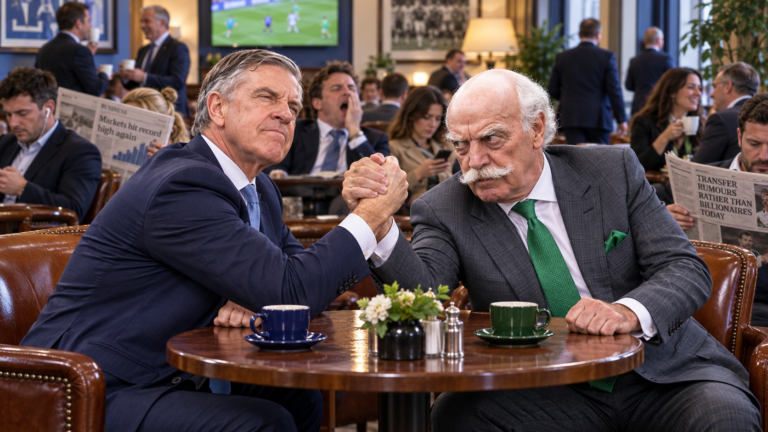
It may be the people who hired him, and, more importantly, the people who continue to leave him in the job.
Because I am increasingly convinced that they are not doing the guy any favours.
I have a friend who, in his early twenties, was offered a major job with what I will only describe as a public service organisation. He told me afterwards that he knew almost from the moment he started that he could not properly do the job. It was vastly bigger and more all-encompassing than he had ever imagined.
It takes a lot for anybody to admit that, even privately.
He did not remain in the post for long, and his overwhelming feeling when he left was relief. When I asked him why he had taken it in the first place, he was completely candid. The money was excellent. The opportunity was enormous. It was simply too good to turn down.
That is probably not an alien concept to many people.
I have been in jobs myself where I wondered whether I was completely cut out for what I was doing. In those situations, all you can really do is learn as quickly as possible and narrow your focus to the task immediately in front of you.
There is a mentality taught in extreme training environments which works along those lines: do not allow yourself to become overwhelmed by the entire challenge. Deal with the next problem. Then the next one. Then the next.
Eventually, you either sink or you swim.
I do not know whether Michael Nicholson feels overwhelmed by the Celtic job. I do not know whether he privately wonders if he is suited to it.
He is probably better at it now than he was when he first took it. Experience alone would almost guarantee that.
But when I read transcripts of meetings he has held with supporter groups, and when I read some of the things attributed to him in those meetings, he often sounds to me like a man who is in over his head and knows it.
Being chief executive of Celtic is also a prestigious and extremely well-paid position. He is hardly likely to walk away from it voluntarily. But I sometimes wonder whether, if somebody took the decision out of his hands, his overwhelming emotion might actually be relief.
Because what I am really saying here is that Nicholson did what a lot of people would have done. He was offered an extraordinary opportunity. He took it. Even if he had doubts about whether he was fully equipped for it, that would hardly make him unusual.
He has now been doing it long enough that he probably possesses a degree of competence in the role. But competence is not enough.
The football example which always comes to mind when I think about this is Gordon Smith at the SFA. Smith somehow ended up as chief executive of the association through a process which, to this day, remains not only opaque but something of a scandal.
He looked like the ultimate expression of an old-pals network operating inside Hampden because he simply did not appear to possess the experience which the job itself demanded, and we know what that job demanded because the SFA actually published the requirements when applications were invited. Smith seemed to meet very few of them.
That always reminded me of a story involving Celtic in the 1990s. When Celtic advertised for its own chief executive, the man who eventually got the job told the story of a colleague approaching him and asking whether he had seen the job description.
He had not. So, the colleague read it aloud and then asked him a question: Who does that sound like? When the man shrugged, his friend said “You.”
The man in question was Jock Brown.
Now, Jock Brown is never going to feature highly on many Celtic supporters’ lists of favourite executives. But in terms of the actual skill set required by the published job description, he ticked one heck of a lot of the boxes. He certainly appeared to tick far more of them than Gordon Smith ever did for the SFA role.
That is why, when I put together my own list of potential Celtic chief executives last night, I was careful to look for people who had actually operated at the highest executive level. It doesn’t mean I wanted them in the job; I was concerned with one question. Could they do the job to a better standard than Nicholson?
Some had strong Celtic connections. Others had extensive football experience. But all of them had relevant leadership credentials. All of them would have been discussed around a table of professional head-hunters asked to find a candidate.
Because only people who have operated in serious chief executive roles truly understand what those jobs demand.
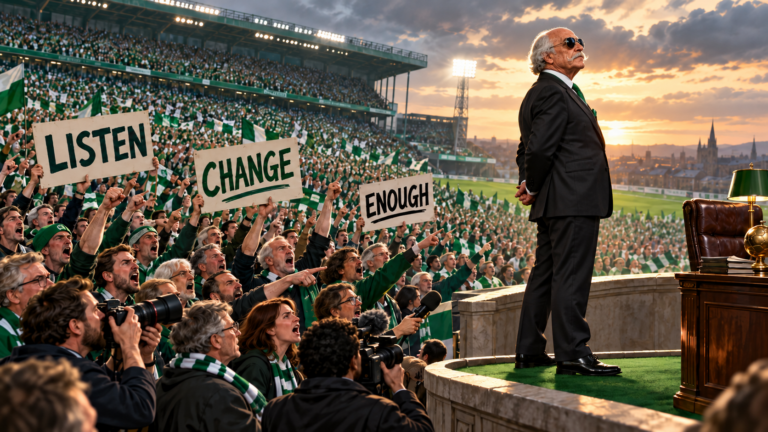
And one of the things they demand is visibility. These are public-facing jobs. Michael Nicholson is not a naturally public-facing individual.
That fact alone should have raised a serious question over whether he was suitable to become chief executive of Celtic. Quite frankly, I think it is remarkable that he was ever put into the position without that particular skill set.
Everybody around that boardroom table, including Peter Lawwell, who was instrumental in his rise within the club, must have known perfectly well what his strengths and weaknesses were. Yet he got the job anyway.
Gordon Smith, of course, eventually proved disastrous at the SFA and departed in circumstances which came after criticism from several directions.
But the example outside football which interests me more is Gordon Brown.
Because Brown demonstrates something much more important. You can be extraordinarily intelligent. You can be deeply capable. You can even be brilliant in one enormous job, and still be fundamentally unsuited to another.
Brown vastly underestimated how different being Prime Minister would be from being Chancellor. More importantly, he tried to perform the role according to the skill set which had made him so effective at the Treasury.
That skill set was poorly matched to Number 10.
Brown had spent years developing habits which served him exceptionally well as Chancellor. His thinking was strategic, detailed and exhaustive. He wanted information. Then more information. Then he wanted the implications considered from every conceivable angle. Economic consequences. Political consequences. Public reaction. Polling. Long-term effects.
Budgets are not created the week before the Chancellor stands at the dispatch box. The process begins months in advance.
Brown thrived in that environment because his mind was built for it.
He is an extraordinary strategic thinker. I have no hesitation in saying that. He is immensely well-read and intellectually formidable. When Brown finally arrives at a conclusion, it is usually a conclusion which has been subjected to an enormous amount of thought, and very often that means that the conclusion is on the money.
But the operative word there is when. Because the Prime Minister does not always have time. Issues arrive on the desk and sometimes a decision has to be taken immediately. There is no opportunity to request another paper. There is no time to study another appendix. There may not even be time to sleep on it.
People who worked closely with Brown and Tony Blair have spoken about the contrast in their decision-making styles.
Blair wanted the issue condensed. Give him the key facts. Give him the options. Give him the consequences. Then he would decide.
Brown wanted everything. And once he had absorbed everything, he frequently wanted more. That did not make Brown less intelligent than Blair. Quite the reverse, in my view. I think Brown is unquestionably the greater intellect and the more naturally strategic mind.
But Blair possessed something Brown did not naturally have. He could absorb information rapidly, trust his judgement and make a decision.
Sometimes that instinct served him brilliantly. Sometimes, perhaps, it should have been restrained. One could certainly argue that the decision to follow the United States into Iraq might have benefited from a rather more Brown-like appetite for questioning every assumption. But the broader point remains.
Blair possessed a skill which a Prime Minister simply has to possess if he is going to function in the role, what a colleague called “velocity of decision making.” Brown was often at his best when a crisis landed on territory he had already mastered.
The global banking crisis was a perfect example. Suddenly the Prime Minister was dealing with banking systems, liquidity, financial institutions and economic collapse. That was terrain Gordon Brown knew intimately. He understood the ground beneath his feet, and his performance – the very finest – reflected it.
If the premiership had actually been the job Brown imagined it was, he might have been superb at it. If every decision had come with time to think, analyse and reconsider, his skill set would have been formidable. But it did not.
And that is the point. A person’s strengths can make him outstanding in one role and unsuitable for another.
That brings me back to Celtic.
Being chief executive of a major football club, especially one as exposed as Celtic, requires a very particular combination of abilities. You have to make decisions quickly. You have to negotiate effectively. You have to communicate. You have to face the media. You have to answer difficult questions. You have to articulate a vision.
You have to project leadership when the organisation is under pressure.
Those things are not optional extras. They are part of the job. They are, in many ways, the most critical parts of the job.
Michael Nicholson may be excellent at the minutiae.
I suspect he probably is. He is a trained lawyer. Like Brown, he is likely to understand Annex 16, paragraph four better than almost anybody in the room.
He may be extremely diligent behind closed doors. He may be methodical. He may be intelligent. He may even be very good at a number of senior executive functions.
But none of that automatically makes somebody a chief executive.
I do not want this to become another personal assassination piece. As a senior executive, Celtic could probably do considerably worse than Michael Nicholson. But as the principal figure at the top of the corporate structure, he is, without question, sadly lacking in several of the qualities the role requires.
Only an internal appointment made his elevation to that position seem natural. If Celtic had employed professional head-hunters, conducted a genuine external search and assessed applicants according to the requirements of running a football institution of this size, would Nicholson have emerged as the outstanding candidate?
I find that impossible to believe. Impossible. He might not even have made the final interview stage.
That is not an attack on his intellect. It is not an attack on his work ethic. It is not an attack on his personality. It is simply an assessment of suitability, and whenever I think about suitability for a job, I find myself thinking about Blake.
Perhaps I think about him too often.
He is, after all, a fictional character created specifically for the film version of Glengarry Glen Ross and absent from David Mamet’s original stage play.
But Blake feels frighteningly real because beneath all the aggression, vulgarity and cruelty there is a brutally simple capitalist logic.
He does not care whether the salesmen are pleasant men. He does not care whether they are decent husbands or loving fathers. He does not care what problems they have waiting for them at home. His entire philosophy reduces the workplace to one question.
Can you do the job?
His infamous attack on Moss captures it perfectly:
“Nice guy? I don’t give a shit. Good father? Fuck you! Go home and play with your kids! If you want to work here, close!”
It is vicious. It is deliberately dehumanising. But buried beneath the nastiness is a truth which every serious organisation ultimately has to confront.
Personal qualities cannot substitute indefinitely for professional suitability. You can either do the job or you cannot, and if you cannot do the job, you should not remain in it simply because you are intelligent, diligent, well-liked internally or because the opportunity was too good for you to refuse.
If somebody is drowning in a role, it is not the responsibility of the rest of the organisation to pretend he is swimming. The responsibility of leadership is to get him out of the water and find somebody who can actually do what the organisation requires.
That is where my criticism now lies. I do not know exactly how Celtic arrived at Michael Nicholson as chief executive. I do know that the people who put him there have had years to assess whether the appointment works.
Whatever else Michael Nicholson may be – intelligent, diligent, professional, capable in other areas – I simply do not believe that anyone can satisfactorily argue that he possesses the full skill set required to be the chief executive of Celtic Football Club.
And so, the greater failure is not ultimately his; it now belongs to those who know it and leave him there anyway.
Choose The CelticBlog as a ‘Preferred Source’ on Google News for quick access to the news you value.








Wish you wouldn’t mix our football with politics especially mixing it with the odious Gordon Brown who faced a few accusations of bullying, not a nice man
Gordon Brown sold off our gold reserves when the price was at its lowest with an estimated loss of £35 billion but the war had to be financed somehow…
HAhahahahahaa, your gold. The gold that was stolen you mean.
Wish I wouldn’t mix our football with politics? FFS.
Let’s face it, this transfer window is shaping up to be one of the most interesting in years, just like politics is all about winning elections, football is all about results, and by every domestic measure everything is going Celtic’s way. If Celtic qualify for the CL or get a good run in the Europa League then everything will be hunky dory for a while. Nicolson and McKay will feel the pressure less, and most fans will go back to enjoying the football at Parkhead, whilst laughing at the comedy gold down Ibrox way. We should just relax and enjoy the show for a while.
It would look to me as if Martin O’Neill has persuaded Desmond to dip into the bank account and bring a few top class players to the club. We know there will be a few players leaving, but that’s modern day football, I for one am excited about this season and what it may hold.
Although this is a Celtic site I really think James you need to reset your perspective of GB being an intellectual powerhouse…car boot sale of gold reserves, looted workers private pension funds, New Deal joke for school leavers costing billions à la new labour spin not to mention his personality. Intelligence of the emotional variety is something he had considerable deficiencies.
…
Jamesey Bhoy I love your work. My first port of call every morning is thecelticblog. Fag, coffee and a shite come after I’ve searched for more of your content. Superb, I’m no scout but I know my football and i know a player when I see 1. Could I possibly request that u do an article on our new french superstar? Or Egyptian superstar. Mark my words my fellow tims. This guy will be incredible for us. The most skillful celt since di canio. A truly remarkable signing. I can’t stand MN but he’s grown on me the last few wks. To stand up to the justified criticism and incredible pressure is admirable, but to then come out with 3 superstar signings who he persuaded to ‘choose’ Celtic is a genuinely remarkable achievement. So credit where its due. We have Duran but nicholson has the balls of steel. Havent been this excited about our attack since Seville. Strap yourself in my fellow bhoys and ghirls We’re building something very special.
“Sometimes, perhaps, it should have been restrained. One could certainly argue that the decision to follow the United States into Iraq might have benefited from a rather more Brown-like appetite for questioning every assumption.”
Make no mistake, Brown would have made the *EXACT* same decision to follow the USA.
Instead of Blair the Poodle we would have had Brown the Poodle.
Two more odious, dishonest and shifty characters than Blair and Brown you couldn’t wish to meet. Yet that doesn’t mean James is wrong to highlight their political abilities and achievements, hence their long periods in office. In fact those very characteristics would’ve helped them excel in those positions.
Back to the main point of the article:
This recent upturn in recruitment policy has got me looking at how many first team ready players Celtic have signed in quite recent seasons, and what part Michael Nicholson would’ve played in the process.
With Hogh, Duran, Hassan and Baur coming in as players ready to start, they can be added to the signings of Sinisalo, AJ, CCV, Trusty, KT, Engels, Nygren, Jota, and maybe one or two others who went straight into the first team and performed consistently well (when fit).
The others might include, A Johnston, Maeda, O’Riley, Hatate.
An insightful and interesting article.
I appreciate your central point, that he is clever but in the othe wrong role. But spare us the Broon eulogies. The man was a complete clown. We are still paying for his austerity after he bailed out zombie banks which he himself did so much to create. He used the Prevention of Terrorism Act to seize Iclandic Bank Deposits – very Trumpian – but do you really believe Icland is a terrorist state? A monstrous abuse of state power. And like Blair he was gung-ho for invading Iraq. The difference was he would never publicly defend that position – always leaving it to others.
He destroyed private pensions meaning in 30 years time we are going to see widespread pensioner poverty. I even remember him increasing the state pension by 80p per week – insulting miserly and heartless. Plus he liked to throw office equipment at people – the only PM to make the typists at Downing Street cry. Oh and by the way, he detests Celtic.
Another well written article James…I did not like Blair one iota, and maybe he is another individual that may well have a place in Hell already booked for him.
As much as MN has generally been berated on here and the majority of Celtic sites for a long time, and rightly so…I think it is only right to give some credit when he/they appear to get certain things right.
The quality over quantity angle, is something we all know should always be pursued and maybe, just maybe, they are also starting to realise that !
Whether that is just the MON influence or something else, all we want to see is the best possible version of Celtic ON the park, at ALL times.
It is very early doors and we have countless, hugely difficult obstacles to overcome in Europe!!!
Nevertheless, we could be in for a very exciting season!
Let’s pray that the positivity continues! HH
Good point Gerry, though even if MON initiated this process there is still a lot of negotiating to do to get these deals over the line, so whoever is doing that part deserves some credit.
Yes I agree DannyGal…we still have to see these players integrate properly and hopefully help us win these tricky CL qualifiers.
Nevertheless, we can’t moan about lack of quality and then not give some credit to those that have enabled this !
Let’s be honest, all we want is for our great club to demonstrate that we can be ran to the professional standards that our resources and support deserve …still a long way from that without a shadow, but let’s be positive about these signings !
Jock Brown? An odious man, and a total Hun to boot. A man who thought he knew everything about football, but knew the square-root of FA. A man who was responsible for driving out Celtic legend, Wim Jansen…days after stopping the ten. Does this remind anyone of a recent employee of Celtic? Initials PL?
Hail Hail.