
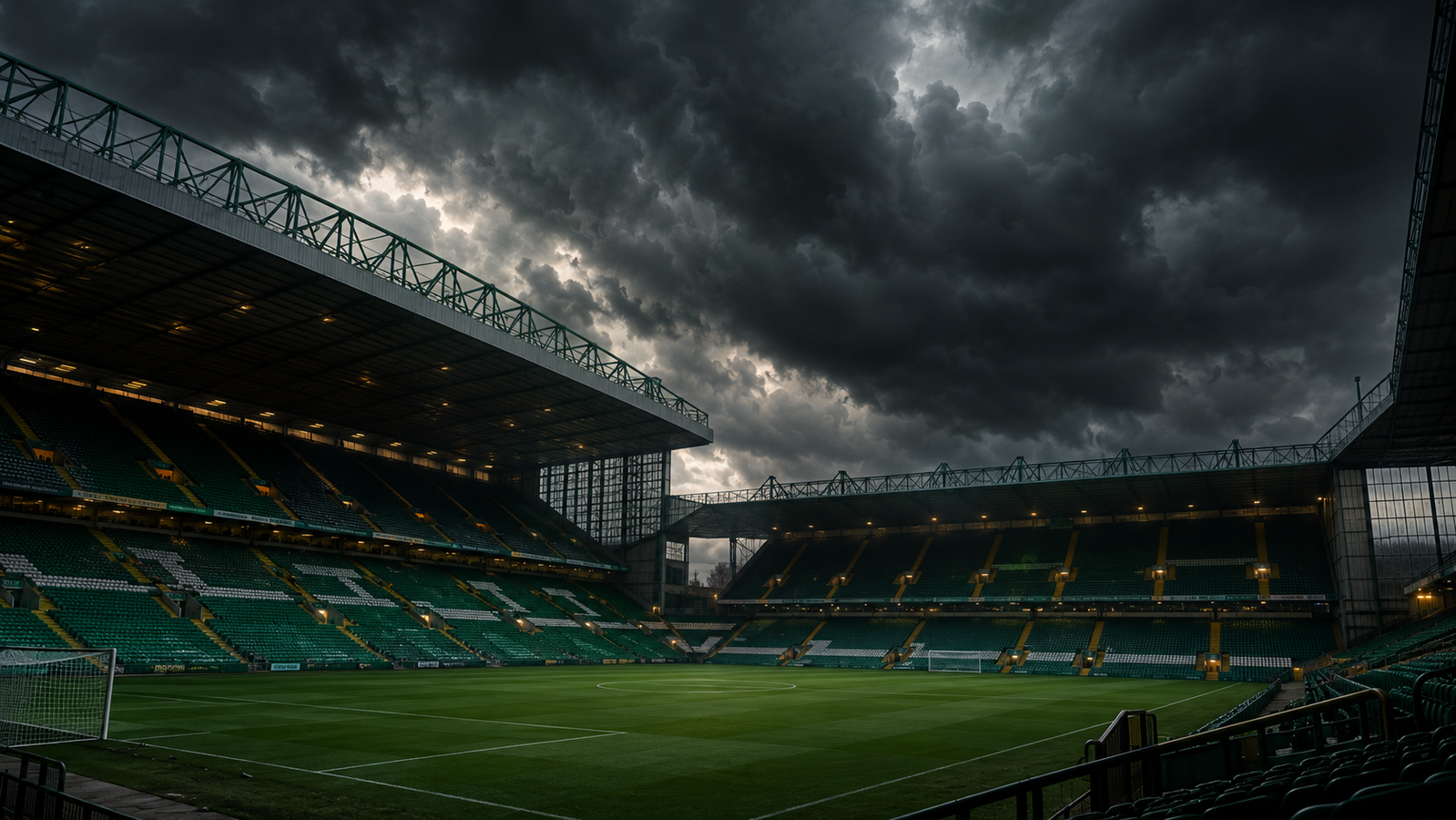
Last night Michael Gannon talked about how surprised he would be if Martin O’Neill was back in the Celtic dugout for the Motherwell game.
I think I can save him, and everyone else, the suspense.
Martin O’Neill will be in that dugout, because Celtic has now reached an appalling, degrading place where almost everyone inside the building appears to have entered full-scale cover-your-own-arse-and-look-after-yourself mode.
From the largest shareholder to the chairman, the chief executive, the manager himself and even, at times, some of the players, the same instinct seems to have taken hold. The rot may have started at the top, but it has spread all the way down.
For Martin O’Neill to remain at Celtic now, when so much is wrong, when he clearly knows so much is wrong and when he himself has publicly questioned whether he still has the energy and capacity to help the team, is difficult to defend purely in football terms.
If money is part of his calculation, I understand that.
Actually, I understand it completely. But that brings us immediately to another act of self-interest: the club itself refusing to make his exit easy.
If Celtic genuinely believed that O’Neill stepping aside was the best thing for him and for the football club, there is a very simple solution. Pay him. Honour what remains of his agreement, give him the dignified exit his service deserves and allow Celtic to begin the restructuring which is so obviously required.
Instead, everybody appears trapped inside their own narrow interest.
Michael Nicholson’s entire tenure as Celtic chief executive increasingly looks like an exercise in institutional self-preservation. He occupies a job which, on all available evidence, appears miles beyond the authority he actually exercises. He must know how little power supporters believe he possesses. He must know how he is viewed. Yet he remains.
Dermot Desmond is the larger version of the same problem.
I wrote months ago that Martin O’Neill should understand something fundamental: Dermot Desmond is not his friend merely because they have known one another for years. Every time Desmond reminds O’Neill about duty, loyalty or obligation, he reinforces the sense that O’Neill owes something to him and to Celtic.
But obligation cuts both ways.
If O’Neill believes he is financially disadvantaged by walking away, then the club should remove that obstacle rather than hide behind it.
I do not know that Celtic have explicitly told him, “If you resign, you get nothing.” But if that is effectively the contractual reality he faces, then nobody should pretend it is irrelevant to the decision he is being asked to make.
And that brings us to the central problem. There is nobody, at this moment, who appears willing to put the institution first.
That is the inevitable consequence of having no meaningful accountability at the top of the house. When the people running the club do not demonstrate accountability, why should anyone underneath them? When everything ultimately revolves around the preferences of one overwhelmingly powerful individual, why would anybody else show initiative, independence or courage?
What reward is there for rocking the boat?
Celtic does not appear to want individuality at the top. It does not appear to want people who challenge established norms. It is run according to an extremely narrow set of principles, and it no longer seems to matter whether those principles are dragging the organisation down.
Everyone simply finds a way to accommodate the chaos. Everyone finds a way through another day. Everyone collects the pay cheque at the end of it.
And that is where Martin O’Neill now finds himself.
If Gannon is right that O’Neill will not simply walk away without being paid what he believes he is due, then I find that entirely believable. Why should he? Why should the manager alone make the financial sacrifice while everyone above him remains in place?
Why should he walk away with nothing while executives who helped create this situation continue collecting their salaries?
I would probably ask exactly the same question in his position.
But understanding that does not make the situation any better, because the best thing O’Neill can now do for Celtic may still be to leave. His departure would at least create the possibility of change. It would offer some hope that this season does not enter the full death-spiral phase. It would force the club to confront the football structure rather than continue pretending everything can simply limp along until the next fixture.
And yet Celtic appears to have no appetite for making that easy.
Equally, the board does not want to fire him.
Because firing O’Neill would immediately place every judgement made above him under examination. It would force questions about the summer. It would force questions about recruitment. It would force questions about why O’Neill was brought back, what he was promised and what support he actually received.
It would unite many former Celtic players and pundits against the people who made those decisions. And it would raise the most dangerous question of all: what is the plan now?
I do not believe they have one.
That is why they would rather leave O’Neill in place. Even if there are people inside the boardroom who believe this is approaching its end, they can continue postponing the moment when they themselves have to make a consequential decision.
They would rather let the manager carry the risk. They would rather let the season deteriorate than act decisively and then be forced to own whatever comes next.
Do not let anybody kid you that Martin O’Neill is being left in place because this board suddenly wants to demonstrate its unwavering faith in him.
Where was that faith when he wanted his coaching structure? Where was it when the squad needed strengthened? Where was it during the summer when the football operation required decisive backing?
They put a 74-year-old man into an extraordinarily difficult situation and now appear happy to leave him standing there in the crosshairs.
That is not support. That is self-preservation.
And it allows everyone above him to survive another day, another meeting, another fixture, another month, another payment. Whatever gets them through. Whatever creates the least resistance. Whatever avoids serious engagement with organised supporters. Whatever avoids irritating Dermot Desmond. Whatever avoids anybody having to take responsibility for a major decision.
That is why the silence from Celtic’s senior executives is not strength. It is weakness.
They do not avoid interviews because they project authority. They avoid them because serious interviews would require serious answers.
Of course Martin O’Neill is still there. Michael Nicholson is still there despite the catalogue of failures which has accumulated during his tenure. The other senior executives remain. Brian Wilson remains after playing a prominent role during one of the ugliest breakdowns in relations between the Celtic boardroom and the support in years.
Nobody goes. Nobody takes responsibility. Nobody pays a professional price.
And when the people at the top operate like that, the culture inevitably spreads.
Why should anybody beneath them behave differently?
This is why I keep coming back to the same word.
Selfishness.
I find O’Neill staying selfish if he believes he can no longer do the job and remains primarily because walking away would cost him financially. But I would probably do the same thing.
If somebody said to me, “You want to leave? Fine. Walk away from the money,” while everybody responsible for putting me in that position sat safely in their offices filling their own pockets, I would have a very simple response.
Fuck that. Pay me.
That does not make staying the right decision for Celtic. It simply demonstrates how completely broken the situation has become.
And there will be people who accuse the supporters of selfishness too. They will say we are hounding a good man out of his job. They will say we are refusing to give the board time. They will say we should show patience and allow these people another opportunity to make things right.
They are wrong on every count.
Nobody is disputing that Martin O’Neill is a good man. Nobody is denying what he has given this club. Nobody is demanding accountability because they enjoy seeing people suffer.
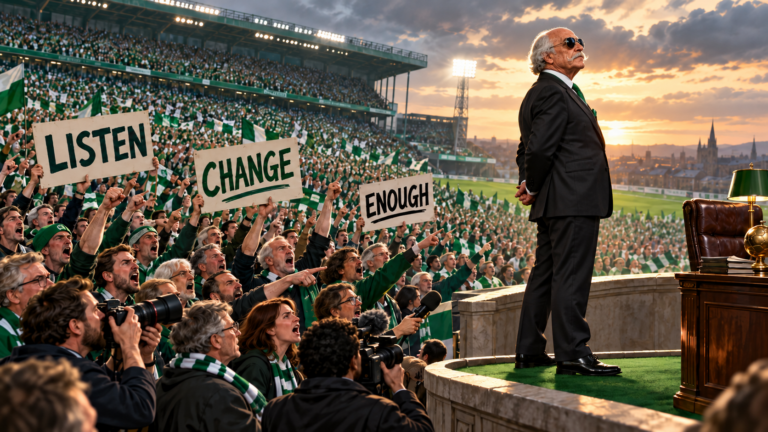
Supporters are asking for the people entrusted with Celtic to put Celtic first.
That is all. The board has had opportunities to make things right. It has had them repeatedly. It has squandered them repeatedly. It no longer deserves the benefit of the doubt.
And that is the fundamental difference between the supporters and so many of the people currently inside the walls.
We are not trying to protect a salary. We are not trying to protect a position. We are not trying to protect access, status or proximity to power.
We want what is best for Celtic.
Right now, I do not believe enough people inside Celtic Park can say the same.
Choose The CelticBlog as a ‘Preferred Source’ on Google News for quick access to the news you value.




“IRELAND boss Martin O’Neill is suing the Queen’s bank, Coutts after losing a fortune in film-based tax avoidance schemes subsequently challenged by the authorities.” This is in the mainstream media in 2018 and I am not sure how it panned out but I think they lost. It might go some way to explain why MON will put his reputation on the line and risk the anger of the Celtic fans.
Another year, another 3 million(?) and then disappear into the sunset?
I remember when O’Neil arrived the first time and the usual bookies sack odds were published that summer. Martin O’Neil was 100/1 with comment that after so many changes in recent seasons Celtic had to give someone time.
Dick Advocaat who the media liked to refer to as the Little General was quoted at 1000/1 sack odds, with comment that no matter what he would be immune from the sack as the previous two seasons he had been nearly all conquering having replaced their 9 in a row side with a new expensively assembled team. (We all know now where that led haha!)
They were correct in that Advocaat wasn’t sacked that season even though O’Neil came in and knocked it out the park by immediately totally overthrowing his Rangers side, winning the first Celtic treble in 30 years and turning a 21 point deficit the season before into a 15 point winning margin.
While he survived that season, the following Season, as it became clear Celtic were stronger still and on for a second title the decision to remove Advocaat was taken but not wanting to sack him they moved him ‘upstairs ‘ bringing in a younger coach in McCleish who was doing well at Hibs.
It all came back to me this week as I wonder if the way forward would be to move O’Neil ‘upstairs’, into the boardroom perhaps. A way to keep him on the payroll and keep his expertise and experience at the club but move in a new team manager and coaching team, Maloney to return to his pathways day job and other coaches staying on or not a decision for incoming manager. Who the new manager would be I’m not sure. I’d like Robbie Keane (but understand many won’t) as proven successful, knows club expectations and achievable to get to come here unlike some of the other names mentioned. Although I see Marvin Bartley who knows Eddie Howe is in media saying Howe would fancy it. The point is, regardless who it was to be, that move ‘upstairs would be a way forward perhaps if looking for a respectful managed transition from O’Neil?
“And it allows everyone above him to survive another day, another meeting, another fixture, another month, another payment. Whatever gets them through”
Perhaps I have become so cynical towards the Celtic hierarchy that personally and correctly or incorrectly, I’ve come to the conclusion that nothing his puppets do will threaten their positions. They are just compliant puppets doing what they are told and as such are blameless to the man at the top.
They probably don’t even get enough freedom in decision making to be culpable to DD.
I’d imagine PL”s financial model to be so set in stone that his predecessors merely need follow where his stoney path leads.