
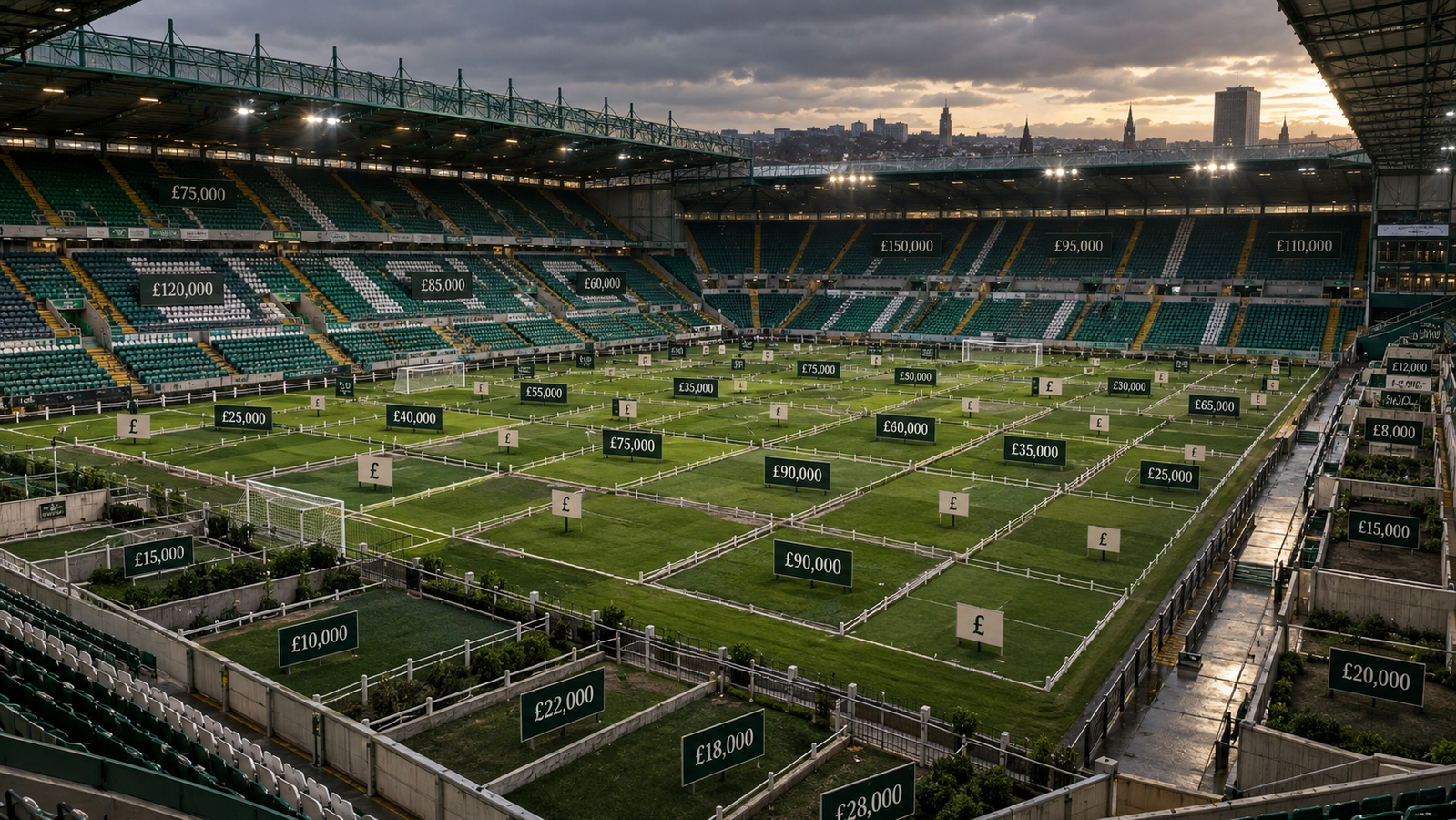
Manchester United are selling their supporters little pieces of the Old Trafford pitch for £125.
Yes. Grass. More precisely, preserved 7cm by 7cm pieces of turf from Old Trafford, packaged as souvenirs and sold to supporters. The first batch has reportedly already sold out. At the same time, United have reported another annual loss despite record revenues.
I mean, honestly.
At some point you have to look at modern football and ask yourself when clubs stopped seeing supporters primarily as supporters and started seeing them as walking wallets.
Because that is what bothers me about this. It is not really the grass itself. If somebody wants a tiny physical piece of Old Trafford because that stadium means something to them, then fine. Football is emotional. Stadiums are emotional. I completely understand why somebody might want a tangible fragment of a place attached to memories of parents, children, great games and extraordinary moments.
But £125? Come on. And when you put that alongside rising prices, relentless commercialisation and football’s constant search for one more way of extracting money from supporters, it becomes something much bigger than a square of turf.
It becomes a symbol.
And Celtic supporters should be very careful about laughing too loudly, because our own club has already demonstrated that it understands this mentality perfectly well.
In fact, there is a beautiful irony here.
Last year, when Celtic representatives were talking to supporters about fan engagement and relationships between clubs and their support, Manchester United was one of the examples held up as a club doing things well.
I remember James writing about how extraordinary that was at the time. The other club they mentioned was West Ham, which I recall him finding even funnier in the worst possible way. Manchester United and West Ham. Good God.
A club whose supporters have spent years protesting against their ownership, whose relationship with the people running it has repeatedly deteriorated into open revolt, and whose fans have demanded greater influence and meaningful change. The aftermath of the European Super League fiasco alone produced formal apologies and promises from the Glazers to improve consultation with supporters.
That was one of Celtic’s examples.
And now Manchester United are selling grass for £125.
You could not write it. Except, unfortunately, Celtic can hardly laugh.
Because in 2024 our own club came up with something which, in my opinion, was even worse. Celtic sold virtual turf. Not grass. Not a preserved piece of the Celtic Park pitch you could put on a shelf. A virtual piece of it.
Supporters were invited to “own a piece of Paradise” through a digital scheme which allocated them a virtual square of the Celtic Park pitch. Contemporary coverage described it as virtual turf accompanied by coordinates and a certificate rather than any actual physical piece of the ground. The reaction from supporters was, understandably, furious.
I thought it was one of the direst money grabs I had ever seen from Celtic. I wasn’t writing for the blog then, but James and I discussed it at the time and I couldn’t believe it. Celtic partnering up and lending their name to a company selling fans … nothing at all. How shocking is that? It’s still hard to believe.
And I still do. Because at least Manchester United are actually giving somebody grass. Celtic managed to reach the point where we were effectively trying to monetise imaginary grass.
That takes some doing. So, when I look at United charging £125 for little squares of Old Trafford, my first instinct is certainly to laugh. My second is to wonder how long it will be before Celtic try something similar.
Because we have already sold pieces of a virtual pitch. Surely physical slices cannot be too far away. Perhaps when it’s relaid after the Oasis gigs? And that is where this stops being a Manchester United story and becomes a Celtic story.
Celtic supporters already know the commercial routine.
Buy the season ticket. Buy the home shirt. Buy the away shirt. Buy the third shirt. Buy the goalkeeper kit. Buy the children’s version. Buy the training range. Buy the retro range. Buy the anniversary merchandise, the scarf, the mug, the badge, the keyring and the pyjamas.
Then somebody in a marketing department has another meeting and asks what else can be monetised. And I am not stupid. I understand why football clubs pursue commercial revenue. Celtic is a modern football business. Merchandise contributes significantly to club income. Commercial strength matters. Money pays players, staff and operating costs and helps Celtic compete.
None of that is controversial.
But football cannot become only that.
There has to be something on the other side of the transaction. There has to be a relationship rather than merely a revenue stream. Because when every aspect of a football club’s history, identity and emotional connection with supporters is eventually turned into another purchasable object, something begins to change.
The supporter gradually stops being treated as a participant in the institution and becomes a customer of it. And that distinction matters enormously at Celtic.
This is not just another football company. Celtic was founded around community, charity and belonging. Brother Walfrid did not establish this football club after identifying a gap in the market for aggressively monetised sporting nostalgia.
The history means something. The identity means something. The relationship between Celtic and the people who sustain it is supposed to mean something.
Yet our own club has shown that it is perfectly capable of looking at that emotional connection and asking how much somebody might pay for another piece of it.
Even a piece which does not physically exist.
That is what made the virtual turf scheme so objectionable to me. It was the philosophy behind it. Take something supporters regard as sacred — Celtic Park itself — divide it into little imaginary squares and find out whether people will pay for them.
If Manchester United selling actual grass for £125 is ridiculous, what exactly were we doing?
And this is why Celtic’s previous decision to hold United up as some sort of model of supporter relations now looks even more absurd.
What exactly were we admiring? Because a genuinely healthy relationship between a football club and its supporters is not defined by how efficiently you sell things to them.
It is defined by trust. It is defined by communication. It is defined by respect. It is defined by whether supporters believe the people running the club understand that they are custodians of something which existed before them and will exist after they are gone.
Celtic supporters give this club an extraordinary amount.
We renew season tickets. We travel. We buy merchandise. We subscribe. We support the Foundation. We raise money. We bring our children. We carry Celtic through families and generations. We provide the atmosphere which broadcasters sell.
We provide the colour advertisers want to associate themselves with. We create the emotional product which everyone else ultimately monetises.
And too often the response feels like: thank you very much. What else have you got?
That is where resentment begins.
You cannot endlessly tell supporters they are the lifeblood of Celtic while behaving as though the most important thing flowing through those veins is their bank balance. You cannot treat them as customers when money is required and then as an irritation when they demand accountability. You cannot ask for unlimited emotional commitment while offering limited engagement in return.
A football club can be commercially successful and still lose something essential.
That is what the Manchester United grass story represents to me. Nothing in modern football is apparently sacred enough not to be packaged and sold. Not the shirts. Not the history. Not the memories. Not even the pitch itself.
And Celtic has absolutely no right to stand outside that culture pretending we are somehow above it. We sold virtual grass. That sentence alone should end any smugness.
If anything, it should act as a warning.
Because if we have already crossed that particular line in the digital world, there is no reason to assume somebody will not eventually decide that supporters would pay for physical pieces as well.
Perhaps there will be a little presentation box. Perhaps a certificate. Perhaps a limited-edition number. Perhaps somebody will call it “owning a piece of Paradise”.
We already know the language. That is precisely the problem.
I want Celtic to be commercially strong. I want Celtic making money. I want Celtic maximising legitimate income because that should help make the football club stronger.
But I also want the people running Celtic to understand the difference between commercial intelligence and treating every emotional attachment as an exploitable asset.
There is a line. Modern football keeps pretending there isn’t. Manchester United have found another way of crossing it.
Celtic already crossed it two years ago with something even less tangible.
So, by all means laugh at £125 grass.
I certainly am. Just do not laugh too loudly. Because we have already been charged for grass that wasn’t even fucking there.
Choose The CelticBlog as a ‘Preferred Source’ on Google News for quick access to the news you value.



“Walking Wallets” good one Paulina. that sums up the way modern football treats the supporters. I would have loved the European Super League to have gone ahead, with the US system of no punishment for failure, and no relegation. It would have gone the way of LIV Golf.
TV companies more or less own football, and the Football Authorities bow to them, as they are the paymasters. The supporters are just treated as financial fodder. The bloated EPL, started the ball rolling by sucking in most of the the British Broadcasting cash, leaving only the crumbs to Scottish Football.