
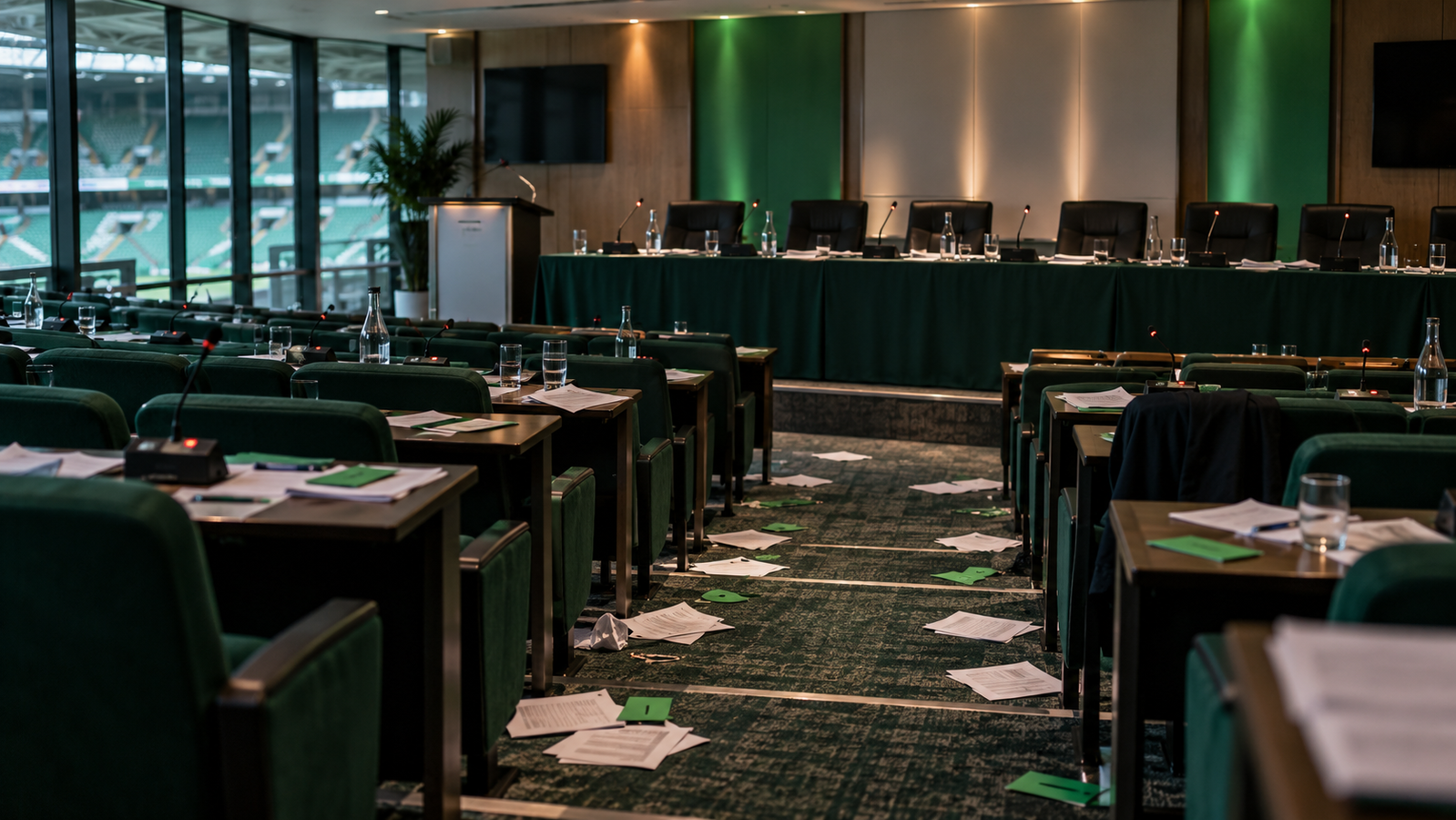
Celtic shareholders are not powerless if the board tries to silence them again, but it will take a lot of people coming together to push something through. That’s the reality they face if the club decides, for the second year in a row, not to answer questions.
We all know that the AGM was abandoned last season after the chair decided that the meeting could no longer continue because of the disruption in the room. Peter Lawwell was practically itching to do it, and the incendiary speech from Baby Desmond set the cat amongst the pigeons, exactly as I think they intended.
That decision to abandon it was disgusting. The board argued that it had been left with no choice. Many shareholders believed the meeting was ended because the questions had become uncomfortable and the atmosphere had turned hostile. Like I said, they thought that it was pre-planned that way.
My dad was one of them, and he wrote a great piece at the time.
Whatever view you take, one thing is clear: shareholders cannot allow the same thing to happen again without preparing for it.
The important point is that shareholders are not entirely dependent on the goodwill of the chair. There are legal mechanisms available to them. They are not necessarily simple, cheap or guaranteed to succeed, but they provide routes towards forcing the board to deal properly with shareholder business.
The first option is to challenge any adjournment immediately.
The chair does, unfortunately, have powers to control the conduct of a general meeting. If the meeting becomes genuinely impossible to manage, an adjournment may be lawful. But that power is not unlimited. It cannot simply become a convenient way of ending an AGM whenever criticism becomes embarrassing.
If the chair announces that the meeting is being adjourned or brought to an end, shareholders should object immediately. They should ask that the objection, and the reasons for it, are recorded in the minutes. They should also request that the issue be put to a vote if Celtic’s articles of association permit or require that.
That last point matters.
There is not necessarily an automatic legal right for shareholders to force a vote on every adjournment. Celtic’s articles of association need to be examined carefully because they govern the detailed procedure and may give the chair specific powers in relation to adjournment, disorder and the conduct of meetings.
However, creating a clear record could matter later.
If shareholders believe the chair acted outside the articles, or used those powers for an improper purpose, the official minutes and objections made at the time could become important evidence.
The worst possible outcome would be for the meeting to disappear into chaos, followed by competing claims about what actually happened. That is what must be prevented at all costs. There cannot be a major protest which gives the board an easy excuse to pull the plug.
I actually argued last year that shareholders should not attend at all, that the AGM had become a stage-managed farce, and I was dismayed to be proved right. But if it is going ahead and people want the opportunity to ask questions, then I understand and support them.
Eventually, we need to get to the place where shareholders themselves can requisition a general meeting, and that mechanism is found in section 303 of the Companies Act 2006.
In broad terms, members representing at least 5% of the voting rights can require the directors to call a general meeting. Once a valid request is made, the directors are then under a legal duty to act within the statutory timetable.
If they fail to do so, section 305 provides a further route under which the requisitioning shareholders can call the meeting themselves and seek to recover reasonable costs from the company.
That is significant because it means shareholders do not have to sit around waiting for the board to decide when it is willing to face them.
They can force a properly constituted meeting on defined business.
That could include putting resolutions concerning directors before shareholders, proposing changes to the company’s articles, testing governance arrangements, or requiring votes on specific matters of company policy.
What it does not automatically do is give shareholders a free-standing legal power to compel directors to answer any question they choose.
The point of a requisitioned meeting is to force the company to deal with properly framed business and resolutions, not to create an unlimited interrogation session.
Celtic shareholders have already demonstrated that they can organise sufficiently to place resolutions on the AGM agenda. The 2025 notice confirmed that resolutions had been requisitioned by members under the Companies Act.
The challenge is reaching the 5% threshold for a requisitioned general meeting and coordinating the process properly. Individual supporters holding small parcels of shares would need to act collectively, with one recognised group responsible for the requisition, the wording and the legal correspondence.
Let us not forget too that shareholders can propose resolutions in advance, and there are a number of them every year.
Section 338 of the Companies Act allows members to require a public company to circulate a resolution proposed for an AGM, provided the statutory requirements are met.
And this is where there is another useful route.
It is not only the 5% threshold which matters. The Act also provides a route through a group of at least 100 voting members meeting the statutory shareholding requirement.
That is important because it means ordinary shareholders may have a realistic way of getting properly drafted resolutions onto the AGM agenda without first controlling 5% of the voting rights.
The wording would have to be precise.
A vague expression of dissatisfaction is not enough. A resolution has to make clear what shareholders are actually being asked to decide.
A shareholder campaign could therefore prepare resolutions dealing with the conduct of future AGMs, publication of a detailed AGM conduct policy, the introduction of a formal question-and-answer process, or governance reforms.
But here again the legal distinction matters.
If shareholders simply want to ask the board to adopt a particular conduct policy, that can be framed as an ordinary or advisory resolution.
If they want to change Celtic’s articles of association themselves, that requires a special resolution, and that means obtaining 75% of the votes cast.
That is a much higher hurdle.
The same applies to any attempt to restrict the chair’s powers formally.
You cannot simply pass an ordinary resolution saying that every future adjournment must be approved by shareholders if that would conflict with the company’s existing articles.
You would need to amend the articles properly.
That does not make such a campaign pointless.
Even a failed special resolution could establish exactly where the major shareholders stand on the right of ordinary shareholders to complete an AGM properly.
We also know that court action is possible in extreme circumstances.
If a meeting was ended in breach of the company’s articles or the Companies Act, shareholders could potentially seek legal remedies.
Depending on the circumstances, that might involve an injunction before a meeting, a declaration about the validity of what took place, or other company-law remedies.
Section 994 of the Companies Act also allows members to petition the court where the company’s affairs are being conducted in a manner unfairly prejudicial to their interests.
But nobody should pretend that this is an easy route.
The threshold is high.
A court is not going to intervene simply because an AGM was unpleasant, badly managed or hostile.
Shareholders would need something much more substantial. They would have to show that rights were being deliberately frustrated, that the company’s constitution was being breached, or that the conduct formed part of something sufficiently serious to justify judicial intervention.
That is why preparation matters.
A solicitor’s letter sent before the AGM, setting out the shareholders’ position and warning that any improper termination will be challenged, may be far more effective than trying to begin legal proceedings after the doors have closed.
The honest answer is that shareholders probably cannot guarantee that a chair will never again attempt to suspend or end an AGM.
What they can do is make it much more difficult for the board to treat the meeting as though it were a private event which can simply be switched off whenever the atmosphere becomes uncomfortable.
The most effective plan would be to organise shareholders and proxies well before the AGM, appoint a solicitor to review Celtic’s current articles, prepare formal resolutions dealing with the conduct of future meetings, establish whether the 5% threshold can be reached, and identify whether the 100-member route under section 338 is available.
They should also give the company advance notice that any disputed adjournment will be formally challenged and make sure every objection is properly recorded, supported by contemporaneous written evidence and, where permitted, lawful audio or video evidence.
One other point matters here.
Celtic plc is a public company, and the Companies Act requires public companies to hold an AGM.
The AGM is not simply a courtesy granted by the board.
It is a formal meeting of the company’s members.
The chair is there to manage the meeting, not to decide that shareholders have heard enough.
And if Celtic’s board genuinely believes that last year’s AGM was brought to an end solely because of disorder, then it should have no objection to putting proper safeguards in place.
It should have no objection to clear rules.
It should have no objection to transparent procedures.
It should have no objection to shareholders knowing exactly what happens if an adjournment is proposed.
If it refuses to support those safeguards, shareholders are entitled to ask whether the real concern is disorder at all, or accountability.
If these people want to pull this two years in a row, we need to make it as difficult for them as possible.
They cannot be allowed to get away with it again.
Choose The CelticBlog as a ‘Preferred Source’ on Google News so you never miss our latest Celtic coverage.









I hope that cool heads win the day, The chair should respect the small shareholders and give them their say, and the shareholders should conduct themselves in a calm way. No shoutinfg slogans, no derogatory speeches from individuals representing their father, and the Chair being neutral regarding both sides of any discussion.
Celtic’s AGM last year was an embarrassment, hopefully this year the discussions will be about getting an improvement in the way our club is run on the field and off the field, with the board being more open about plans for the future.
It sounds so easy and reasonable, but our Board never seem to find being reasonable and open easy.
Totally agree micmac. Last year’s embarrassment of an AGM did not leave anyone looking good. A section of small shareholders by their actions gave the board the ammunition to close the AGM down. One shareholder took offence when their request to go straight to questions was rebuffed by the board. The board for their part knew exactly what they were doing. But to be honest it didn’t take much. So this year shut up and let them go through the agenda and then at the appropriate time ask the questions in a calm and structured way, where each successive questions leads on from the last and finally gets them to a point where they’ve got nowhere to go. So instead of childish antics like throwing tennis balls onto a pitch focus on arguments that have to be answered and rebuff vague responses – no detail, ask for proof. There should be enough like minded shareholders that can deliver this.