
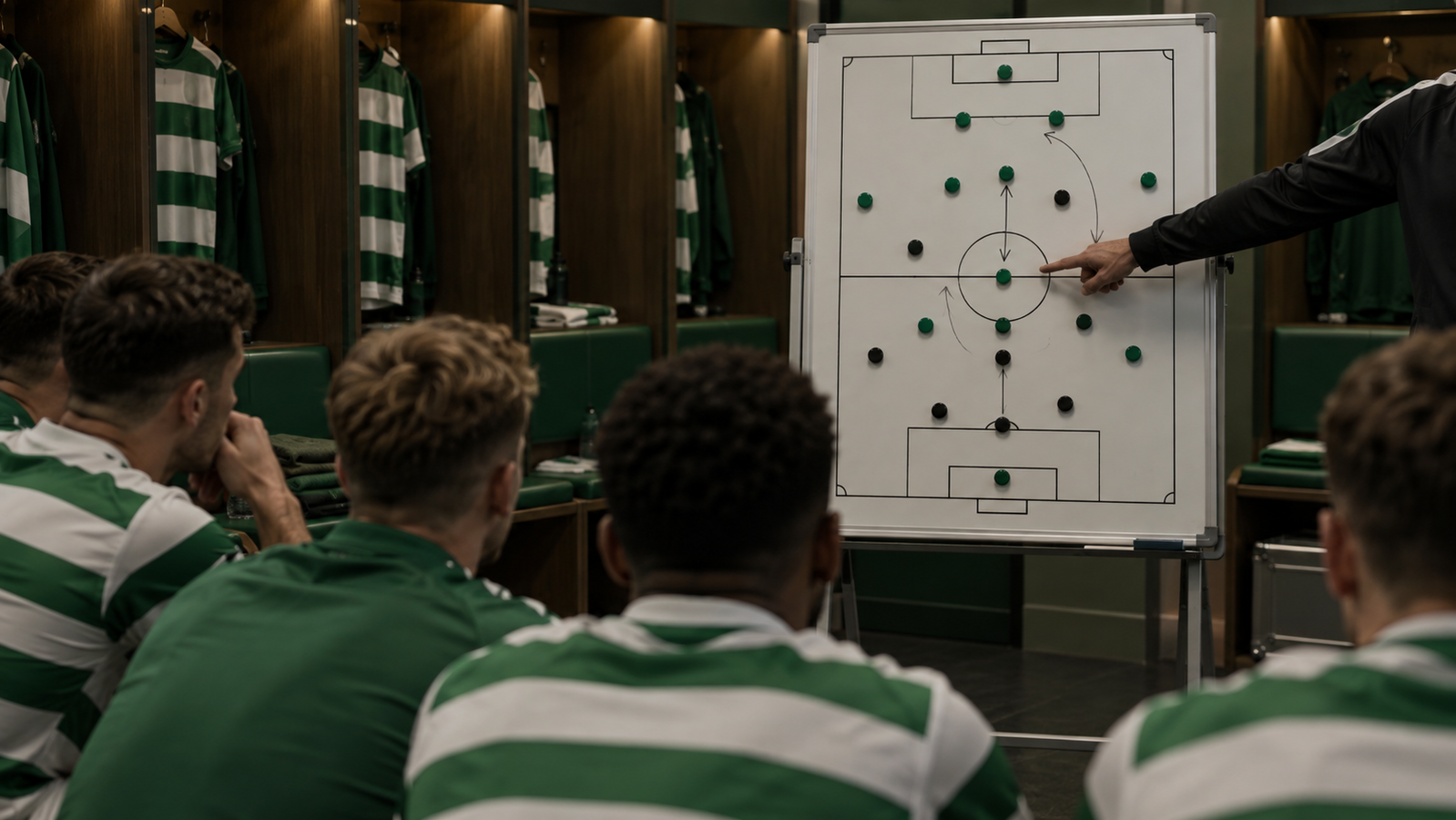
There are two questions that have haunted us since the weekend.
How can so many of Celtic’s best players have failed so spectacularly in two massive games of football? Why do we look vulnerable in every game we presently play?
The tactical side of the club is a mess, and individual players are suffering and being blamed for it. When I say individual players, that is exactly what I mean: this is a collection of individuals, the very criticism Callum McGregor made at the weekend.
McGregor is first on the list of targets.
Over and over again, people are commenting on everything he does wrong, without considering how the system creates the situations for which he gets blamed.
I am going to explore the ways that failure manifests itself, using graphics to show what happens when we have the ball, what happens when we lose it, and what changing things would actually require. This is not a detailed tactical analysis. I am not an expert. But I have looked at this enough to think I have a handle on what’s going on. Being able to fix it is another skill-set entirely, one I don’t have.
Before I start, I am not here to defend McGregor from every criticism.
He is not the player he was, but then you would not expect him to be. He was an outstanding box-to-box midfielder before becoming our regular number six. In my view, our failure to do the spadework of recruiting a proper successor to Scott Brown has squandered too much of what McGregor could have given us further forward. Moving him further forward would still solve a lot of problems, but only until you ask who plays behind him.
We are asking similar questions all over the pitch.
Players are being given jobs that do not suit their strengths, then carrying responsibility for failures which belong above their heads. You construct a machine to work in a certain way. Misalign a component or leave an essential part out, and you will be lucky if the whole thing does not break down.
Benjamin Nygren is one part of this problem. Kasper Høgh is another. Camilo Duran was moved wide at the weekend, and there are questions about what we want from Sebastian Tounekti as well.
None of that excuses individual mistakes. But before deciding that all these players are failing us, we should examine what we are asking them to do as a team.
For me, it starts in the middle of the pitch, with a guy who at this particular moment is called Mika Baur.
He has barely arrived, barely knows his teammates, and at the weekend was asked to link attack and defence in a system of such incoherence that a much better, more experienced player would have struggled.
Think about our midfield three.
McGregor is the six, between the defence and the rest of the midfield.
Baur is the eight, the central link.
Nygren, who actually wears number eight, is playing as a ten, hovering around the box and supporting the forwards.
Those different roles can complement one another, but only if the players supply the movement, connections and cover that make them a unit. That is only part of what is missing here, and part of it lies in their respective roles.
Nygren is a highly specialised attacking player. His strengths lie in receiving between the lines, combining around the box and getting into positions from which he can score. We have already seen how exceptional he can be at that.
Asking him to come deep, receive under pressure and help organise the build-up is asking for a different skill set. Demanding that he should stop being lazy, arrogant or simply do more does not resolve whether he is suited to the job.
In the situations illustrated below, he stays high, McGregor stays deep, and Baur occupies the space between them. Three midfielders in three separate zones, with one man expected to connect the whole thing. Now consider what happens when the opposition starts moving.
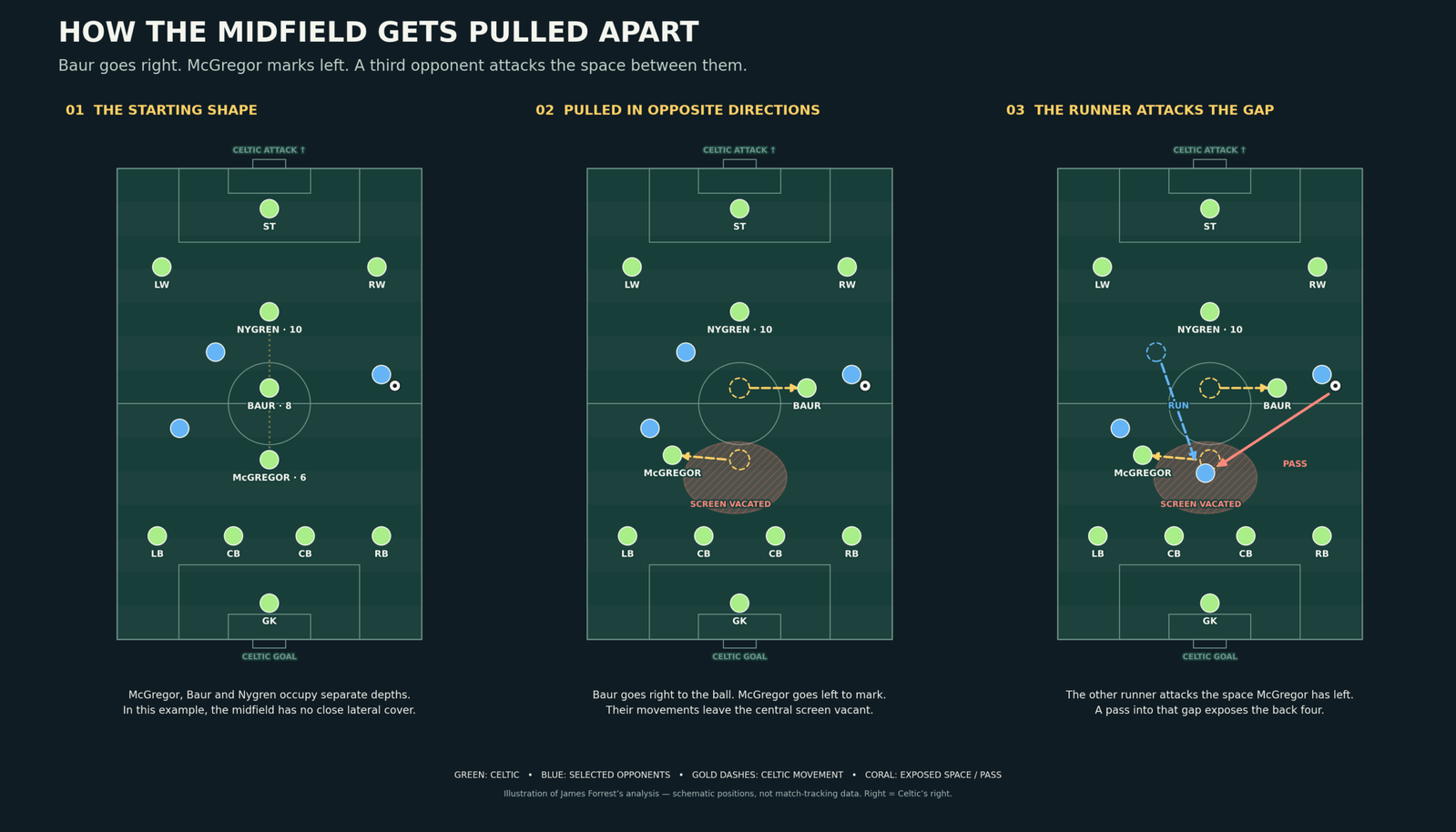
An opposing player has the ball to Baur’s right. Baur goes to close him down, leaving space behind and inside him. Another opponent makes himself available on the other side. McGregor moves across to mark him, because leaving that player free also presents an obvious danger. Baur has gone one way, McGregor the other, and a third opponent runs through the middle into the space McGregor has vacated.
You can blame McGregor for that all you want, but the system has presented him with a choice between two problems. Hold his position and an opponent is available elsewhere. Move across and the central screen disappears. Without support, he cannot cover both. If a centre-back steps out to help, somebody else must cover the space that defender leaves.
That is the kind of opening opponents have been finding around the edge of our box. The diagram illustrates the mechanism; it is not a frame-by-frame reconstruction of any specific goal. But anyone who watched the freedom opponents enjoyed in Austria and again at Ibrox should recognise that it stems from the setup itself.
Baur’s name is almost incidental to this. At the weekend he was the poor sod who had to make those decisions.
You could put Oxlade-Chamberlain or Sørensen there, or bring Arne Engels back for one last game. If the other positions and responsibilities remain unchanged, the central player still has too much ground to cover and too little support.
That is when the opposition has the ball.
Now look at what happens when McGregor is supposed to start our attacks, with the same lack of support around him.
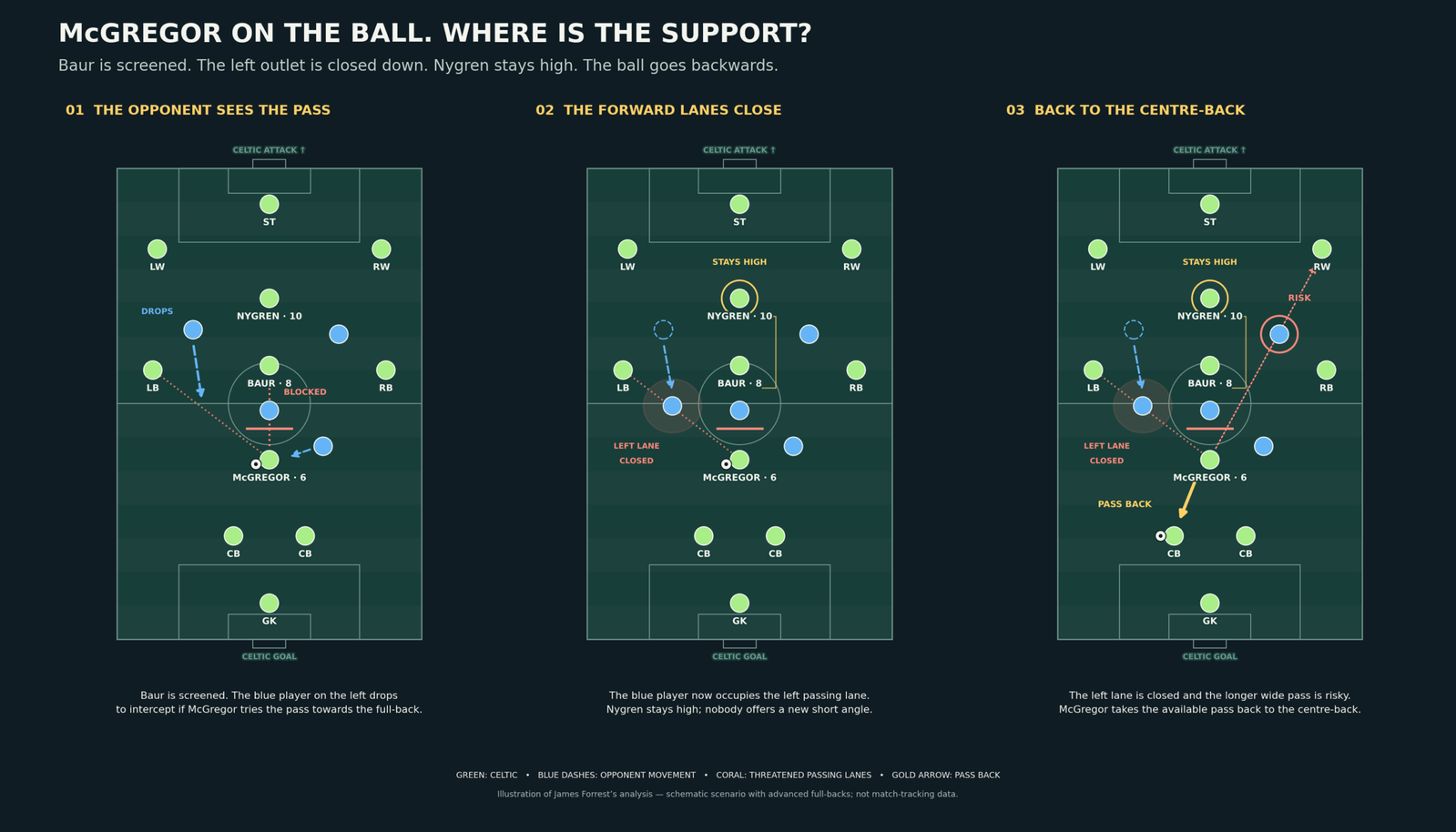
McGregor receives and is immediately put under pressure. An opponent screens the pass to Baur. Our full-backs are advanced, the wide attackers are further away, and Nygren is waiting beyond the midfield. Even the pass which appears to go into space becomes dangerous when an opponent is already moving to close that space down.
McGregor has to decide quickly. Attempt a difficult forward pass, carry the ball past the pressure, or return it to the centre-backs. How often have we watched that movie? How often have people criticised the backward pass without asking what useful forward option was actually available?
There is nothing inherently wrong with going backwards to create a better route forward. The problem is going backwards because no new route appears. Even if McGregor finds Baur, Baur can inherit the same difficulty: opponents closing him down, teammates too far away, and no easy combination to get through them. The ball comes back again.
And here is the beautiful part of this ridiculous arrangement.
Nygren is being kept high because of what he can do in dangerous positions, but that lack of midfield support helps prevent us getting the ball to him there. We incur the cost of his advanced role without consistently receiving its attacking benefit. The system undermines the very strength it is supposed to provide.
McGregor becomes the convenient whipping boy. He is expected to protect the defence, cover runners, support Baur and launch the attack. People ask whether he still has the legs, but that question depends on the job. Being younger or quicker might help him recover from some situations. It would not put him in two places at once.
Modri?’s longevity at Real Madrid is sometimes thrown into this discussion as if age alone makes the comparison meaningful.
But his midfield partners supplied complementary qualities and shared responsibilities. The point is the unit around him. McGregor’s performances cannot be judged sensibly without examining what support his own unit provides.
Throughout the transfer window, we talked about needing a number six. That player would not solve everything, but a suitable partner could change McGregor’s options, share the defensive work and allow one midfielder to advance while another stayed behind.
My suspicion is that the failure to sign that player compromised what O’Neill intended to do. Whatever the original intention, the need to adapt became unavoidable when the window closed, and the problem is that we didn’t even do that.
Taking Nygren out of the midfield at Ibrox would, in my opinion, have been the best response. Another supporting midfielder could have helped both Baur and McGregor. Nygren’s ability is not the issue. The issue is whether the team can afford his particular role against an opponent who prevents us supplying him. McInnes compounded that problem by using James Penrice to mark him centrally.
There are other choices: bring the wide players closer, restrict the full-backs, share the holding duties, or change the formation. Every one involves a compromise. Before looking at them, though, follow the consequences of our present arrangement to the forwards.
When Celtic cannot play through the press, the temptation is to bypass it.
The ball goes long towards Høgh. What is he supposed to do with it? If Nygren is available for a lay-off and Duran is running beyond him, there is a move to construct. If Nygren is marked, Duran is distant and the midfield is nowhere near the second ball, Høgh has been left to manufacture an attack on his own.
At the weekend, he was given pelters for not being able to engineer a positive outcome in precisely the scenario I just outlined.
Winning the header is not enough if the opposition collects it. Holding the ball up is much harder when support never arrives. Then possession comes straight back, and the striker gets criticised for being ineffective.
We have spent £11 million on a player and are asking whether he is good enough before properly asking whether we are using the skills that made him worth signing.
Høgh can link play. His work at Bodø/Glimt included combinations with teammates running close to him, and he has scored in Europe against outstanding opposition. What I cannot understand is the apparent expectation that he should become a Chris Sutton clone, repeatedly wrestling for isolated balls. The support around a striker is part of that job too. His height does not make every direct ball a sensible one.
We spent a lot of money on a player we do not seem to know how to use. A player we are attempting, almost certainly in vain, to turn into a different one altogether. It would be incomprehensible if we hadn’t seen this movie before.
Duran out wide creates another question. If he comes inside to help Høgh, who supplies the width? If he remains wide, who supports the central striker? Starting on the flank need not make him ineffective, but the movements have to fit together. At the weekend, we got neither the central partnership nor the supply that would have justified separating them. Two players diminished by the same arrangement.
This is what I mean by square pegs in round holes.
Every player needs the support of a teammate. McGregor’s criticism of a team of individuals raises a question that goes beyond the players’ application: how does each man fit into the setup? If the connections are missing, individual moments of magic become the means of rescuing the whole thing.
The most attack-minded Celtic side I have watched was Ange Postecoglou’s, and he understood the need to support the players committed forward.
Greg Taylor would move inside from left-back when we had possession, providing another midfield connection and helping protect central space if the attack broke down. It was the first time many of us had heard the term inverted full-back.
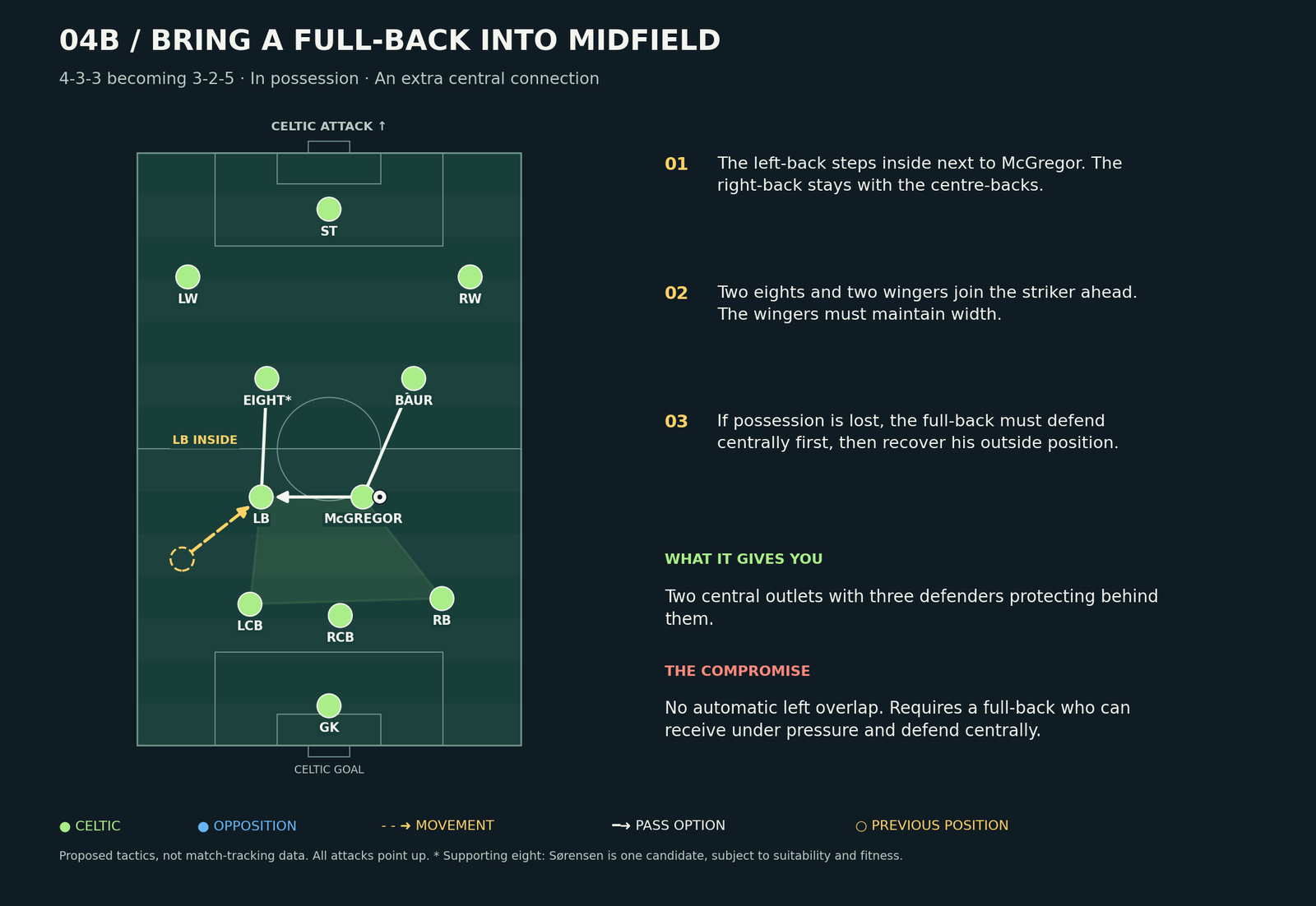
That support helped McGregor and allowed players such as Hatate and O’Riley to get forward. Taylor’s movement changed the options around the ball.
If an opponent followed him inside, that could open a route elsewhere. If he was left free, Celtic had another central player through whom to build. Ange developed Taylor’s role while improving how the team fitted together.
Penrice’s assignment at the weekend had a different purpose: he moved centrally to restrict Nygren when Celtic had the ball. It was not an exact copy of Taylor’s possession role, but it showed how a full-back could influence the midfield battle.
We should hardly have been astonished by that possibility. We had watched our own team exploit central support from that position for two spellbinding years.
So, what can O’Neill do now? Here are six alternatives. Some can be combined. None lets every player retain every freedom, and that is the point: the manager has to decide what the team can afford.
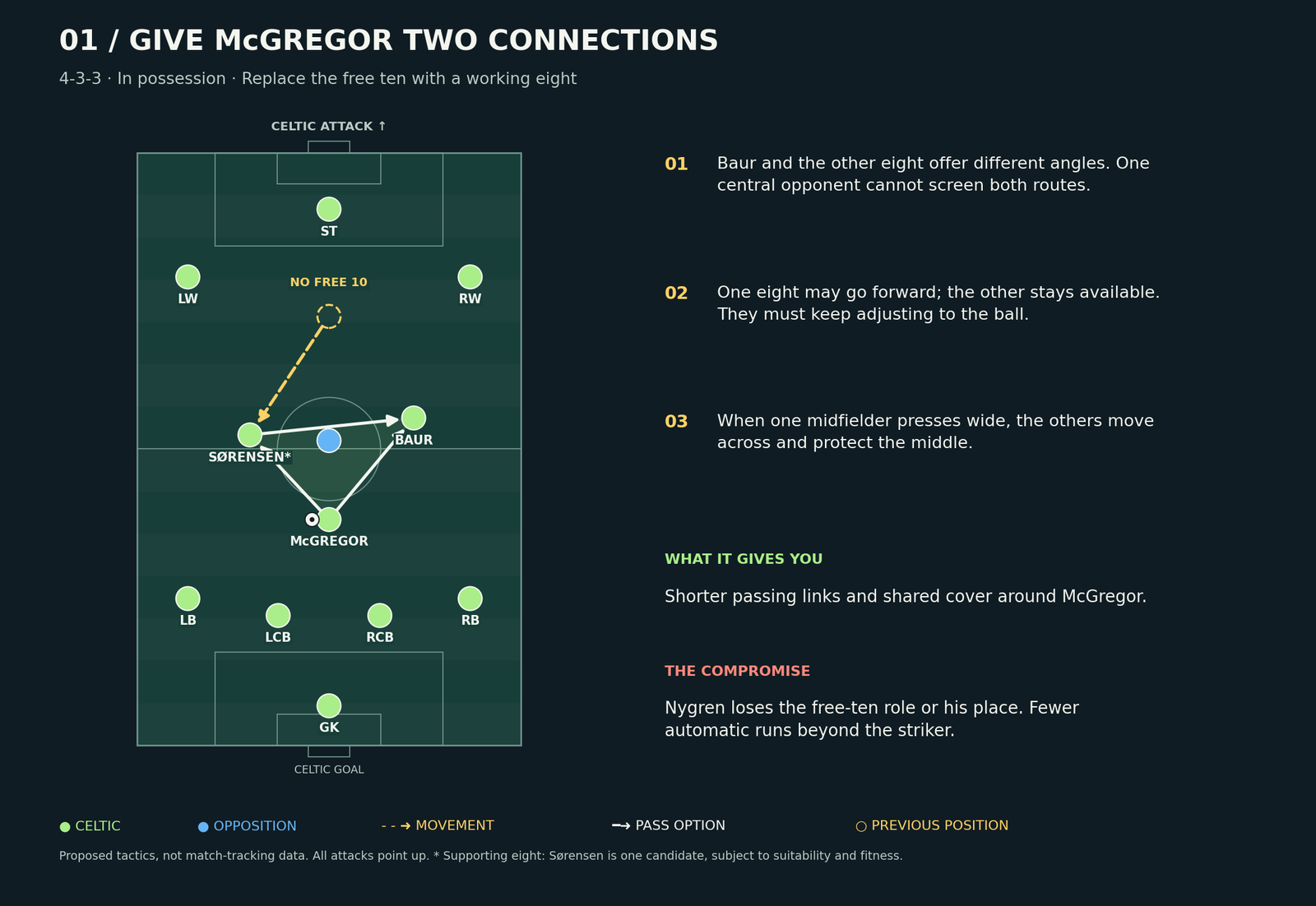
The first is a compact 4-3-3, replacing the free ten with another supporting midfielder. McGregor has Baur and a second eight ahead and either side, offering different passing angles. When one goes forward or across to engage an opponent, the other helps protect the centre. The team improves its connections and its cover.
The cost is Nygren’s role or his place. One of Celtic’s most potent attacking players may have to sit on the bench. Nevertheless, this was an option available at the weekend and, in my opinion, the one O’Neill should have taken.
Sørensen is a candidate for that supporting job; the choice must depend on who can actually perform it, rather than another name simply being put into the empty space.
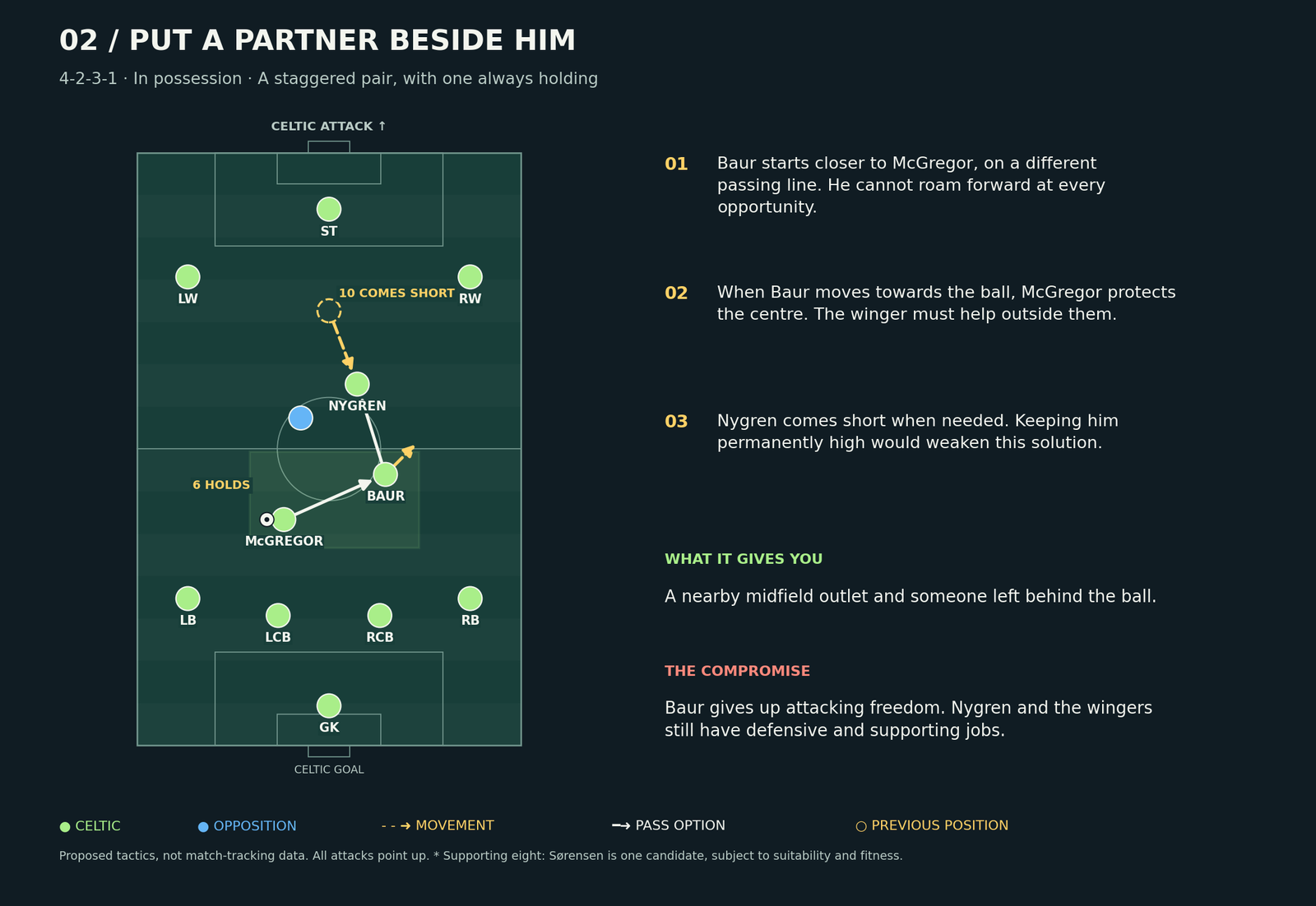
The second is the double pivot: give McGregor a nearby midfield partner and share the responsibility. They offer different passing angles, and when one engages or advances, the other holds. That could involve Baur accepting a more restrained role. The player we failed to sign might have made this a stronger option, but that’s closed off to us, and we have to examine what the available players can do.
It also requires help from the ten and the wide players. You cannot put two men together, leave everyone else distant and announce that the midfield is fixed. The sacrifice here is attacking freedom: somebody has to stay available, somebody has to recover, and the central pair cannot continually chase opponents towards opposite touchlines.
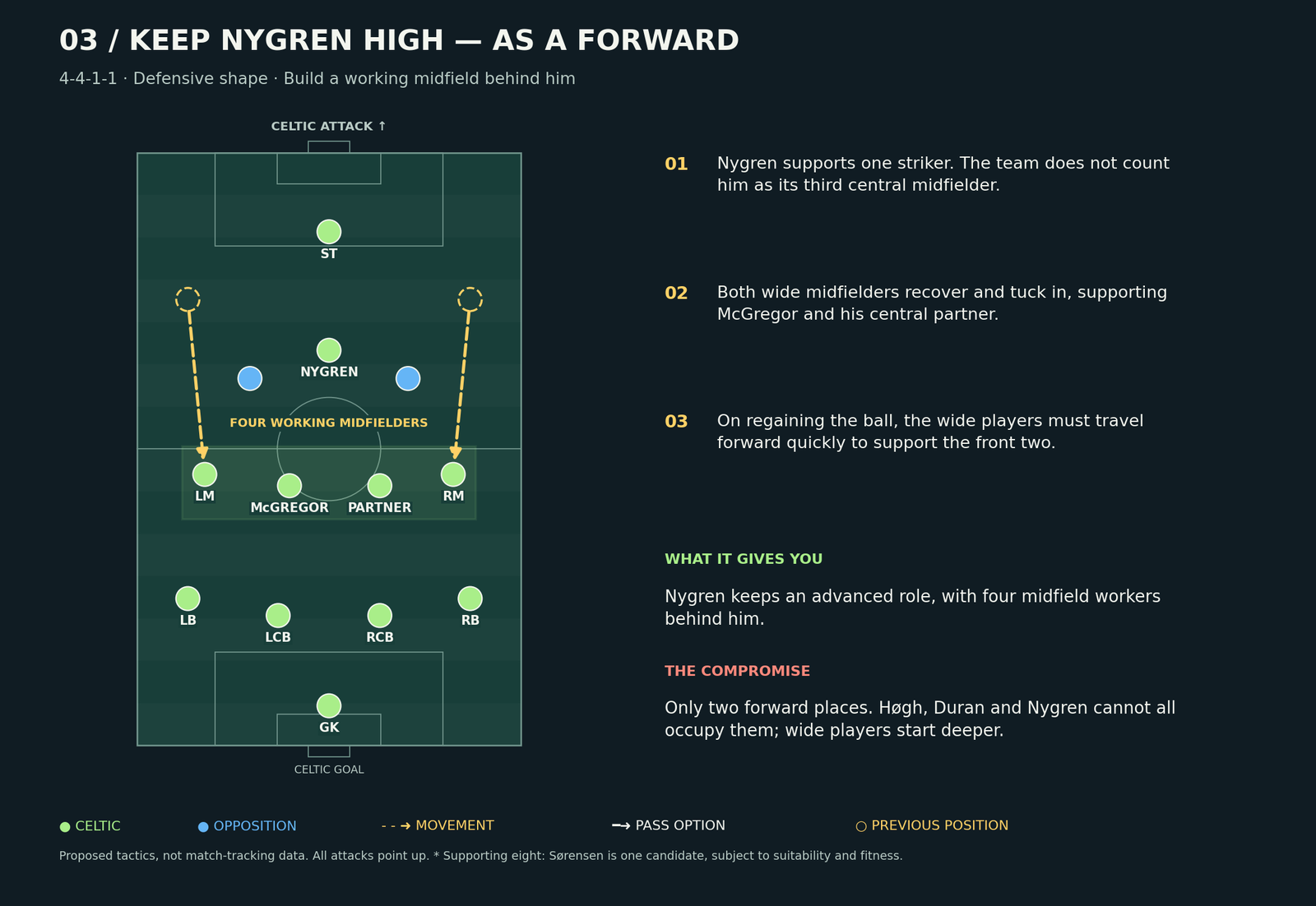
A 4-4-1-1 offers another approach. Keep Nygren behind one striker and put four working midfielders behind them. The wide players recover and narrow to support McGregor and his partner. Nygren retains an advanced role, but the team no longer counts him as its third central midfielder.
That means a difficult attacking choice. Høgh, Duran and Nygren cannot all occupy two forward positions. If one of the forwards is used wide, he must perform the midfield job that comes with it. Simply putting an attacker’s name there recreates the problem. The wide players also have further to travel when Celtic win possession.
That system may not even be possible with the current personnel; imagine Tounekti playing deeper, and covering the middle. Imagine Hussan having to.
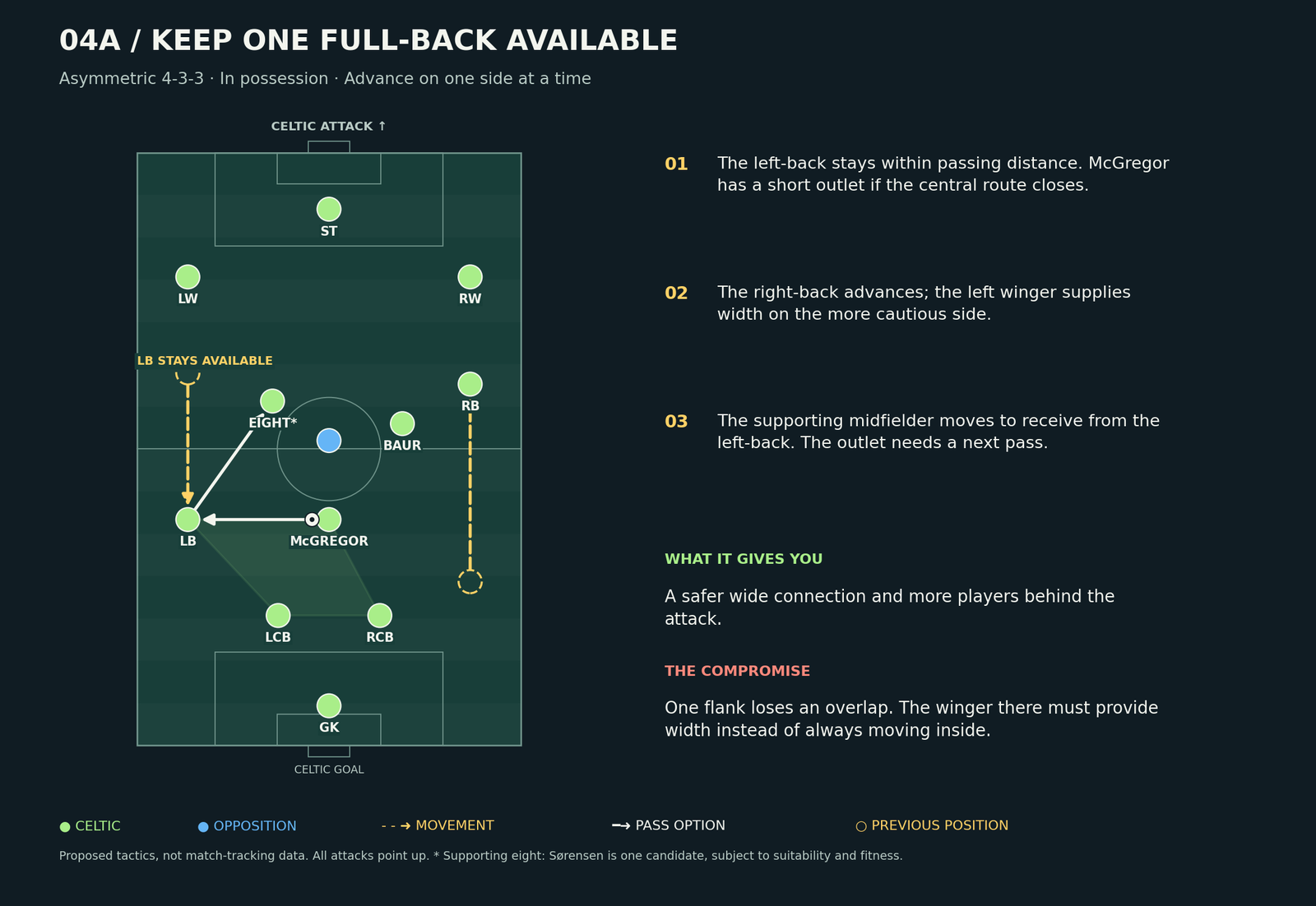
The first full-back variation is to advance on one side at a time. The other full-back stays within passing distance and offers McGregor an outlet. The winger on that side must provide width, while a midfielder moves into position to receive the next pass. It gives the team another connection and more protection behind the attack.
The sacrifice is an overlap and some freedom for the winger to drift inside.
The second variation is the Taylor option illustrated earlier: bring a full-back into midfield. But that requires someone comfortable receiving under central pressure and defending there when possession changes. Tierney’s qualities do not automatically make him suitable, and asking Donovan to learn it in a major fixture would carry an obvious risk. Neither adjustment removes the other midfielders’ responsibilities.
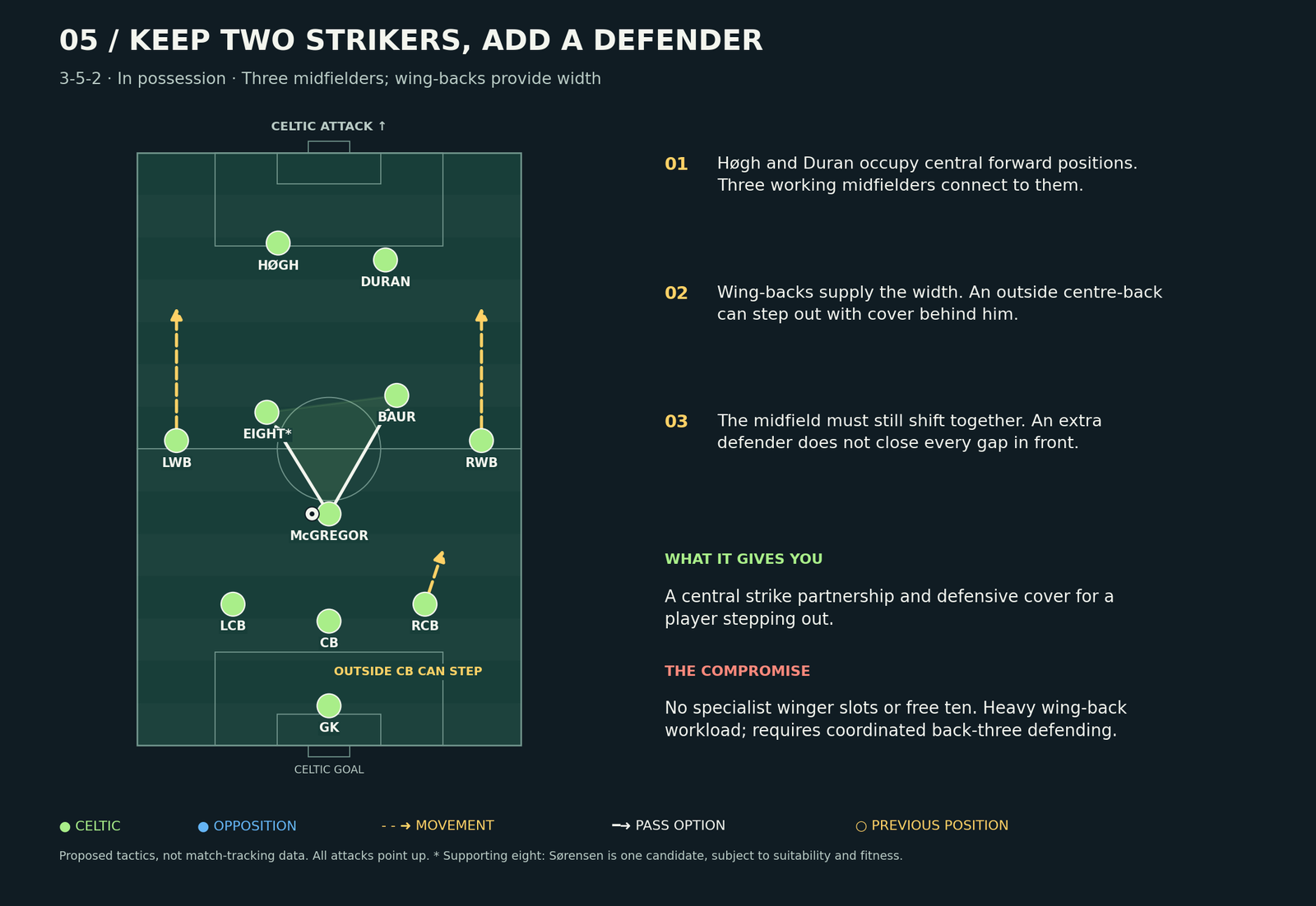
Then there is the 3-5-2, which I discussed on the podcast. The version people imagine looks tempting: Trusty, Scales and Carter-Vickers at the back; McGregor, Baur and Nygren centrally; Tounekti or another attacker on the left, Hassan on the right, and Høgh with Duran up front. All those attacking names on the pitch. What could possibly go wrong?
Look at the midfield. If Nygren stays high and McGregor stays deep, Baur faces the same problem connecting them. If the wide players remain high too, the extra centre-back is being asked to compensate for a great deal. A defender can step out, but that movement needs cover. Three at the back is no guarantee of protection for the space in front.
This was not at all the system O’Neill used last time he was here. That’s the one in the graphic, and it presents compromises of its own.
That uses three working midfielders and genuine wing-backs. One midfielder can still join attacks, provided someone covers him; the formation does not prohibit support arriving in the box. But if Nygren is the free ten, this becomes a different arrangement, closer to 3-4-1-2, and we are back to asking two central midfielders to do an awful lot.
O’Neill’s earlier Celtic teams understood the importance of those supporting duties, with Neil Lennon holding and others able to advance.
The wide roles were wing-back jobs, requiring recovery and defensive responsibility as well as attacking contribution. You cannot reproduce that by treating two attacking wingers as full-backs whenever the opposition gets the ball.
This also creates demands on the available defenders.
Tierney could be considered on the left of a back three or as a wing-back, so he is not automatically excluded. But you still need depth, fitness and players suited to the duties. It might preserve the Høgh-Duran partnership while sacrificing Hassan’s place, Nygren’s role or both. There is no version which avoids making those sorts of choices.
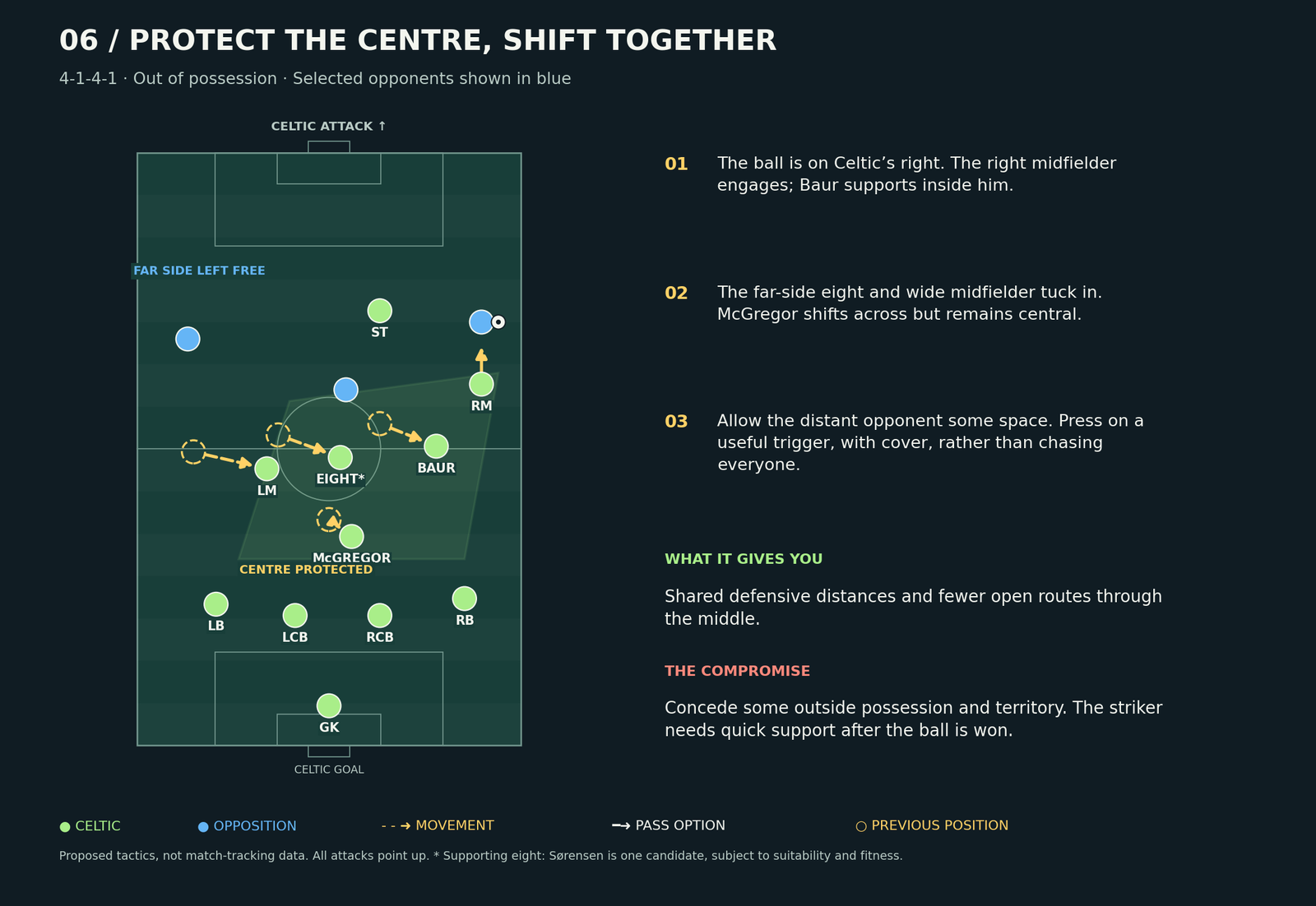
The final option is a compact defensive block. Protect the middle, move across together, and accept that the opponent furthest from danger may have some possession. When one player engages, others provide cover. You do not keep following separate opponents until the centre of the team is empty.
That is a collective discipline, rather than a formation requiring eleven defensive specialists.
It could be combined with several of the other changes. The compromise is territory, some outside possession and deeper starting positions for the wide players. You also need an outlet when you regain the ball, or your striker becomes isolated and the pressure simply returns.
It was a serious option for Ibrox, not a guaranteed result.
These alternatives expose the difficulty of the squad we have, but they also expose the limitations of O’Neill’s stated aim of getting our best players on the pitch.
Some changes require a different selection; all require different responsibilities. The manager and his coaches must be willing to make those choices.
Waiting for January is not a tactical plan.
Brendan Rodgers took enormous criticism when Arne Engels, Adam Idah and Auston Trusty did not start every week.
But a first-team signing is not a player whose fee obliges you to select him regardless of the match. There were circumstances in which Idah offered something different from Kyogo, or a midfield combination without Engels was the better choice. Selection changed with the opposition, the players’ condition and the demands of the game. That was not writing those players off. It was knowing why you had signed them and when to use them.
A strong bench is one of the things recruitment should buy you. If the only way to justify a signing is to start him every week, you have turned an option into an obligation.
The Galácticos and PSG offer larger-scale examples of the danger of accumulating talent without maintaining the relationships that let it function.
Madrid’s early success included the balance supplied by Claude Makélélé. PSG’s European breakthrough came with a team whose stars also pressed, combined and supported one another. Individual quality still mattered enormously. So did the work that connected it.
That brings us back to the player we did not sign. One addition would not transform Celtic into a side that swept aside all opposition. But the right player can supply a missing connection and make several teammates more effective. Vieira, Keane and Gerrard were different types of midfielder, but they illustrate how much a team can gain from a player around whom complementary roles are properly organised.
Do we have such a player? I would argue no, not anymore. The board failed to supply the midfield option the manager wanted.
That may have denied him a foundation for the changes he intended.
But I’m going to be blunt; I have serious doubts about the coaching staff now, because the problems extend beyond that vacancy. A new six would not, by himself, explain how to get Høgh and Duran working together or how to supply either of them properly.
It would not fix the incomprehensible folly of a midfield where McGregor plays as a 6 and Nygren plays as a ten; as I said earlier, in that midfield three the name of the guy in the middle doesn’t matter all that much. You’re asking the impossible of him.
The manager’s needs were not met, and we will continue to suffer for that. Talk of rectifying the situation in January does not impress me one bit. It should not impress anyone else either, because our season could be beyond life support by the time January comes around.
Which brings us back to McGregor’s observation: a collection of individuals.
What I have sought to explain is how the tactical shape produces that outcome, how the apparent failure to understand the types of players we have signed, or how to utilise their strengths, forces players to rely on individual moments to rescue the team from its own internal contradictions. We cannot keep blaming each man for the failure of relationships the coaching staff are supposed to establish.
As difficult as it will be with the current personnel, that structure has to change.
There are no easy answers, and every alternative creates compromises and problems of its own. That is the reality of the squad we have, the one O’Neill signed off on and thanked the board for providing.
But he is the manager of this team. Whatever he really thinks, whatever he knows deep down, he is paid the big bucks to make those decisions.
That choice is going to define whether we get to January in a strong enough position, or whether January even matters.
Because if he does not change things now, our fate is already sealed.
Choose The CelticBlog as a ‘Preferred Source’ on Google News for quick access to the news you value.








I would conclude from your analysis James, that MON and the coaching staff would need to build a team around the strongest options available.
That would mean Duran and Hogh up front as a two, and a three man midfield that excludes Nygren. The rest of the team would need to be fitted in around those two areas.
James you are over complicating it ,play a 4-4-2 midfield calmac,baur,ox and hassan, attack as a unit and defend likewise you don’t always need 2 wingers I remember a midfield 4 of burns,grant,mcstay and proven being the one winger also and the most important part we get our two strikers on the field.
Quite brilliant and informative but why can’t Mon or Maloney or any of the other managers not
see it and more importantly deal with it as in insist on nothing else but a midfield enforcer.
The contrast in styles was blatantly obvious. Sevco had players who could run with the ball immediately they won it, attack on. Celtic dilly dallying at the back until someone panics and launches it up the park to well organised defence.
This has been going on for years and will continue until we get a manager in that knows his stuff, like the Lask guy.
I think playing a keeper to give him a taste of the event is a resigning issue. Like McCowan he is probably devastated.
Good post James, you do wonder what the hell our manager and coaching staff are doing at Lennoxtown, nearly every Celtic supporter in the World knew for sometime that the M/F 3 wasn’t functioning, and needed changing.
We might not have the M/F player available to fill the defensive midfielder role that we needed, but surely the coaching team could have come up with a system that doesn’t leave us so easy to play through.