
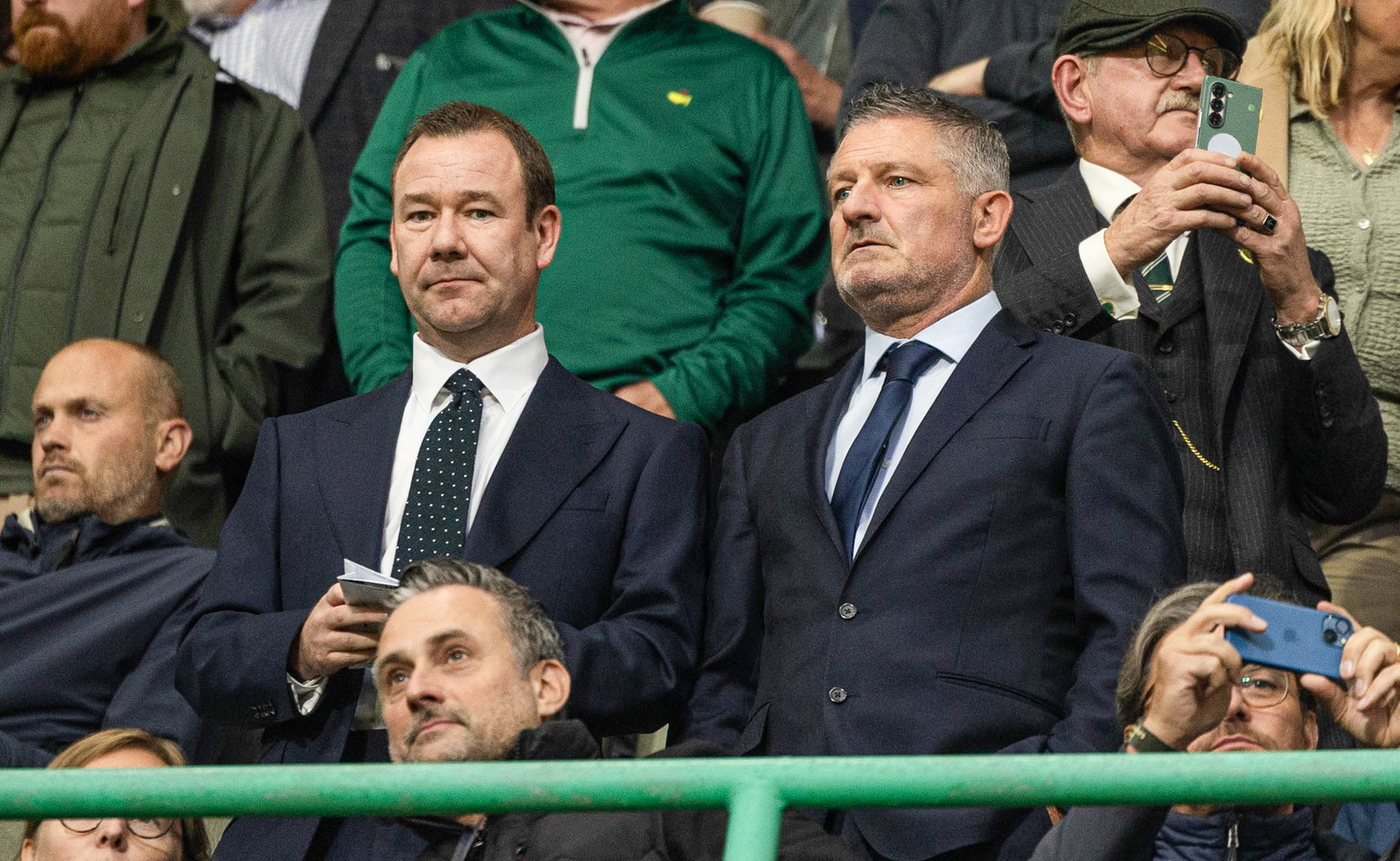
EDINBURGH, SCOTLAND - AUGUST 27: SFA Chief Football Officer Craig Mulholland (L) and Scotland Mens Under-21 Head Coach Tony Docherty during a UEFA Europa Conference League Playoff Round Second Leg match between Hibernian and KAA Gent at Easter Road, on August 27, 2026, in Edinburgh, Scotland. (Photo by Ross Parker/SNS Group via Getty Images)
One of the least surprising things that happened over the weekend was the backlash against the SFA’s brilliant new idea for youth development.
I was not remotely shocked to see Keith Jackson this morning asking the obvious question: if Craig Mulholland is so good at developing young players, where was the evidence of it when he was working at the Ibrox club?
Mulholland was responsible for youth development there, and I know there has already been criticism of people who seem determined to personalise this entire debate around him, as though he alone was responsible for that club’s mad policy of signing a new team every year.
There are people saying that is unfair. There are people saying he did a reasonable job. There are people saying his credentials are stronger than his critics acknowledge. But the answer is the same as it often is in these situations.
It does not really matter what is fair.
It matters what people believe.
That is the curse of the age we live in, and it is useless pretending otherwise. The very worst person to send out to lecture the rest of Scottish football about youth development is somebody who held responsibility for that area at one of the clubs now being held up as a major offender. It does not matter how well intentioned he is.
It does not matter how well credentialed he is. It does not even matter if you think he is right. I certainly think Scottish clubs should be doing far more in real terms to develop young players. But one of the worst offenders in recent years has been the Ibrox club, and Mulholland was directly associated with that part of its football operation.
Whether he likes it or not, whether the SFA likes it or not, whether it is entirely fair or even entirely accurate, the optics are dreadful.
He is the last person you want carrying this particular message.
His record is too easy to attack. The output of the system he was involved in is too easy to attack. And there are clubs, and people running clubs, who will use that as a reason not to listen to him. More importantly, they will use it as a reason not to support the plan.
I already think the plan itself is fundamentally broken. I do not believe imposing quotas on clubs is going to raise standards one bit. I think there is a real danger it does the opposite. If clubs are forced to play young players who are not ready, simply because a regulation says they must, that does not magically make those players better.
It can weaken teams. It can damage confidence. It can distort selection decisions. And it can turn development into box-ticking.
The Scottish FA’s proposals are significant. They would require two Scotland-eligible under-21 starters in the Scottish Cup and League Cup, with at least one remaining on the pitch, while Premiership clubs would also be expected to average 60 minutes per match for eligible under-21 players or lose ten per cent of their final placing prize money. The rules, if approved, are intended to begin in 2027/28.
That is not a small intervention. It is a governing body telling clubs not merely how many players they may register, but who they should actually put on the pitch.
I do not know what Celtic’s official position is going to be.
I expected some kind of indication before now, although perhaps the club will wait until closer to the meetings where these proposals will eventually be voted on. But I would be surprised if anyone at Celtic was particularly enthusiastic about them.
We do at least have two relatively recent academy graduates around the first-team picture who are getting meaningful football, but that is almost beside the point.
I would feel much better about Celtic’s position if I believed there was a coherent plan inside the club to improve our own academy structures. I do not.
I believe in that about as much as I believe in January jam.
The ugly truth is that I do not think our board knows how to build an elite modern academy operation. Worse, I do not think it has shown any serious appetite to recruit the kind of person who does know and then give that person the freedom, authority and resources required to transform it.
That is the real problem. Quotas do not solve structural failure.
They conceal it.
They allow governing bodies and clubs to say something has been done because a young player appeared on a teamsheet. But appearing on a teamsheet is not development. Development is what happens in the years before that.
It is coaching. Recruitment. Sports science. Facilities. Education. Competition structure. Individual development plans. Talent identification. Pathways. And above all, quality.
If the player is good enough, the problem becomes how to create the route into the first team. If the player is not good enough, forcing him into the first team does not solve anything.
Judging by the reaction already coming out of the Ibrox side of the argument, and the obvious lack of enthusiasm there, I suspect we are getting an early indication of how a number of clubs may view this.
And that brings me back to Mulholland.
There will be clubs which do not like this proposal anyway. They will look at him and say: why should we take instruction on academy development from somebody whose previous club has hardly been a shining example of producing first-team players?
Again, you can argue that this is unfair. You can argue that there were circumstances beyond his control. You can argue that first-team managers, recruitment policy and ownership decisions all contributed.
Every one of those points may be valid.
But if you are trying to sell a deeply controversial reform to clubs which are already suspicious of it, this is not the salesman you want. I am astonished the SFA did not see that coming.
Clubs do not like quotas. They never have. When European squad rules were reformed, the direction of travel was towards allowing clubs greater freedom to spend and construct squads as they saw fit, while UEFA retained locally trained player requirements. Even now, the 25-man List A system reserves eight places for locally trained players, with at least four effectively needing to be club-trained if a club wants to use the full allocation.
That requirement remains a source of irritation for some big clubs, but the smarter ones have treated it as an incentive to improve their own academy structures rather than merely complain about it. That is the distinction.
A registration rule creates an incentive to produce your own players. A mandatory playing quota tells a manager to put one on the pitch whether he believes the player is ready or not. Those are not the same thing.
Quotas are not going to make Celtic better at academy level. The thing most likely to make Celtic better at academy level is the spiralling cost of transfer fees.
As buying established players becomes more expensive, the economics of producing your own become more attractive. At some point, however much money you pour into coaching, scouting, facilities and development, it starts to look cheap compared with repeatedly spending £8 million, £10 million or £15 million on somebody else’s finished product.
That is the incentive which can transform academies. Not an arbitrary demand for minutes.
I would not be surprised if many other clubs feel the same way. They would rather develop their young players according to their own circumstances, their own standards and their own judgement without the governing body reaching into team selection.
And they will be even less inclined to accept that intervention when the principal salesman for it is someone whose own record can be attacked so easily.
Mulholland had access to one of the biggest academy structures in Scotland. He had resources. He had facilities. He had the institutional platform.
And critics will say that the first-team return from all of that was nowhere near good enough. Maybe that is too simplistic. Maybe it does not tell the whole story. But politics, football politics especially, is full of arguments which do not need to tell the whole story.
They only need to land. This one lands. That is why Keith Jackson can ask the question and why plenty of people will nod along with it as dumb as he is.
And that is why the SFA has created another problem for itself before anybody has even voted on the substance of the proposals.
If your reform is controversial, your messenger matters. If your salesman is part of the argument against the product, you have made the sale harder before you even enter the room. For all the supposedly sophisticated thinking behind this youth initiative, the SFA somehow missed something as basic as that.
Choose The CelticBlog as a ‘Preferred Source’ on Google News for quick access to the news you value.









As a guy who grew up in the 40’s and 50’s and the 20 a side game with your pals on a Sunday which was the football nursery of its day, I’ve not got a clue how you improve the development of modern day young players. What I would say is that there has been a hell of wastage amongst young promising players over the past number of years, and anything o help the development side of the game would be welcome.
100% THIS:
“The ugly truth is that I do not think our board knows how to build an elite modern academy operation. Worse, I do not think it has shown any serious appetite to recruit the kind of person who does know and then give that person the freedom, authority and resources required to transform it.”
I think a majority of clubs will be ok with the proposed requirements as when you look outside of our club and Sevco, by necessity teams play more young Scottish players. There’s a valid question over the skill levels of these players and why Scotland appears to have struggled over recent years to produce creative forward players and goalkeepers. The SFA Coaching Badges were once highly regarded with players coming from all over to earn their badges at Largs – is this another area where the SFA have rested on their laurels and haven’t invested?
The jump from the B team to the first team is too great and sending players out on loan to Ayr and Partick I’m not convinced by as the facilities and level of coaching and support less than is needed. Reinstating a reserve league, with teams required to field a minimum number of u21s would be a positive step for me.