
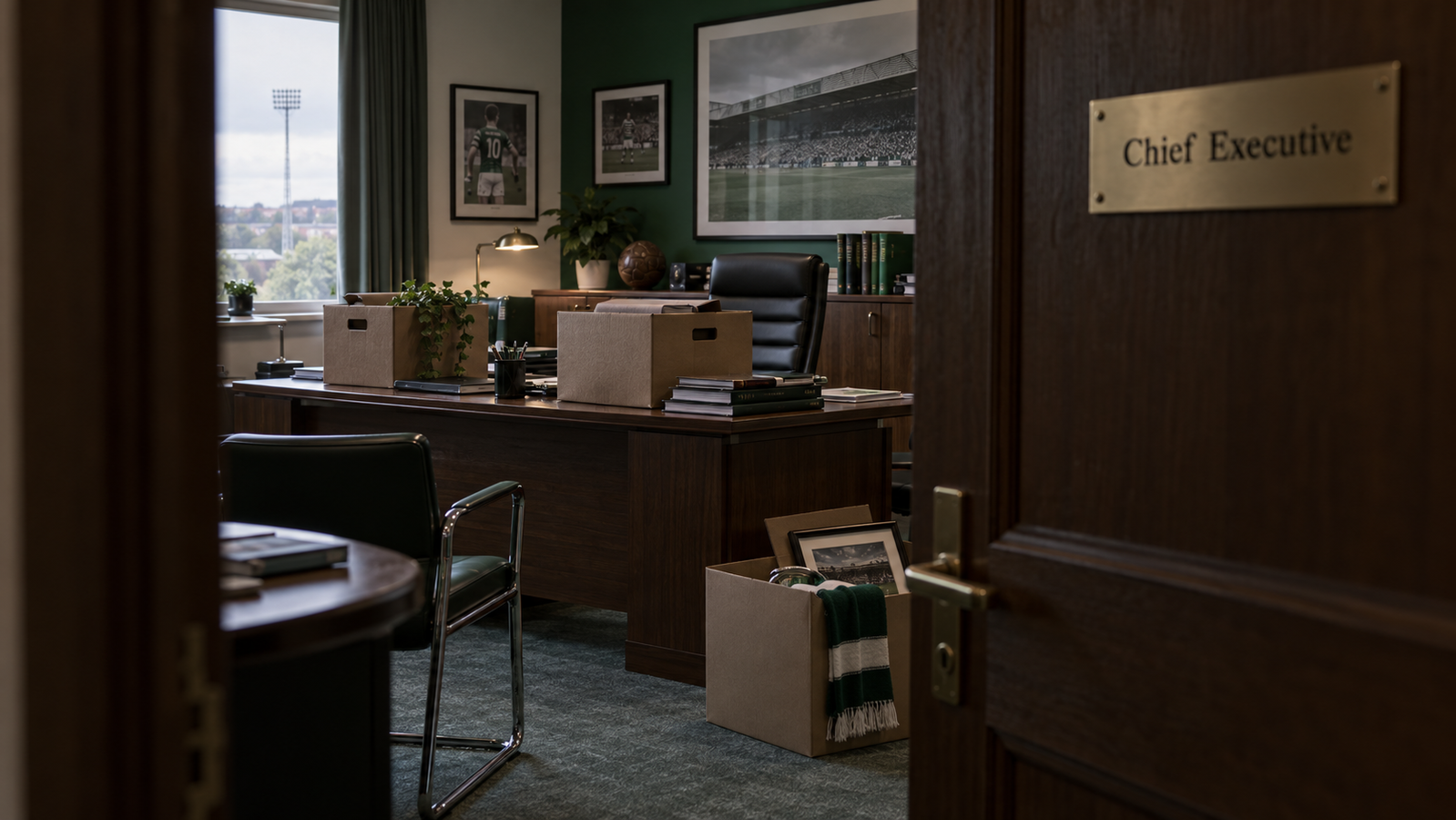
Sometimes you don’t need to be a financial expert. You don’t need to sit in a boardroom surrounded by spreadsheets, accountants and people wearing expensive suits. Sometimes you simply need to look at what has happened to Celtic Football Club and ask one very simple question: how the hell does Michael Nicholson still have a job as Celtic CEO?
Because let’s examine this properly.
The annual results for Celtic’s 2025/26 financial year have now landed, and they make uncomfortable reading. Revenue fell from £143.6 million to £111 million, a staggering £32.6 million drop. The club went from a £33.9 million profit after tax to a £4.8 million loss, while operating expenses increased from £117.1 million to £122.1 million.
Yes, Celtic themselves point directly to the difference between Champions League and Europa League participation as the principal reason for the fall in revenue, and that is perfectly fair. Champions League football brings enormous money into Celtic Park.
But that is precisely why I want to focus on the Champions League. This is not some completely random external event that happened to Celtic. European qualification is one of the fundamental responsibilities of the football operation, and when you repeatedly fail to reach the Champions League, the financial consequences are enormous.
Cash fell from £77.3 million to £66.4 million. Player-trading gains dropped from £31.5 million to £16 million. Yet somehow the man sitting in the chief executive’s chair remains exactly where he was. Why?
I genuinely want somebody to explain it to me, because this is not about one bad result, one missed signing or supporters being angry because Celtic lost a football match. It is about a pattern.
Look at what happened on the football side. Brendan Rodgers left. Wilfried Nancy arrived. Nancy left. Martin O’Neill returned to rescue the season. And thank God he did.
O’Neill inherited an absolute mess and somehow dragged Celtic over the line to win the league on the final day before adding the Scottish Cup. That domestic double was magnificent, and I will never take that away from him, his staff or the players.
But the fact that Martin O’Neill rescued the season should not become an excuse for everything which came before it.
In fact, the opposite is true. The more dramatic the rescue, the more serious the questions should be about how Celtic ended up needing rescued in the first place.
A club with Celtic’s resources, support, infrastructure and financial advantages should not find itself in a position where one manager leaves, another arrives, another leaves, and then a club legend has to walk back through the door and put out the fire. That is not a sustainable football strategy. That is crisis management, and crisis management cannot be the long-term strategy of Celtic Football Club.
Then there is the title race. Celtic were pushed all the way to the final day before eventually winning the league. I am delighted we won it. Of course, I am. Give me a Celtic league title and I will celebrate it every single time.
But one thing teaching has taught me is that context matters. Winning the title does not erase the managerial instability. It does not erase the European failures. It does not erase the financial consequences, and it certainly does not erase the deterioration in the relationship between Celtic’s boardroom and its supporters.
At the end of 2025, the Celtic Fans Collective launched its “Not Another Penny” campaign, calling on supporters to boycott merchandise and matchday spending as part of its protest against the board.
Think about what that means. Your own supporters are organising a financial protest against their own football club because they believe the people running it are failing them.
That is not a few angry tweets. It is not somebody booing after a bad substitution. It is a breakdown in the relationship between an organisation and the people whose money sustains it.
In almost any other corporate environment, that would set every alarm in the building ringing. Imagine another major company where customers organise a sustained boycott because they believe the leadership is failing. Revenue falls, profits disappear, costs increase, the organisation suffers repeated operational failures and senior executives come under sustained criticism.
Would the shareholders simply shrug and say everything was fine?
Of course they wouldn’t.
So why does Celtic appear to operate by a completely different set of rules?
And no, I do not claim that Michael Nicholson personally caused every individual problem at Celtic. That is not how corporate accountability works. A chief executive does not personally select every player, coach every training session or decide whether a goalkeeper saves a shot.
But the chief executive is responsible for the environment in which those things happen. Leadership is about structure, recruitment, strategy and accountability. It is about making sure the right people occupy the right positions and that everybody understands where the organisation is going.
And if the structure repeatedly fails, eventually somebody at the top has to answer for it. That is not scapegoating. That is accountability.
So here is the question I think Celtic supporters have every right to ask: what exactly is the performance threshold for Michael fucking Nicholson?
What would actually have to happen before the board decided that his position required serious review? Two Champions League failures? Well we’re there now, aren’t we? Another fan boycott? I think that’s on the cards. Another steep fall in revenue? We might be headed for that. Managerial instability? A title race which goes to the final day or one that is dead before it even gets there?
What more are we waiting for? Some of that might already be on the way, and the fact I’m able to write that sentence at all should be the end for him.
And please do not tell me Celtic won the double. Yes, we did, and I will treasure that double forever. But Martin O’Neill winning it should not become a protective shield for the boardroom.
It should make us ask an even bigger question: why did Martin O’Neill have to save Celtic in the first place?
That is what matters.
I do not want another emergency. I do not want another managerial rescue mission. I do not want Celtic stumbling through another European campaign and then explaining away another enormous financial hit.
I want Celtic to have a proper long-term football structure. I want accountability. I want ambition. And I want people running Celtic who understand that Celtic is not simply a balance sheet.
It is a football club. It is Paradise. It is generations of supporters, the noise inside Celtic Park, the history and the expectation. And yes, it is also a business, which means the business side has to work as well.
The evidence demands answers, not excuses, not slogans and not another statement telling us everybody at Celtic is working tirelessly.
So Michael Nicholson, I have some questions.
Where is the accountability? Who answers for the lost Champions League millions? Who answers for the managerial instability? Who answers for the deterioration in the relationship with the supporters? Who answers for the football structure? And ultimately, who answers for the fact that Celtic supporters are once again sitting here asking why the people running our club appear to face so few consequences when things go wrong?
I am tired of Celtic being run as though domestic success automatically grants everyone in the boardroom a lifetime exemption from scrutiny.
Winning is the minimum expectation at Celtic. Building a club capable of winning sustainably is the real job. And that is why, after everything that has happened, I keep coming back to the same bloody question.
How the hell does this pretender still have a job?
Choose The CelticBlog as a ‘Preferred Source’ on Google News for quick access to the news you value.


Hi guys, could someone explain celtics current ‘published figures’ please. Do they include transfer fees up to and including current day. (Daizen,engels etc). Thats at least 30 million or so?
Thanks in advance guys.??