
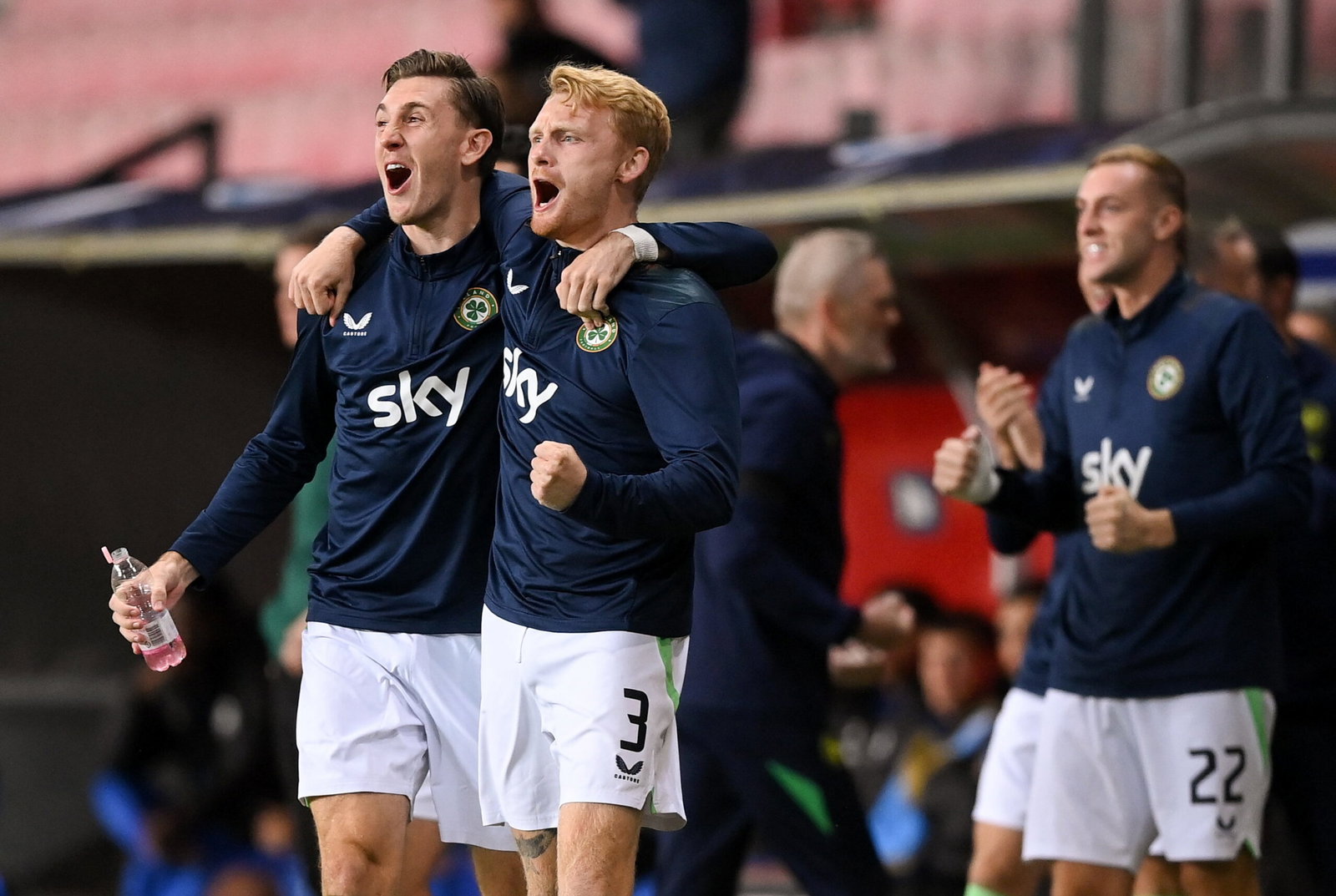
Debrecen , Hungary - 27 September 2026; Jimmy Dunne and Liam Scales of Republic of Ireland celebrate after their side scored a second goal during the UEFA Nations League B match between Israel and the Republic of Ireland at Nagyerdei Stadion in Debrecen, Hungary. (Photo By Stephen McCarthy/Sportsfile via Getty Images)
If you are a fan of a certain type of story, you will know that one of the great plots is the hero’s journey. He starts out as one thing, and by the time it is over he is something else entirely. Sometimes the hero vanishes for a while and comes back a changed man. Sometimes you see how that change was wrought, and sometimes you do not.
Liam Scales will come back to Celtic a different person.
He will walk a little taller, with his head a little higher, his back a little straighter and his stride a little more confident. He has shown a quality of character which is becoming rarer to find, and whatever anyone thinks of his politics, that deserves respect.
The Republic of Ireland’s decision to fulfil its Nations League fixtures against Israel has been enormously controversial.
The FAI confirmed that a significant majority of the squad voted to play, while the players agreed to wear black armbands recognising the lives lost in the conflict.
The association itself had previously asked UEFA to suspend the Israel Football Association from European competition, although it also made clear that refusing to fulfil the fixtures could have brought serious sporting consequences for Irish football.
That disagreement eventually reached the players themselves.
Gavin Bazunu decided that, in conscience, he could not take part. He withdrew from the group for the Israel fixture and made clear that his decision was directed against the killing of civilians, not against Israeli people or the Jewish community.
Scales did not withdraw, but reports have identified him as one of the players sympathetic to Bazunu’s position; not only did Scales not want to play but he stood up for his team-mate. Some will claim he could have done more. I think he did enough. He took a moral stand. He has sacrificed for it.
Last night, he was named among the substitutes rather than in the starting eleven. What we should not do is state as fact that one caused the other, because nobody in authority has confirmed that. But the wider point remains.
Scales was apparently prepared to make his view known when keeping his head down would have been much easier.
He could have said nothing. He could have disappeared inside the collective decision and allowed everyone outside the room to assume whatever they liked. Nobody would necessarily have known where he stood.
Instead, reports of those discussions have put his position into the public domain.
And there is something admirable in being willing to stand by your conscience when doing so may make your professional life more uncomfortable.
None of this makes me any more of a fan of Liam Scales the player.
Scales does not come back to Celtic a better centre-half because of this. He does not suddenly become quicker, more technically gifted or more suited to the kind of football I want Celtic to play. He comes back with something different.
My respect for the man has increased.
That matters more than football.
There are moments throughout a lifetime when people discover what their principles actually cost. It is easy to have values when agreeing with them requires nothing from you. The real test comes when speaking up might make your life harder.
That is what principle means.
We have seen another version of that recently in music.
Macklemore was removed from Ed Sheeran’s US tour after pro-Palestinian remarks, with Sheeran saying promoters and venues, rather than he himself, made the decision. Every remaining support act subsequently withdrew in solidarity, including Finneas, Aaron Rowe, Lukas Graham and Sheeran’s touring band Beoga.
Whatever view people take of the politics involved, those artists gave something up.
A tour alongside one of the biggest performers in the world is an enormous opportunity. It means audiences, exposure and the possibility of reaching people who may never previously have heard your name. They walked away anyway.
That is why the cost matters. If taking a position risks nothing and costs nothing, it is very easy to take it. When there is something tangible on the other side of the scales, people find out how important their beliefs really are.
That is where I think Scales deserves recognition. He didn’t walk. He stayed and played the game. But his disgust is not a secret. He wholeheartedly sympathised with his fellow team-mate and has made sure the Association knows he does not stand alone. If there are to be consequences we met yet see if Scales is willing to pay them.
And I am not saying everyone has to agree with his political position. They do not. People can reach different conclusions about extraordinarily difficult political questions, and the situation surrounding Israel and Gaza remains the subject of profound international political and legal dispute, although where I stand on hardly needs stressing for the number of times I’ve said Israel should be thrown out of UEFA.
But there is a difference between disagreeing with somebody’s values and recognising that they genuinely possess them. Scales stood up for his.
Bazunu went further and removed himself entirely, describing his choice as one of conscience and principle. That may prove costly for him too.
And that is why I come back to the way Scales will return to Celtic.
He will be exactly the same footballer who left us. My criticisms of his football will remain exactly where they were. Nothing that happened this weekend changes any of them.
But sometimes you learn something about the person wearing the shirt which matters more than what he does with a football. Sometimes you discover that when confronted with a difficult choice, somebody is prepared to say what he believes even when silence would be safer. That deserves respect regardless of whether you share every part of the belief.
When Scales comes home, I hope Celtic supporters recognise that distinction. We do not have to pretend he has become a better player. He has shown us something about the man.
And long after people have forgotten particular games, tackles, misplaced passes or team selections, character has a habit of being remembered. That is why Liam Scales comes back from this international break a little different from the man who left.
Not a better footballer. But, in my estimation, a man standing taller because when an issue mattered deeply to him, he was apparently unwilling simply to disappear into the crowd. Whatever happens next, that is worth remembering.
Choose The CelticBlog as a ‘Preferred Source’ on Google News for quick access to the news you value.


He could have walked a lot taller if he had refused to play, shame on the Irish players and management who took part
Bazuna’s the player who walked the complete walk and bravely followed through with his principles without compromise to its just conclusion.
I’m sorry to say that Liam Scales just fell short of that level of bravery. Only Basuna can be compared with the citizens of Pordadown, who not only complained about the orange march, but stood in front of it, arm in arm, and prevented it from taking place.
That’s the level of protest that the likes of Liam Scales and the Celtic collective should aspire to.
“Irish goalkeeper Gavin Bazunu was reportedly verbally abused by a team-mate after his decision to withdraw from their clash against Israel on grounds of conscience.
And multiple players have ‘turned’ on the goalkeeper, with ‘genuine anger’ towards him leaving the player ‘brutally isolated’,” according to the Irish Times.
Did not expect that.