
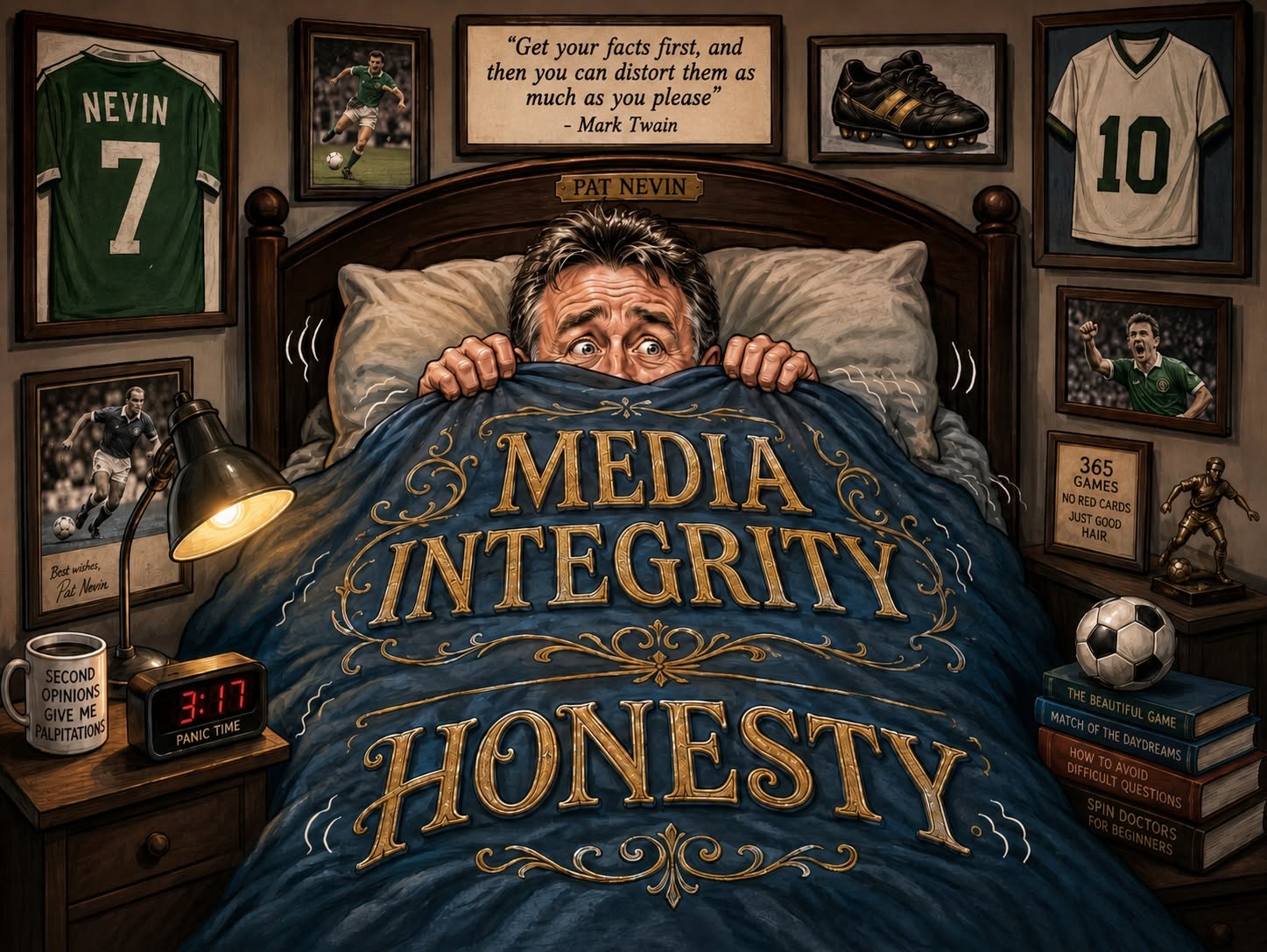
I have to say, there are moments in football when a person’s words make you stop, look at the screen and think: Seriously, man? Have you actually thought about what you are saying?
And this is one of those moments.
Pat Nevin, the former Scotland international, has now had it confirmed by the BBC’s Executive Complaints Unit that his comments during BBC Radio 5 Live’s coverage of Celtic’s 3-1 victory over Hearts in May fell below the BBC’s editorial standards of accuracy. The match, of course, was the one that secured another Premiership title for Celtic.
Nevin told listeners that he had seen “two or three” Celtic fans punch the Hearts captain during the pitch invasion. He described the scenes as “sickening” and “unacceptable”.
Now, let me be absolutely clear: if a footballer is physically attacked, that is unacceptable. Nobody should be assaulted at a football match. But that is precisely why accusations of violence must be made with care, accuracy and responsibility.
And according to the BBC’s own investigation, Nevin did not have the evidence to state what he stated. The ECU concluded that the scenes were chaotic, that the commentators were trying to describe events as they unfolded, and that Nevin subsequently acknowledged he should not have said definitively that the Hearts captain had been punched by Celtic fans.
The BBC accepted that it was an honest error made in the heat of the moment, but still concluded that it fell below its editorial standards of accuracy.
Well, there we have it. An accusation was made. It was broadcast to listeners. It was wrong. And the BBC has now said so.
But I am not going to pretend that the apology makes the whole thing disappear, because words matter. And when those words are spoken about Celtic supporters, I think we have every right to ask why the accusation was made so quickly, so confidently and with such inflammatory language.
Celtic had just won the league. Another league title. Another season as Champions of Scotland. Another occasion when the supporters wanted to celebrate with the players who had delivered it.
Yes, Celtic fans came onto the pitch. That happened. It was a chaotic scene. There is no need to pretend otherwise. But a pitch invasion is not, by definition, an assault. Celebration is not violence. Goading is not physical violence.
And an accusation of punching somebody is not a small detail that can be thrown into a live broadcast and corrected later as though nothing happened.
Nevin himself has now acknowledged that what he thought he saw was apparently a confrontation or perhaps goading from one of the hundreds of Celtic fans who had invaded the pitch. He said: “Goading is not physical violence.”
Exactly. So why was the original statement delivered as though it were established fact? Why was the language so strong? Why were Celtic supporters immediately placed in the position of being portrayed as a dangerous, disgusting mob when the evidence did not support that conclusion?
I am sorry, but I find that deeply frustrating, even alarming. I know that people were frustrated with how the season ended – everyone wanted the Hearts fairytale. But you don’t allow your disappointment to affect your professionalism.
And as an English teacher, I am particularly conscious of the difference between what someone thinks they saw and what they can responsibly claim happened.
“I thought I saw a punch” is one thing. “Two or three Celtic fans punched the Hearts captain” is another.
The first is an observation qualified by uncertainty. The second is a definitive accusation. Those are not the same sentence. They do not carry the same meaning, and they certainly do not carry the same consequences.
Let me say something else, because I do not want anyone to misunderstand me.
I am not saying Celtic supporters must never be criticised. I am not saying that every Celtic fan is perfect. I am not saying that if a Celtic supporter behaves badly, we should ignore it because they wear green and white.
But that is not what happened here.
What happened here was that a commentator made a serious allegation about Celtic fans, and the BBC subsequently accepted that he should not have stated it as fact.
And I think it matters even more because of the atmosphere surrounding Celtic supporters in the media and in Scottish football generally.
There is often a readiness to describe Celtic fans in the most poisonous terms, a readiness to turn a celebration into a threat and to treat a crowd of supporters as though they are automatically a problem waiting to happen.
That’s one of the justifications those pricks at Ibrox used to restrict the number of tickets we got for the last game. And I am bloody tired of it.
This is where my frustration becomes even stronger, because when I look at the way some incidents involving Celtic supporters are discussed, I cannot help asking: where is this same urgency when it comes to the Ibrox mob?
Where is the same determination to identify responsibility? Where is the same concern about violence, intimidation, bigotry and the atmosphere that can surround certain matches? If a Celtic supporter commits an offence, investigate it. If an Ibrox supporter commits an offence, investigate it. If a club’s supporters create a dangerous atmosphere, address it. If there is violence, condemn it.
But that never happens. Instead, when the Ibrox fans invaded the pitch in the Scottish Cup it was blamed on Celtic fans. Eah?
The media wants to make Celtic supporters carry the burden of every ugly incident simply because it is convenient, or because it fits some tired narrative about our club.
And do not accuse Celtic fans of something as serious as assault unless you are actually certain of what happened. That is not too much to ask.
Nevin has apologised publicly. He has addressed the matter in his BBC Sport column, and the ECU noted that he had already apologised on air on two occasions before addressing it in his newsletter.
I accept that an apology is better than refusing to acknowledge a mistake. And I accept that live commentary can be difficult. Things happen quickly. The commentator is trying to describe a chaotic scene. There is pressure to speak. There is no opportunity to investigate every detail before the next sentence.
But that is exactly why commentators must be careful with their language.
Because once an accusation is broadcast, it is out there. It can be repeated. It can be quoted. It can be used to reinforce a narrative. It can become part of the public perception of a group of people who may not have done what they were accused of doing.
And Celtic supporters deserve better than that.
We deserve commentators who understand that there is a difference between describing a chaotic celebration and declaring that Celtic fans have attacked somebody. We deserve journalists who know that accuracy is not an optional extra, and we deserve the same presumption of fairness that every other group of supporters should receive.
I am not going to pretend that I am happy about what Nevin said. I am not.
When I heard the accusation, I was furious, because Celtic fans had just won the league and, instead of the focus being on the celebration and the joy of another title, we were suddenly being presented with an allegation of violence.
And now the BBC has confirmed that the statement was not accurate. So yes, Pat Nevin, I have a strong opinion about that. Next time, if you want to put the blame on Celtic fans, or accuse them of something nasty, I suggest you bite your fucking tongue first.
Make sure you know what you saw. Make sure you know what you are saying. And if you do not know, then say that you do not know.
Because Celtic supporters are not a convenient target. We are not a mob to be described with whatever language happens to come to mind in the heat of the moment. We are supporters who love our club. We travel, we sing, we celebrate, we suffer, we stand together. We are part of the history and soul of Celtic Football Club.
And when our team wins the league, we should be allowed to celebrate without being automatically painted as dangerous or disgusting.
So, Pat Nevin, I will take your apology. But I will also remember the accusation. You behaved like a prick. And I will continue to ask the same question: why is it always so easy to blame Celtic?
Because if we are going to talk about football violence, then let us talk about it honestly. Let us talk about it accurately. Let us talk about it without double standards. Above all, let us stop treating Celtic supporters as though we are guilty until proven innocent.
We are Celtic. We are the Champions of Scotland.
And we deserve better than that.
Choose The CelticBlog as a ‘Preferred Source’ on Google News.





Celtic should be suing the BBC for slander, admitting the mistake does not absolve them from further action and we should be taking them to court in order to dissuade others from doing the same in the future.
We’re an easy target because our never speak up for us and everyone knows they can say and what they like with no fear of a challenge from our board who are cowards so it’s never going to change till they do
We’re an easy target because our board never speak up for us and everyone knows they can say and do what they like with no fear of a challenge from our board who are cowards so it’s never going to change till they do
Thank you, Pauline, for writing a piece without a ginger witch reference. Refreshing. (Seriously.)
Nevin’s supposed “apology” does not match with BBC’s statement that he’d made an “honest” error which breached the BBC’s standards on accuracy, by saying that he saw “two or three Celtic supporters attack Lawrence Shankland on the pitch, in sickening and unacceptable scenes.
His snidy effort at an apology was this:
“I made a mistake in a commentary at the end of the last game of the Scottish season.
“From my angle in the gantry I thought I saw a punch thrown, but it appears it was a confrontation or maybe just goading from one of the hundreds of Celtic fans who invaded the pitch just before the end of the game.
“Goading is not physical violence and I will take it on the chin, the way the Hearts player probably didn’t. My apologies to those offended.”
Those weasel words come nowhere near to addressing what he said live on air. He’s “apologising” for saying he thought he saw one punch when he said two or three, and he’s also saying Shankland “probably” wasn’t punched.
BBC should have demanded that the wee shite made a full retraction of his original comments, not those snidy words, undoubtedly writted with his obligatory smug wee smirk on his face.