
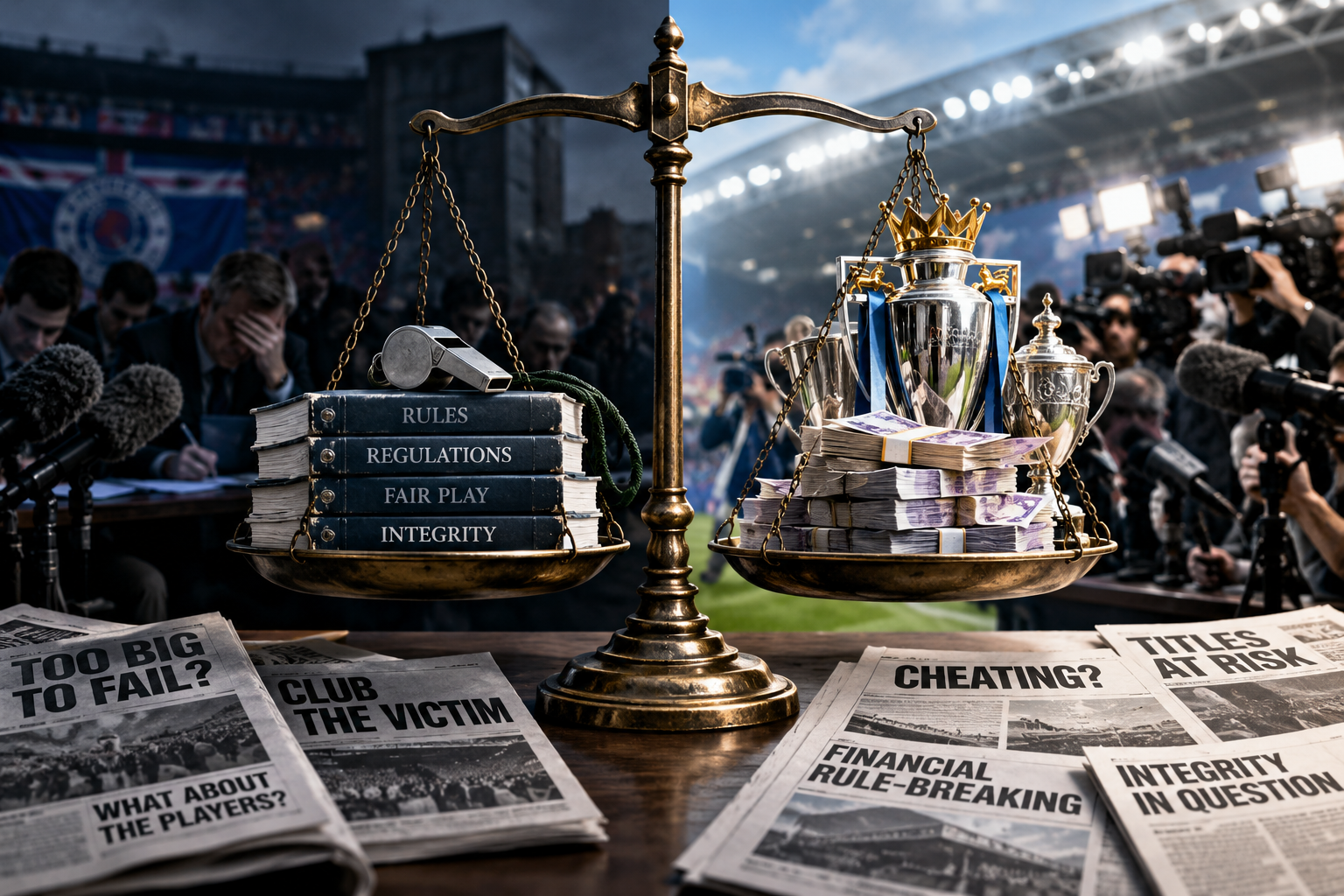
On Monday night’s podcast, we discussed the Manchester City situation, but only briefly, and only in the context of what should happen to them and why their case does not bear much relationship to the one involving our one-time rivals at Ibrox.
I already talked about the relegation question the other day, because that does not arise in the Rangers case in the way people continually pretend that it does. But there is, of course, a much bigger question here, and that is the punishment question.
This is where there really is no comparison between what happened at Ibrox and what is happening with Manchester City.
Because, as we all have said, there was no major football punishment worth the name imposed for what happened at Ibrox. There were standard clauses which kicked in because the club went into administration, and that involved a points deduction, but there was no serious sporting sanction for the years in which titles were won while the club was operating financial arrangements which ultimately collapsed under scrutiny.
The governing bodies in England are vastly stronger than the ones we have had to endure here, and far more committed to protecting the integrity of their competition.
What interests me is something simpler than that and, in a way, much darker. I want to talk about the media, because from the very beginning of the Ibrox EBT case, huge sections of the Scottish media wanted to frame the club itself as the victim.
When the seriousness of what had happened became impossible to ignore, we were then told that the club was too big to fail.
We were warned about what might happen to the rest of Scottish football if meaningful consequences followed, and then came the sympathy for the players.
They had won those titles on the pitch, we were told.
Well, Lance Armstrong won his on the bike.
Big deal. That is not a legitimate argument for what the institution behind those sporting achievements was doing.
If titles had been stripped and individual players felt aggrieved by that, then their grievance should have been with the club which created the circumstances in which those honours became vulnerable in the first place.
If a company commits fraud, loses contracts, loses awards, collapses and people lose their jobs, that is unfortunate for the people involved, but we do not normally blame society for the stigma. We blame the company which caused it.
And so it is here.
I am not particularly interested in relitigating the case against individual footballers. Nor am I interested in relitigating the entire case against Rangers.
If people want to believe every player involved was completely blameless, fine. If people want to convince themselves that Rangers somehow became the victim of a scheme created and operated within Rangers, so be it.
If they can square that circle in their own minds, they are better at doublethink than anyone Orwell ever created, including O’Brien.
What I want to talk about is the media, because when you look at how the English sporting press is covering Manchester City and compare it with how our press treated what happened at Ibrox, the difference could not be clearer if one was made of glass and the other of concrete.
Our media sought constantly to minimise the damage to Rangers. Sporting integrity was barely treated as a serious concept at all. At times it was almost used as an insult, as though the rest of us were naive children for believing that the rules of a sporting competition should actually mean something.
And we got that ludicrous argument over and over again.
It does not matter how the players were bought. It does not matter how they were paid. It does not matter that contractual information was not properly disclosed. All that matters is that they won their titles on the pitch.
It is bullshit. It has always been bullshit, and it is an argument without any meaningful moral foundation because the whole point of sporting regulations is to establish the circumstances in which the contest takes place.
You cannot separate what happens on the pitch from the mechanisms which allowed you to put that team on the pitch in the first place. Yet that was precisely what Scottish football was encouraged to do.
Lord Nimmo Smith’s commission concluded that Rangers had gained no unfair competitive advantage from the arrangements, and that conclusion was gleefully embraced by those who wanted the matter closed. For me, it remains one of the most extraordinary conclusions Scottish football has ever produced.
If financial arrangements allow you to recruit or retain players you otherwise might not have been able to afford, and if relevant contractual information is not properly disclosed to the authorities, what exactly are we supposed to call the resulting advantage?
Decorative? Accidental? Irrelevant?
Manchester City’s case is being discussed in completely different terms. The English media has no hesitation in asking whether financial rule-breaking distorted the competition, no hesitation in talking about cheating, no hesitation in discussing whether titles should be stripped and no hesitation in using words like sporting integrity.
Crucially, it understands the bigger point.
This is not just about one football club. It is about whether powerful institutions can do whatever they like while everyone else is expected to follow the rules. It is about what regulations are for if they can simply be ignored with impunity.
That is the bigger picture, and the English media gets it.
Whatever you think the eventual punishment should be, the argument is at least being conducted on the right battlefield. Was an unfair advantage gained? Were competitors disadvantaged? Were financial rules circumvented? If so, what punishment is necessary to preserve confidence in the competition?
Those are serious questions.
Compare that with Scotland and the questions our media asked; if Rangers was punished too severely, if the NewCo was not allowed right into the top flight, what would happen to the television deal? What would happen to Scottish football? What would happen to the players? What would happen to the supporters? What would happen if the club was not kept as high up the league structure as possible?
We heard warnings about disaster and predictions of financial catastrophe. There were even extraordinary claims about what might happen socially if the club disappeared.
Then it did disappear, and the world kept turning. Scottish football survived. The leagues continued. The television cameras remained. The rest of us somehow managed to carry on without civilisation collapsing.
But the framing throughout that period told you everything.
The concern was overwhelmingly about Rangers and very little of it was about everyone else. Very little of it was about the clubs which had competed against them, or the supporters who believed they were watching competitions governed by the same rules for everyone. Very little of it was about what happens to a sport when people stop trusting the structures which regulate it.
And that is what makes the City discussion so revealing.
Down south, journalists understand that this is about power. English football now contains some of the richest owners and investment groups in world sport, and that makes regulation more important, not less.
Because if the most powerful organisations can simply bend or ignore the rules, then what protection exists for everybody else? What are the rules for?
That is precisely the question Scottish football should have asked years ago.
Instead, we were encouraged to see consequences as persecution.
We were encouraged to see scrutiny as hostility. We were encouraged to think that sporting integrity was somehow less important than ensuring one particular institution survived in something resembling its previous form.
Even the governance around the investigation should have set alarm bells ringing.
Campbell Ogilvie had been a Rangers director during part of the period involved and had himself benefited from an EBT. When the issue came under scrutiny, he had to remove himself from aspects of the process because of the obvious conflict.
For me, that should have been the moment when the whole thing was taken completely out of the hands of Scottish football. It should have gone somewhere genuinely external.
Some of us said so at the time.
Instead, Scottish football found its own route through the mess, produced the verdict it wanted, and large parts of the media were delighted because the one outcome they never wanted was meaningful sporting punishment.
Let me be clear on something; I have never wanted Celtic handed titles. I’ve never wanted them. We should have been champions on Black Sunday and the memory of it will never leave me, and no retrospective awarding of it to us will ever change the memories I have of that day, all of them negative.
But that is not the same thing as believing that Rangers history should automatically have been allowed to retain them. Those are completely different arguments.
If an honour is invalidated, it does not have to be handed to somebody else. The record can simply show that the competition was compromised. That would have been enough for me. It would have been justice, and we’d all have moved on.
And there is another thing; other clubs might then have considered what financial losses they had suffered over those years, because that is a different thing from wanting titles. We are already hearing that discussion around Manchester City. That conversation never really happened here in the same way, and part of the reason is obvious.
There was eventually no old Rangers left to sue.
I have always believed Celtic should have been far more aggressive in protecting the interests of its own shareholders and supporters. There was a serious argument that Celtic had lost money because of failures in the way the competition had been regulated, and I would have wanted that argument tested properly.
Put people under oath. Obtain documents. Establish who knew what and when. That is how you find out what actually happened.
Instead, Lord Nimmo Smith effectively closed off the sporting argument, and the media accepted it with extraordinary enthusiasm. That is what still angers me.
The English press has people in it who disagree about what should ultimately happen to Manchester City. Good. That is what a serious media is supposed to do. But they understand that the integrity of the competition itself is the issue.
They understand that rules which cannot constrain the powerful are not really rules at all, and they understand that if a club gains an advantage by breaking regulations, then the question of sporting punishment cannot simply be waved away because the players still had to go onto the pitch and kick a ball.
Scottish football’s media never properly confronted that. Too much of it spent its time trying to protect Rangers from the consequences, and that is the real comparison here.
One media culture looked at a scandal and asked what it meant for the integrity of the competition. Too much of ours looked at the scandal and asked how much Rangers could be protected from it.
That is why what happened still stinks, and that is why watching the City story unfold is such a reminder of how disgracefully the whole thing was handled here … and how abysmally it is still being handled to this day.
Choose The CelticBlog as a ‘Preferred Source’ on Google News for quick access to the news you value.








Desmond, and his man at Celtic Park Lawell, by their silence were complicit in the cover up and lies, driven by the Scottish Media and Nimmo Smith, a complicit judge brought in to do the window dressing on behalf of the SFA hierarchy. Most Celtic supporters didn’t want the tainted trophies, but they did want Scottish Football to face up to the cheating, and the financial advantage Rangers FC got from this breach of SFA contract rules and the titles to be stripped from the record books of the original Rangers FC.
To add to the farce the new club are allowed to claim the old clubs trophies, including these tainted titles. The Late Turnbull Hutton and his Raith Rovers Board were the only people in Scottish Football who came out of this debacle with any integrity.
English Football is run Professionally by competent people, the SFA and most of Scottish Football still have the bowling club mentality.