
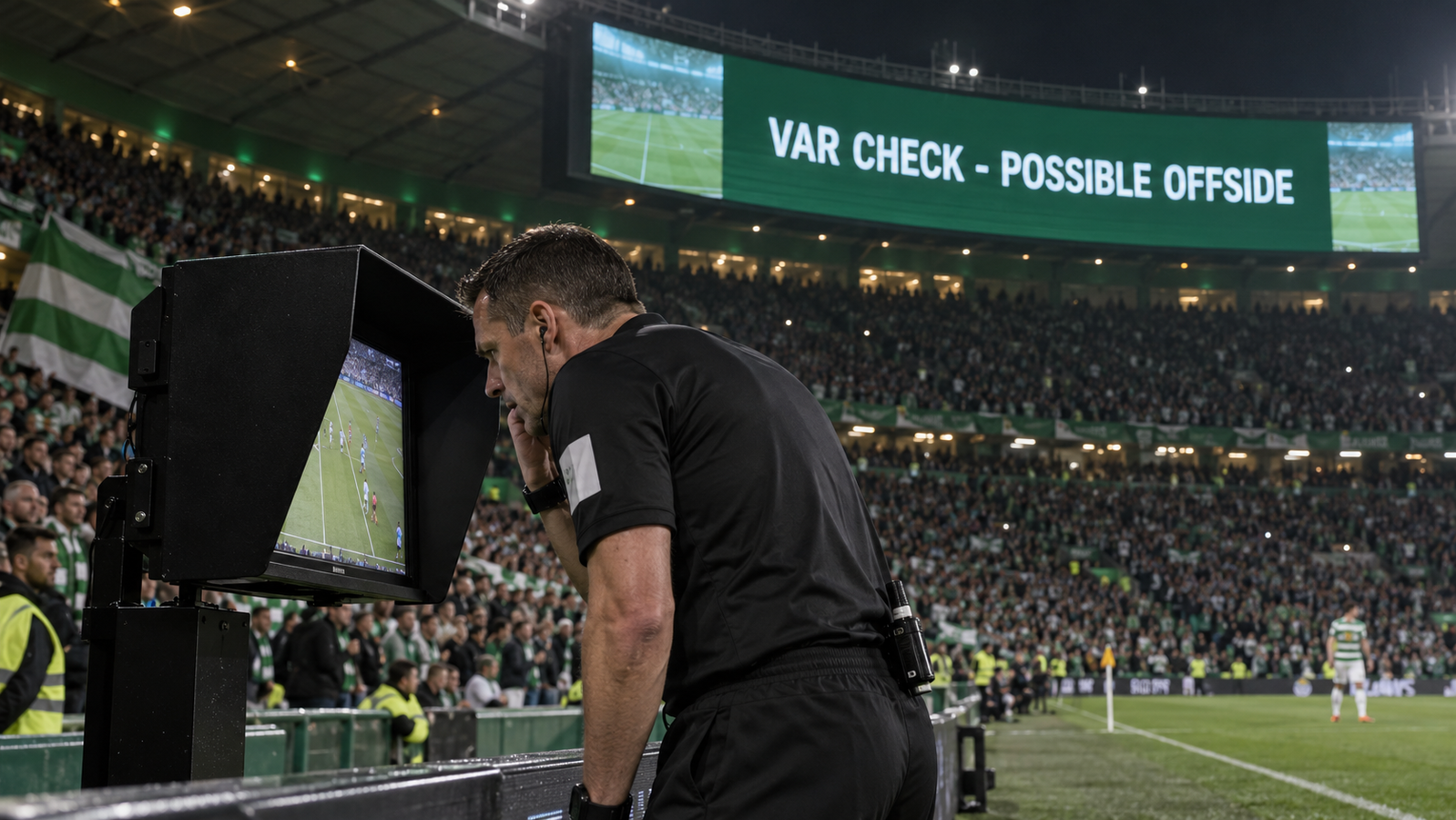
I have listened to the VAR audio from Shim Mheuka’s disallowed goal against St Mirren, and I have to say, the more I hear, the less convinced I am that this decision has been explained properly. In fact, I am beginning to wonder whether Scottish football’s refereeing authorities believe that if they repeat the same explanation often enough, Celtic supporters will eventually stop asking the rather obvious questions.
Well, this Celtic supporter is still asking them.
And as an English teacher, I have to say that the language used in this whole affair is doing very little to inspire confidence. “I think it’ll be offside.” “Looks like he’s offside.” “You can’t draw lines.” “We don’t guess.”
Excuse me, but what exactly are we doing here?
Because if I were marking a piece of work from one of my students, I would be asking them to make up their mind. Is it offside or is it not? Can you establish it or can you not? Have you got the evidence, or are you relying on an impression?
And if the answer is that you cannot establish it factually, then I am afraid that “it looks like” is not going to earn you an A.
Let us go back to the incident itself.
Celtic had already seen Camilo Duran denied by a tight offside decision in the same match, so supporters were hardly approaching the Mheuka incident with unlimited patience. Then Mheuka appeared to score, and the goal was awarded on the pitch.
That should have been the starting point: a goal given by the on-field officials.
VAR then became involved.
The audio tells us that the VAR official says, “I think it’ll be offside”, while Lee, looking at the available pictures, says: “So that looks like he’s offside from that.”
And then: “Although you can’t draw lines, that looks like it’s offside.” The goal was subsequently disallowed.
Now, I am not suggesting that every close offside decision must automatically favour Celtic. That would be ridiculous. Football has laws, and if a player is offside, the goal should not stand. Simple.
But the whole point of VAR is to help establish whether the original decision was correct. And when we are talking about an offside decision, the expectation is surely that the technology should allow officials to determine the position of the attacker in relation to the defender. Here, according to the explanation given by Collum, they could not establish it with the lines. And that is where my eyebrows begin to rise.
Speaking during the VAR Review programme, Collum insisted there had been no malfunction with the technology.
The Scottish FA describes the programme itself as an examination of VAR decisions using matchday audio and Collum’s explanation of how those decisions were reached.
He said: “They never malfunctioned. You know, you can still draw lines here, but if you attempt to draw lines on [unclear], you’ll be guessing. And what we said in the first clip, we don’t guess.” Well, that sounds very reassuring, does it not?
“We don’t guess.” Lovely. I am all for that. As an English teacher, I would put a gold star beside those words. But then I would listen to the audio again.
The VAR says, “I think it’ll be offside.”
Lee says the player “looks like” he is offside.
And Collum himself explains that the decision could not be treated as a factual offside overturn because the lines were not available to establish it.
So, forgive me, but I am struggling to understand how the process is supposed to sound anything other than subjective.
If you cannot draw the lines because doing so would involve guessing, then surely the next question is: what evidence do you actually have to overturn the goal?
Not what you think. Not what it looks like. Not what you feel might be the case. What do you actually have? Except for a guess?
Because those are rather different things.
Now, I know football is full of judgement calls. Referees have to make decisions in real time. They have to interpret challenges, assess handballs, judge whether a foul has occurred and decide whether an incident is worthy of a yellow card, a red card or nothing at all.
That is part of the game.
But offside is supposed to be one of those areas where VAR can provide something much closer to a factual answer. And if the technology cannot provide that answer, then the officials should be extremely careful about overturning the original decision.
Instead, we have a situation where the goal was given on the pitch, the VAR could not place the lines, Robertson believed Mheuka was offside from the available footage, and Lee then overturned the goal because it “looks like” the Celtic player was beyond the defender.
I am sorry, but that is not the sort of explanation I would accept from a student who had submitted an essay claiming to have proved something.
If a student wrote, “The evidence looks like it supports my argument,” I would ask them to go back and find the evidence. If they wrote, “I think this is the answer,” I would ask them to explain why. If they wrote, “It seems to me that this is correct,” I would ask them to provide something more substantial. And if they told me they could not establish the answer but had decided it anyway, I would be reaching for my red pen.
“Insufficient evidence to support the conclusion.”
That is the comment I would be writing.
Collum went on to explain why the referee was sent to the monitor: “But here, in their opinion, the Celtic player is offside. So, the referee is brought to the monitor, and it’s then up to him to make that decision, because it doesn’t become a factual overturn, because we don’t have the lines there to put them down and say this is factually offside.”
There it is. It does not become a factual overturn. The lines are not there to establish that it is factually offside. So, the referee is brought to the monitor to assess the footage and make the final decision. Based on all the missing evidence.
So what else is he doing but hazarding a guess?
Now, I understand the distinction Collum is trying to make.
He is saying that the VAR officials did not simply declare the goal factually offside. Instead, they advised the referee that, in their opinion, Mheuka appeared to be offside, and the referee then made the final call.
But that does not make the situation any less frustrating.
In fact, it makes it more frustrating.
Because if the goal was given on the pitch, and the available technology could not establish a factual offside position, then why was the original decision overturned on the basis of an appearance?
Why was “looks like” enough? Why was “I think it’ll be offside” enough? And why are Celtic supporters expected to accept that as a satisfactory explanation?
Then we come to the part that really makes me laugh. Well, laugh in the way one laughs when something is so ridiculous that the alternative is throwing a cushion at the television.
The SFA’s VAR Review programme.
The same authorities responsible for the system are the ones explaining the system. The same people responsible for refereeing standards are the ones telling us whether those standards have been met.
And, of course, the homework has been marked.
All the boxes are ticked. Everything is apparently in order.
A little confusion here, a little uncertainty there, a few “looks like” and “I think” moments, and somehow the final mark is still an A.
Well, I am sorry, but I am not buying it.
If I marked a student’s work that way, I would be hauled into a meeting.
“Paulina, you have given this essay an A, but the student has not actually established the argument.”
“Yes, I know.”
“They have not provided the evidence.”
“Yes, I know.”
“They have relied on what something looks like.”
“Yes, I know.”
“So why have you given them an A?”
And I would have to say, “Well, because they insisted they had done a good job.”
That is not how marking works.
You do not give yourself an A because you say you deserve one. You do not pass your own homework because you have written a report explaining why you think the homework was acceptable. You prove your work.
You demonstrate that the evidence supports the conclusion. And if the evidence is insufficient, you do not pretend otherwise.
Now, I have said it before and I will say it again: our version of VAR is shite.
But the bigger issue is not simply that VAR is shite. The bigger issue is that the people operating it must be held to a higher standard. Because VAR is not supposed to be a second referee’s personal impression machine. It is not supposed to be a magical box which turns “maybe” into “definitely”.
And it is certainly not supposed to be a system where a goal can be overturned because someone looks at a picture and says, “Well, that looks offside.”
If the technology cannot establish the position, then the officials need to be honest about that. And if the original decision cannot be established as wrong, then the threshold for overturning it should be exceptionally high.
Otherwise, what is the point? Why have the technology at all?
Why not simply have another referee sitting in a room saying, “I think that looks like a foul”, or “I think that looks like a handball”, or “I think that looks offside”?
Because that is not what supporters were promised.
We were promised clarity. We were promised consistency. We were promised that errors would be corrected when the evidence was clear.
Instead, we are being asked to accept a decision which even the explanation itself admits was not a factual offside overturn. And that is not good enough.
So, what is my verdict?
As a Celtic supporter, I am furious. We had a goal given, then taken away in circumstances where the normal offside-line process could not establish the factual position. We had another tight offside decision involving Duran in the same match. And now we are being told that the officials did not guess, even though the language used in the audio sounds very much like subjective judgement.
As an English teacher, I would say the explanation is muddled, the evidence is insufficiently demonstrated and the conclusion is not properly supported.
The SFA’s marking, however? Apparently, everything is fine. Apparently, the homework has passed. Apparently, we should all go home and stop asking questions.
Well, I am afraid I am not going to do that.
My final mark: 3/10. And that is being generous.
The SFA can keep its straight-A homework. I would rather see them do the actual work properly. Because Celtic supporters deserve better than “looks like”, “maybe” and “I think it’ll be offside”. We deserve officials who know the difference between an opinion and a fact, and if they cannot establish the fact, then perhaps they should stop pretending that their opinions can pass for the same thing.
Choose The CelticBlog as a ‘Preferred Source’ on Google News for quick access to the news you value.










As per usual, the nodding donkeys in our boardroom will lap up all of Collum’s bullshit and challenge none of his distorted and contrived conclusions. What a waste of fkn time they are, cardboard cut outs would be more effective.
If you look at the TV pictures, the guy with the perfect view was the assistant ref with the flag that he did not raise, because he was sure it was onside. Without VAR not being able to decide that the onfield decision was wrong, why on earth did it not stand . Collum twisting the English language trying to make sense of a balls up by the VAR officials, who then talked the inexperiencd referee into disallowing the goal. It was farcical.