
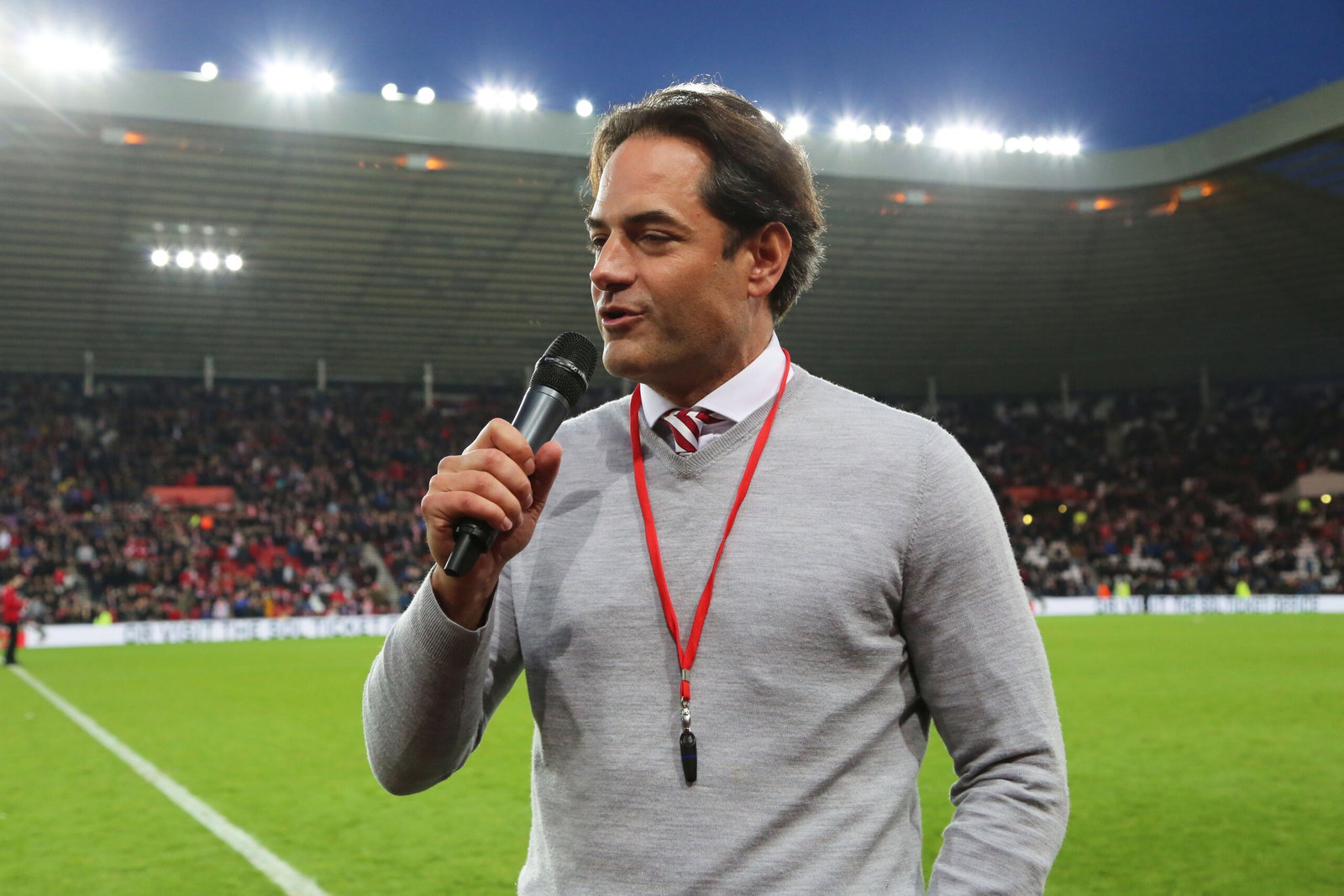
SUNDERLAND, ENGLAND - DECEMBER 26: Sunderland director Charlie Methven thanks the crowd for their support during the Sky Bet League One match between Sunderland and Bradford City at Stadium of Light on December 26, 2018 in Sunderland, United Kingdom. (Photo by Ian Horrocks/Sunderland AFC via Getty Images)
A couple of days ago Russell Boyce of The Bhoycie Bus wrote the first article he has ever published on this site, and it was about the interview Charlie Methven gave on the Business of Sport podcast the other day about the Celtic board.
I am going to talk a little later about Sunderland ’Til I Die in a completely different context, but for the moment I will say this: any Celtic fan who dismisses Charlie Methven on the grounds that he ran Sunderland into the ground did not pay attention in class.
Methven arrived at Sunderland as part of Stewart Donald’s takeover in 2018, and those guys walked into a club which was already a basket case.
Sunderland had just suffered consecutive relegations from the Premier League to League One, the previous ownership had been carrying enormous debts and the whole operation was haemorrhaging money.
Ellis Short wrote off the historic debt as part of the £40 million takeover, but the business Donald and Methven inherited still required drastic restructuring. Sunderland subsequently cut its wage bill from £46.8 million to £26.7 million in their first season.
Methven has since described the club they encountered as having been around £180 million in debt before the takeover and losing roughly £27 million annually on an operating basis. Whatever anyone thinks of his personality, there is no serious argument that Sunderland was some healthy, efficiently run football club which these guys wandered into and wrecked.
It was already in a catastrophic position.
People said to me when Sunderland ’Til I Die aired, “How would you like him for your boss?”
I told them then what I will tell you now: I would have liked him just fine as a boss because I work hard and I am willing to listen when people propose new ideas and new ways of doing things.
If something makes sense, it makes sense to me.
If something is going to change how things work and make them better, I will sign up for it.
What Methven encountered at Sunderland was an entrenched culture in which responsibility had become blurred and the old answer to every problem had effectively been to rely on Ellis Short’s money.
In the documentary, you could see immediately why that approach drove him up the wall.
He was trying to break habits which had developed inside a football club where failure could continually be cushioned by somebody else writing the cheque.
Yeah, I thought he came across as a bit of a prick at times.
But how do people think these things get done?
If you walk into a failing business and your job is to save it, how exactly do people imagine that process works? By asking everyone nicely if they would mind changing the habits which helped create the failure? Especially when some of those people are entrenched in those habits, do not want the boat rocked and are perfectly comfortable collecting their wages while the organisation around them underperforms?
A guy in Methven’s position is always going to have to kick some backsides.
Stewart Donald was naturally the softer public face.
Methven was the guy who went into rooms and told people how it was and how it was going to have to be. He was not there to make friends. He was there to help turn a loss-making business into one which could eventually attract stronger investment and become sustainable.
They did not create Sunderland’s mess, but they certainly worked hard to clean up large parts of it.
Methven in particular had to do some of the dirty work, facing staff who did not want change and telling them that change was coming anyway.
A guy who has worked at that sharp end learns things. He knows what dysfunction looks like, what waste looks like and what happens when an organisation is operating on the wrong wavelength.
People like that can make decisions quickly, aggressively and unsympathetically, and sometimes that is exactly what is required. They are not people to underestimate simply because they are abrasive.
If we had somebody like that operating at Celtic Park right now, I do not think this club would be in the state it is in.
I am not saying Methven and Donald got every decision at Sunderland right. Nobody gets every decision right, and there were genuine controversies around their ownership, including the use of parachute-payment money in financing the takeover.
Sunderland’s own accounts later showed a £10.58 million pre-tax loss for 2018/19, although without a £20.5 million exceptional impairment connected to that takeover structure they would have shown a £9 million profit.
But their essential job was to trim the fat, work out what was worth salvaging and put the football club into a healthier condition for the next phase. They substantially reduced costs, inherited a club which had suffered two consecutive relegations and eventually left behind an operation which was attractive enough for Kyril Louis-Dreyfus to take control of in 2021.
That is why, when Methven talks about football business, he is not talking as some outsider who has never been in the building. He has been inside one of the biggest institutional messes in English football, seen the waste, seen the neglect, seen the missed opportunities and had to participate in fixing real structural problems.
He is also not naturally sentimental about supporters.
If you watched Sunderland ’Til I Die, you saw him sit in rooms full of fans and tell them hard truths. You saw him effectively say: I know this is how you want it done, but this is how we are going to do it.
He could be dismissive of criticism of the speed they were working at or the manner in which they approached things because he believed the people putting the money in had the right to expect some recognition of reality.
That point matters because he has often regarded supporters at football clubs as spoiled when they demand ever-increasing spending from somebody else’s pocket without recognising that there has to be a sustainable basis underneath it.
And do you know what?
That is precisely the attitude we on this side of the city have laughed at for years when we see it from supporters across the city.
Their club can run a summer net spend in excess of £20 million and approaching £30 million, funded overwhelmingly by shareholder investment, and large sections of their support will still complain that it is not enough. The answer is always the same: spend more.
More of somebody else’s money.
Their sense of entitlement seems limitless.
Methven knows exactly what that sounds like because that is the type of culture he encountered when he arrived at Sunderland. Whenever a problem had appeared there historically, the solution was essentially to call Ellis Short and ask him to cover it.
At Ibrox, the names have changed over the years. Dave King. Various directors. Wealthy supporters. New investors. Now it is the American ownership and the money behind the Delaware-registered structure. But the mentality remains familiar: somebody else should spend more because the support has decided it is entitled to more.
Methven knows what ungrateful supporters sound like.
What was striking about his Celtic comments was that he went out of his way to say that this is not what Celtic supporters are doing. His point was precisely the opposite. Celtic fans built this financial strength.
Celtic fans fund the institution. Everything sitting in those accounts ultimately comes from the economic power created by the support, whether through tickets, merchandise, television audiences, sponsorship value or the commercial ecosystem surrounding the club.
Celtic does not operate because some billionaire owner continually covers the losses.
That is the distinction.
For perhaps the first time in a long time, Methven finds himself looking at the argument from the supporters’ side because he knows what a dysfunctional football business looks like from the inside, and even from outside he can recognise elements of that dysfunction at Celtic. If somebody asked him tonight what he thought of the way this transfer window has ended, I suspect he would be even more incredulous.
The bulk of our important business is being completed after the Champions League exit. The calibre and type of targets we are now considering have been influenced by a failure Celtic helped create for itself.
As I wrote earlier, I may ultimately be very satisfied with the transfer business if the remaining deals are completed, but everything about the timing has been shambolic.
The schedule has been a disaster.
It ended in that calamitous night in Linz which sent Celtic crashing out of the Champions League. Too much has been done too late, and virtually every warning supporters were shouting throughout the summer was vindicated.
If Methven was asked to assess the process when the window finally closes, I suspect his criticism would be even more brutal than what we heard on the podcast.
Russell’s argument was that people should listen to what Methven actually said instead of attacking the man saying it. Play the ball rather than the man. That was fair and it was the correct argument to make.
But I actually think it’s a self-destructive strategy anyway. They want to argue that he is not worth listening to at all, that his arguments have no validity because his time at Sunderland supposedly proves he is incompetent.
My question is simple: where the hell are they getting that from?
Did they even watch the show properly?
Because it seems that they saw a different version of it than I did.
The attempt to play the man is particularly stupid in this case because the man is more substantial than many of his critics would like people to believe.
He is certainly smarter and more experienced in this specific field than plenty of people dismissing him, and that includes people sitting in the Celtic boardroom who may think this is some insignificant pinprick from somebody whose opinion can simply be ignored.
People in football know better than that.
People who have operated at senior levels understand what Methven and Donald were trying to do at Sunderland. They know how difficult it is to alter an entrenched organisational culture built around complacency, overspending and resistance to change while simultaneously turning around a business which has been haemorrhaging money.
That is like trying to turn a supertanker. It is difficult even when you know how.
For the average supporter looking in from outside, it is almost impossible to comprehend how much work sits behind it.
He and Donald inherited a club which had crashed two divisions in two seasons.
They cut enormous amounts from the wage bill, stabilised important parts of the operation and helped move Sunderland away from a model which had depended on one owner absorbing staggering losses. That work formed part of the platform on which the next ownership eventually built. Anyone who watched the documentary also knows why Methven rubbed people the wrong way.
Even his own staff sometimes looked exhausted by him. His personal assistant openly talked about encouraging him to moderate the way he spoke to people because his delivery could get in the way of the message.
I completely understand why some people disliked him.
But I could also see what he was trying to do and the circumstances in which he was trying to do it. Sunderland could not afford endless delay. Every pound unnecessarily lost mattered, and when an organisation is bleeding cash and you have been brought in specifically to stop it, there are moments when you simply do not have time to enter every room and worry about whether everybody likes your bedside manner.
Since everyone knows I love my little pop-culture references, think of Methven as Mr Wolf in Pulp Fiction.
Vincent Vega objects to being ordered around and suggests that a “please” would be nice. The Wolf’s basic response is that he is the guy trying to get them out of the shit, and perhaps this is not the moment to worry about politeness.
Then, because Vincent insists, comes the great line: “Pretty please, with sugar on top, clean the fucking car.”
That is Charlie Methven.
You might not enjoy being spoken to that way.
You might think he is an arsehole.
But if your car is covered in blood and when time is a factor in you cleaning up the mess with the homeowner’s wife potentially coming up the road, perhaps the more important question is whether the guy knows how to solve the problem.
That is the difficulty for the board apologists and for anybody inside Celtic who would like to dismiss Methven’s intervention as inconsequential.
They do not merely have to deal with the substance of what he said, which is damaging enough on its own. They also have to deal with the fact that it comes from a man who has been inside football organisations, dealt directly with the financial and cultural consequences of failure and understands what structural dysfunction looks like.
That is why his condemnation of Celtic hits like a sledgehammer. If Methven really was what some people want to portray him as, some nobody who wandered into Sunderland and destroyed the football club, nobody would care what he thought.
His opinion would be easy to laugh off.
There are plenty of people whose lectures on football governance deserve precisely that response. If Simon Jordan or David Murray decided tomorrow to give Celtic a seminar on sustainable football finance, we would laugh, and rightly so.
The reason people are not laughing at Methven is because they know this is someone whose voice carries weight in football business circles, whose opinion is worth listening to and whose experience means that when he looks at an organisation and says, “You are shit at this,” other people pay attention.
They start looking for themselves. They start asking whether he is right.
That is why I think his intervention is one of the most fundamentally satisfying and positive contributions anybody from outside Celtic has made to this debate. That is why it was so welcome, and why hearing somebody with that background understand the supporters’ position was so damned good.
Because these words came from a man who knows.
And that is exactly why some people do not like them.
Choose The CelticBlog as a ‘Preferred Source’ on Google News for quick access to the news you value.









The biggest threat to the club is the possibility that we will drown in a sea of potential / possibilities that we did not take.
It is not the fact that we have £70mill in the bank.
It is not the conjecture that we could have £700mill in the bank if we had been a well run club.
It is the fact that we stagnate in a fast moving world where football becomes the largest entertainment business ecosystem on the planet and we become irrelevant to the point that we become the Preston North End / Queens Park of the CL generation.
The Irish Raj was only ever interested in the EPL.
PL was only every interested in his bonus and his position.
Using Govan FC to make sure he put in a little effort as possible.
The Bronskis in the support only want to be one step ahead of Govan FC.
So we all to easily have become an analogue club in a world rapidly going digital.
And how far has the rot spread — start a conversation on a new main stand to see the power of the lazy / do nothing / more of the same dinosaur vibe.
Wee Fergus saved us on a number of levels.
The support need to save themselves from a lifetime of exploitation.
This season the Irish Raj will take money out of the club because the support have put in £60mill to £70mill directly.
That was the situation last year and it will be the situation next year.
The Irish Raj has been phoning it in for 20 years and it has to stop.
We have huge opportunities all around us.
Just a case we need to look beyond bonuses and start building for the future.
Strange place to start but this year’s Reading Festival offers hope.
Business Techno-babble — we need to become a networked organisation.
Even the Irish Raj would get a warm feeling about getting Stalybridge / Cwmbran / Cleator Moor / Harrow into the Championship. Then comes Canada and potentially South Canada when they manage to get rid of Donny John and accept Carney’s terms of surrender.
We need to play more football and we need to expand.
If we don’t then we will become a footballing antique.
The more that people like him tell some ” unwelcome” home truths…the better…I refer to Sevco as a basket case ( which they are)…but based on this window…we, for different reasons, are as well…This window is many things, and many words could be used to describe it…..but embarassment should be at the top of the list…Absolute horror show.