
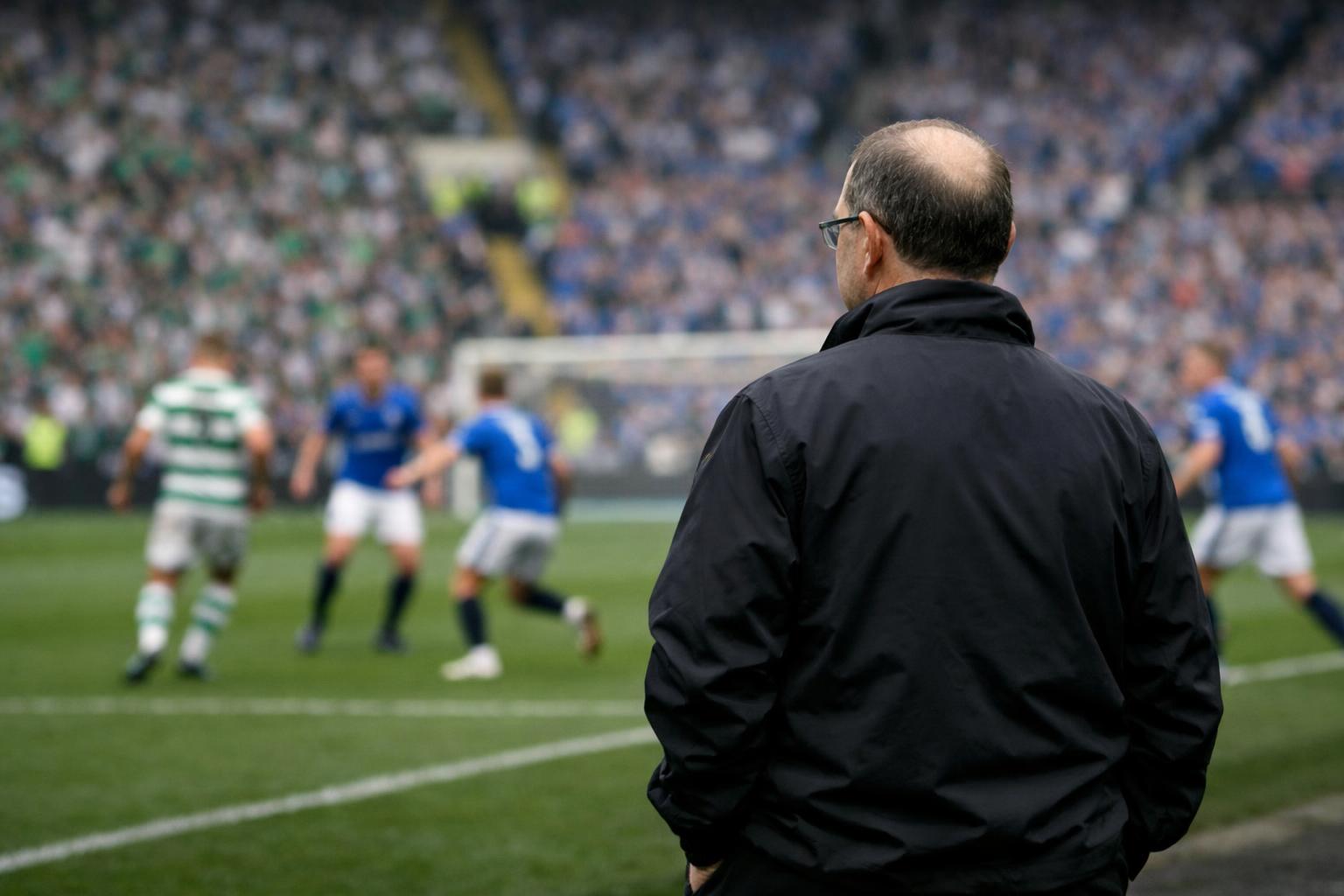
This is serious stuff today. The Celtic coaching team needs to win this.
Martin O’Neill has created his own measuring stick at Celtic this season.
Not me, not the supporters, not the media.
Martin did.
Before the season began, he spoke about changing aspects of how Celtic played. He wanted greater purpose in possession, more speed and an ability to adapt rather than simply being married to the same system regardless of the opposition.
His words at the end of June were pretty clear:
“When we have possession of the ball, it’s great to keep it and absolutely right, but I’d like us to keep it for a purpose.”
O’Neill also spoke about wanting Celtic to play “very quickly” and “with a dash”, while believing he could marry that approach with the possession-based football already ingrained in the squad.
Then, after the arrival of Kasper Høgh, he went even further.
Discussing the possibility of accommodating Høgh and Duran together, O’Neill acknowledged Celtic’s longstanding reliance on 4-3-3 before saying:
“We should be able to adapt during the course of the game.”
Read that quote again with yesterday in mind…
He even referenced his first spell at Celtic, when his side switched between 3-5-2 and 4-4-2 as opponents began figuring them out.
Brilliant.
I completely agree.
There’s just one problem.
Where is it?
Because what I watched at Ibrox at the weekend looked painfully familiar.
Same formation, same painfully patient build-up, same horseshoe football and the same predictability.
Worse still, we now appear willing to put square pegs into round holes simply to preserve a formation Celtic have been using for years.
That’s not adaptation.
That’s the exact opposite of it.
Celtic are becoming painfully predictable
This was one of the strongest points from our Bhoycie Bus discussion after the game.
Celtic have essentially been operating with the same 4-3-3 framework for years. The personnel changes, the manager changes and occasionally the instructions change slightly.
Yet everybody watching knows roughly what shape Celtic will appear in.
If we know, opposition managers certainly know.
That brings me to Derek McInnes.
Whatever anyone thinks of McInnes, he’s been around Scottish football long enough to recognise what was sitting in front of him.
The Ibrox side changed.
Celtic didn’t.
McInnes went with a different structure and, most importantly, had the courage of his convictions to do it. Celtic walked into Ibrox with something which could practically have been printed on the team sheet three days earlier.
Our own discussion summed it up perfectly: an opponent doesn’t need to be a tactical genius when Celtic make the examination paper available beforehand.
As Eric pointed out on the show, McInnes has been managing in Scotland for nearly two decades. He’s seen enough Celtic sides and enough opponents attempt to exploit this shape to understand where the opportunities were.
Credit where it’s due. He changed his own formation and went after it.
This is not a great team though that has exposed Celtic here, let’s have it right.
That should really bother Martin.
The other manager adapted.
The manager who told us Celtic would adapt didn’t.
What happened to playing with a dash?
Go back to Martin’s pre-season comments.
Purpose, speed, adapting.
Those words excited me because they sounded like exactly what Celtic needed.
Instead, we’ve fallen back into that familiar horseshoe.
Centre-half to full-back.
Back inside.
Across the pitch.
Recycle it.
Wait.
Try again.
There’s absolutely nothing wrong with possession football. Martin himself made that distinction. Keep the ball, absolutely — but keep it for a purpose.
That’s where we’re losing our way.
Possession cannot become the achievement itself.
I’d rather Celtic lose the ball occasionally trying something brave than have three players collect lovely passing statistics while the opposition stands exactly where it wants to stand.
Where’s the unpredictability?
More importantly, where is the adaptation Martin himself told us was possible?
Square pegs in round holes is another concern of mine.
The selection at Ibrox made the tactical rigidity even harder to understand.
If Martin insists upon playing 4-3-3, then at least pick players suited to the positions within it.
Duran shouldn’t be pushed out wide simply because Høgh has returned and needs accommodated centrally.
If Hassan is your natural option on the right, play him there. If circumstances mean James Forrest is the best available option on the other side, use him.
What doesn’t make sense is weakening one position to accommodate another player while simultaneously retaining a formation which supposedly isn’t immovable.
As we said on the Bus: if you’re going to play 4-3-3, put the players who can play 4-3-3 in the positions they need to be in.
That isn’t revolutionary tactical analysis.
It’s common sense.
Particularly when Martin has already spoken about the ability to adapt during matches.
So do it.
This doesn’t suddenly mean I want Martin O’Neill gone
This is where nuance disappears very quickly after a derby defeat.
I’ve already seen people rewriting history and pretending they never wanted Martin appointed.
I’m not doing that.
The alternative was Robbie Keane, it’s that simple. Never in a million years was that going to be a good move, hence the relief Martin got the gig.
What Martin achieved last season also earned him enormous goodwill.
None of that means he gets a free pass.
I want to be pretty balanced on this. There are legitimate questions to be asked of him now, but screaming for another managerial change in September after a bad result is knee-jerk stuff.
The board have unquestionably dealt Martin a difficult hand.
Recruitment wasn’t completed when it should have been. Major targets didn’t arrive. Celtic threw away a four-goal Champions League advantage before the summer business was completed.
I’ve spent enough time writing about those failures.
But two things can be true.
The board can have failed Martin O’Neill while Martin O’Neill can also be getting things woefully wrong too.
Team selection is his responsibility.
Formation is his responsibility.
Substitutions are his responsibility.
Getting performances from the squad available to him is his responsibility.
At Ibrox, Celtic were second best tactically and physically. Celtic lost battles, looked lightweight and fielded a predictable team which the Ibrox side were able to counter.
Martin has to own his share of that.
Don’t go out regretting what you never tried
This, for me, is the biggest point.
If Martin O’Neill is going to continue as Celtic manager, I desperately want him to do it his way.
Forget protecting somebody else’s philosophy or what Celtic have traditionally done over the previous five or six years.
Who cares whether Shaun Maloney prefers one system, another coach prefers something else, or certain players are more familiar with 4-3-3.
Martin is the manager.
He told us Celtic could adapt and that he wanted possession with purpose.
It was Martin who talked about marrying modern possession football with the quicker, more aggressive football associated with his own successful teams.
I want to see it now though.
Because the worst possible ending to this would be Martin eventually leaving Celtic having stubbornly continued with a style he didn’t even truly believe in.
Is he being persuaded to retain 4-3-3, or is he unsure how to implement the changes he talked about?
Either possibility worries me.
Martin set this KPI himself.
He promised a change in style.
So far, we haven’t seen enough of it.
The next meeting with the Ibrox side is his opportunity
Thankfully, football gives you another chance very quickly.
The Ibrox side arrive at Celtic Park next weekend knowing what worked against us.
If Celtic line up in exactly the same way, with exactly the same ideas and exactly the same predictable patterns, why wouldn’t McInnes try exactly the same thing again?
Martin needs to give him something different to think about.
Maybe that’s two strikers, or a more physical element in midfield.
Perhaps it’s still technically a 4-3-3 but with dramatically different personnel, positioning and aggression.
I don’t particularly care what numbers somebody writes on a tactics board.
I care about seeing the change Martin promised.
Celtic are at a potential turning point. The weekend was an opportunity for McInnes to generate momentum and he took it. Next weekend gives O’Neill exactly the same opportunity in reverse.
There’s still time to alter the direction of this season.
Nobody needs to panic in September.
But nobody should pretend everything is fine either.
Martin O’Neill has enough experience, intelligence and credit in the bank to recognise when something isn’t working.
More importantly, he already told us he recognised the need for change.
That’s why those summer comments matter now.
Celtic were supposed to become quicker, more purposeful and more adaptable.
Instead, we’re looking increasingly like the Celtic we’ve watched for years: predictable, patient and far too easily read by opponents who know exactly what’s coming.
Martin doesn’t need to prove anything about his history at Celtic.
That’s secure forever.
It is also irrelevant when it comes to the here and now.
What he needs to prove now is that the manager who talked about adaptation in the summer still believes in those words when the pressure arrives.
Change it, Martin.
Put your own stamp on this team.
And if eventually it doesn’t work, at least go out on your shield knowing you actually tried to build the Celtic you told us you wanted.
Because keeping everything the same and failing anyway?
That’s the one outcome he really would regret.






Ah still have faith in MON as manager for this season and the players need tae do their part as well. And ah believe he means it, when he said after the game, he now needs tae look more at his own decisions, regarding tactics and the team. Some people doubted the wisdom of Martin takin another season. Tho imo, if more money had been spent on quality and he had been given the correct tools in key positions, we wouldn’t be in this situation.
Good article Bhoycie & comment Kev.
We all still love MON, and of course it’s too early to be shouting for his head…he deserves our utmost respect for pulling off the unexpected in last year’s turbulent, anxious filled season.
However, I disagree with anyone that believe he’s exempt from criticism and that yesterday’s result is all on the board.
I’ve made my feelings very clear on the lazy, greedy charlatans that run our club in their continued clueless fashion.
However, regardless of the continued mess they make of our club, MON decided to come back and we have to support him.
He should not have been put in that position or asked, but again his appointment was another example of a board that has no ambition or professionalism and you couldn’t mark their necks with a blowtorch!!!!
MON has enough options in our squad to get the balance, formation and tactics correct for every game.
If every fan can see it, then obviously he can too. Although there should always be a Plan B or C, and it certainly should’ve been in place before, but DEFINITELY after the LASK debacle …I’m sure he will be hurting after Sunday and the requisite changes to personnel, shape and tactics will be formulating in his head, as we speak.
Although we all have our own thoughts and opinions on our favoured shape and team, we have to keep our faith in MON to help us bounce back, and quickly.
Failure to do so, will only heap more criticism on him, his coaches and players, and it will become even harder to defend him! HH