
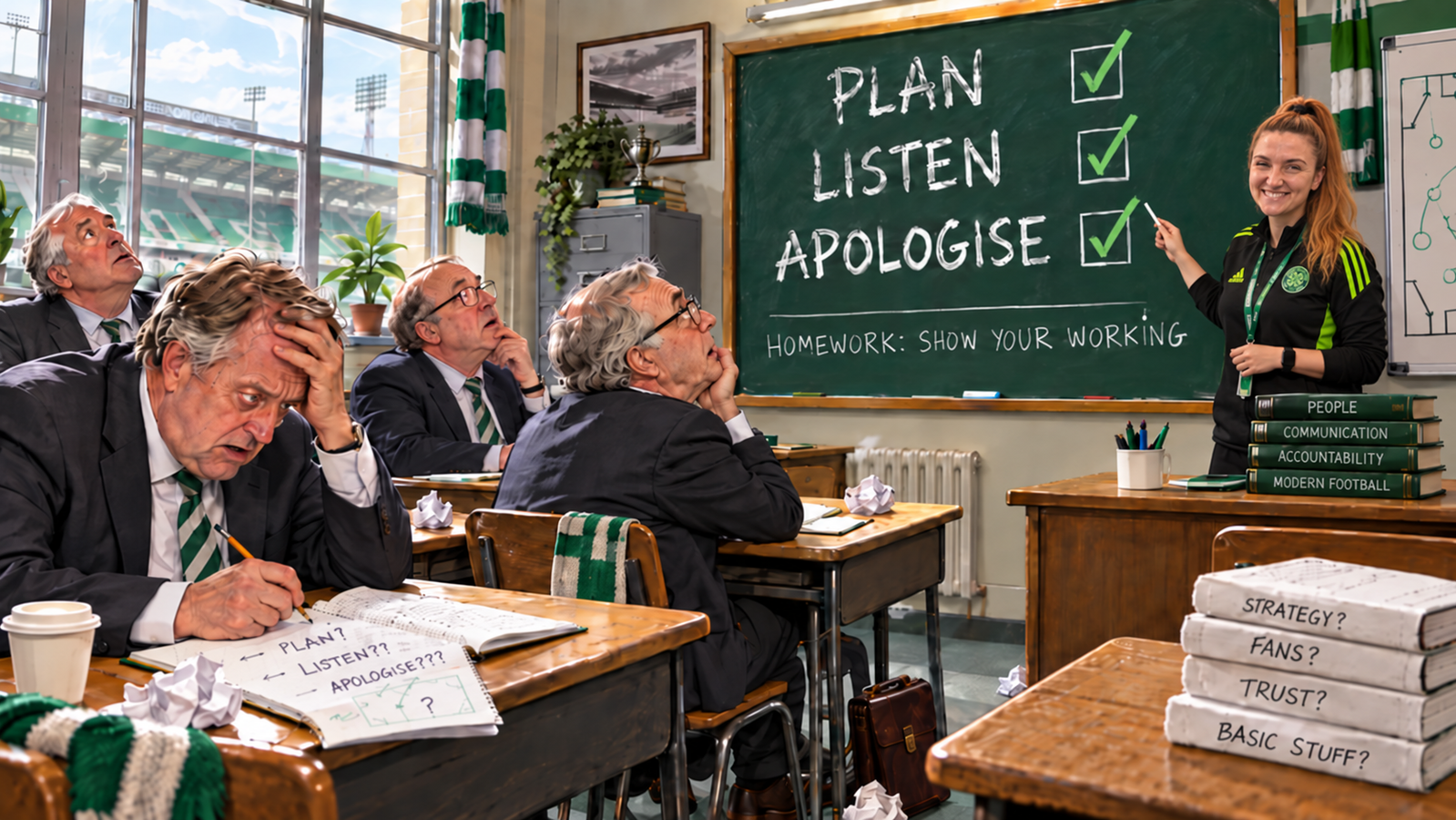
Earlier on, I had a proper look at the three motions being put forward for Celtic’s AGM, and honestly, I am struggling to decide whether to laugh, cry or simply stare at the screen wondering how any of this has become controversial.
I wanted to talk more about this because it just seems so obvious to me that all of these motions should pass, and in a better environment would pass.
Because the demands are not extraordinary. Celtic should have a plan. Supporters should be listened to. And when something goes badly wrong, somebody might occasionally say sorry.
I know. Hardly radical stuff.
But in my earlier piece, I concluded that these would not pass. Rather than just leave it like that, I want to talk about why that seems ridiculous.
I mean let’s take it to its conclusion. Next week perhaps somebody will propose that the football team should practise before matches; will everyone at Celtic Park will have to call an emergency meeting to discuss that?
The thing I find fascinating about these motions is not that they are extreme. It is precisely the opposite. They are so boringly reasonable that in almost any other organisation they would barely cause an argument.
The first motion asks Celtic PLC to prepare and publish a three-to-five-year strategic plan designed to improve the club both as a business and as a football team.
Now stop everything. Shock!
Somebody has suggested Celtic should actually have a plan. A proper one. Not “we hope the manager gets it right”, not “we will see what happens in the transfer window”, and not “we remain committed to delivering success”.
An actual plan, covering several years, which supporters can read and eventually use to judge whether the people running Celtic have achieved what they said they would achieve.
Good grief.
Whatever happened to simply waking up in August, signing a collection of players, crossing your fingers during the European qualifiers and then explaining afterwards that nobody could possibly have predicted how things turned out?
I am being sarcastic, obviously, but only because screaming is bad for my throat.
A football club the size of Celtic having a strategic plan should be about as controversial as having a fire exit. Businesses have strategic plans. Sporting organisations have strategic plans. Plenty of football clubs publish them. Yet somehow at Celtic this appears to require an AGM resolution.
Even better, practically the same idea was rejected last year.
Perhaps the document has been stuck in the printer ever since. Perhaps somebody forgot the password. Perhaps the Board has spent twelve months debating whether three-to-five years means calendar years or Celtic transfer windows.
I have another theory.
A published strategy creates something terribly inconvenient called accountability. If you tell supporters where you intend Celtic to be in three years, somebody might return in three years and ask whether you got there.
Ghastly.
They might even say: “You told us this was the plan. Why are we doing something completely different?”
Imagine the horror.
The second motion is equally outrageous. It asks for a review of the Security Department carried out in cooperation with elected fan representatives, with supporter safety and wellbeing prioritised.
Supporters should be safe. Supporters should have representatives. Those representatives should be listened to.
What next? A suggestion box?
Perhaps they could install one outside Celtic Park, although I suspect it might mysteriously disappear after somebody puts “listen to the supporters” inside it.
The interesting phrase is “elected fan representatives”, because that immediately raises the question of who Celtic actually considers representative.
The Fans Collective have genuine representative structures behind them, and that makes them considerably more awkward than people who simply happen to be convenient for the club to talk to.
There is a wonderful version of “consultation” which organisations sometimes practise: “We absolutely believe in listening to you. We have listened very carefully. Thank you for your contribution. We will now do exactly what we were planning to do before you arrived.”
Magnificent.
That is not consultation. That is theatre with tea and biscuits.
Nobody is suggesting elected supporter representatives should run Celtic. Nobody is asking for the keys to Celtic Park. Nobody is proposing that transfers should be decided by a show of hands in the North Curve.
It is simply asking Celtic to recognise that when supporters elect representatives, those representatives have a legitimacy which cannot be recreated by inviting whoever happens to be agreeable.
Then we reach the third motion.
My favourite. An apology.
Somebody has actually asked the Celtic Board to apologise for facilitating the behaviour of Dermot Desmond’s son at last year’s AGM and to give an assurance that there will not be a repeat.
Imagine it. “We got that wrong. We are sorry. We will not do it again.”
Three sentences.
No transfer fee required. No UEFA coefficient. No scouting trip to South America. No negotiations with an agent. No medical.
Just words. And somehow I suspect those words might prove more difficult to extract from Celtic than a £10 million transfer.
Because apologising requires admitting that something went wrong, and that appears to be the part which causes difficulties.
Indeed, given the current relationship between the club and the support, I would not be remotely shocked if this year’s AGM somehow managed to involve supporters being lectured again rather than listened to.
At this point, why not? Pour petrol over everything, strike a match and then issue a statement complaining about the flames.
We have seen stranger strategies.
But strip all the AGM language away and look at what these motions actually ask for.
Plan. Listen. Apologise. That is it. Three words.
Perhaps I should make a PowerPoint presentation. Nice green background. Big friendly letters. Maybe a cheerful tick beside each one.
PLAN ? LISTEN ? APOLOGISE ?
There we are. I have completed the strategic communications exercise.
Invoice to follow.
What makes these motions interesting to me is how ordinary they are. They do not ask Celtic to surrender control of anything. They do not ask the Board to resign en masse. They do not ask Dermot Desmond to hand over his shares.
They ask the people running Celtic to behave in ways most sensible organisations would regard as completely normal. Know where you are going. Listen to the people affected by your decisions. Own mistakes when you make them.
That really should not require revolutionary courage.
Yet here we are.
And perhaps that tells us something important about the relationship between Celtic and its support. We have reached the stage where basic expectations of good organisational behaviour can look like radical demands simply because supporters have become accustomed to being told no.
My English-teacher verdict is therefore very simple. The motions themselves are beautifully straightforward. The grammar is excellent. The meaning is clear. There are no difficult words.
So, if the Board struggles to understand them, I can only recommend further study.
Homework for the AGM: plan, listen, apologise.
And please show your working.
I know this is a much more sarcastic piece than earlier. I know it will sound, to some, more bitter. But the more I thought about this the angrier I got. I said earlier that I was in no doubt that the club would reject all three motions and would look bad doing it … but really, they will look worse than that. They will look like a spoiled child hoarding the ice cream at a party.
They will look pathetic, but this is all just Good Governance 101 and I cannot see what the problem with any of them would be.
Choose The CelticBlog as a ‘Preferred Source’ on Google News for quick access to the news you value.
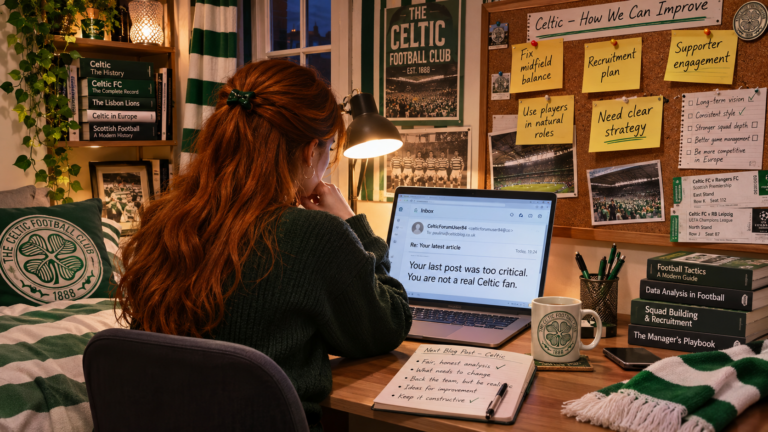






Plan, Listen, Apologise , on the face of it seems perfectly plausible and without controversy in ‘normal’ times. It is free of aggression and makes sense as a way for the Board and the support to come together.
Nevertheless, these are not ‘normal’ times and given the task of presenting this simple proposal, consideration should be given to the merit of the third of these. With such a divisive and toxic atmosphere permeating the club at the moment, I don’t believe the request for an apology will help anyone. While the fans, members of the Collective and members of the Green Brigade may see it as an olive branch and a step forward in perhaps achieving a sense of harmony, it should be remembered that the perception of the Board is unlikely to be in harmony with that of the Collective or the Green Brigade, for example. They may even believe that the apology should be given to them.
I agree that there is far less controversy in the other two elements, which would create a foundation for the warring parties to work together in collaboration with shared objectives. Should progress be made on these fronts with future regular meetings organised and Board and supporters in attendance, maybe the time would then be right for all sides to apologise for past indiscretions, before showing respect and moving forward together.