There is something fascinating about the way potential Celtic managers suddenly find their names appearing in newspaper columns and football podcasts.
One minute, nobody is discussing a particular candidate. The next, journalists are confidently floating names, supporters are debating their suitability, and an entirely new conversation has developed around the future of the football club.
But where does that information actually come from?
More importantly, who benefits from those conversations taking place?
Those are questions worth asking following the latest comments from Daily Record journalist Michael Gannon, who has expressed considerable scepticism about Celtic’s supposed succession plan for Martin O’Neill.
Speaking on the Scottish Football Podcast, Gannon revealed that he keeps being told a plan exists, although he remains unconvinced that Celtic have genuinely established one.
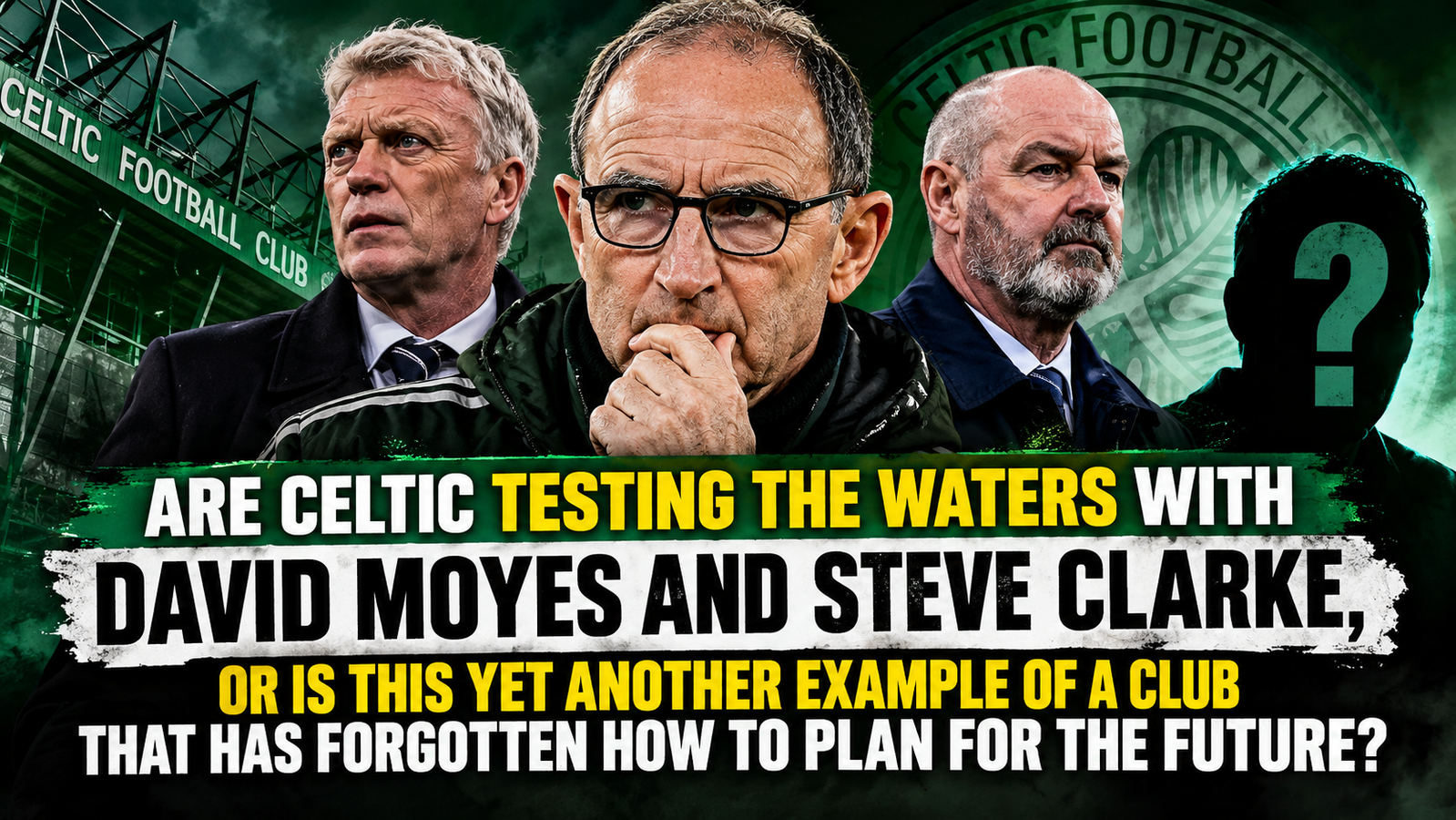
He subsequently suggested that David Moyes or Steve Clarke could represent the sort of experienced, safety-first appointments Celtic might pursue.
Now, that immediately caught my attention.
Not necessarily because of the names themselves, but because of the wider question surrounding how journalists obtain their information and whether certain suggestions are being deliberately introduced into public discussion.
Are Celtic Using The Media To Gauge Supporters’ Reactions?
Let’s establish something immediately. I am not suggesting Michael Gannon has knowingly participated in some elaborate public relations exercise.
Journalists speak to contacts. Those contacts speak to other people. Information circulates between clubs, agents, representatives and individuals with varying degrees of influence.
That’s how football journalism works.
However, football clubs and people operating around them also understand the influence of the media.
Floating a potential appointment can generate an immediate reaction without anybody at the club having to make a public commitment.
Suddenly, supporters are discussing whether a particular manager would be acceptable. Social media provides an almost instant indication of the prevailing mood.
It would be naïve to pretend that such conversations cannot be useful to those making decisions.
I have long suspected that something similar may have happened when Robbie Keane’s name emerged in previous discussions about the Celtic managerial position.
That’s my personal belief, rather than something I can substantiate.
Nevertheless, I wondered at the time whether his name was being floated to establish how Celtic supporters might react.
Now we’re hearing Moyes and Clarke being mentioned, and the same question comes to mind.
Are these simply educated suggestions from journalists, or are people connected to the decision-making process quietly testing the waters?
We don’t know.
What we do know is that Celtic’s recent record hardly inspires confidence in their ability to plan effectively for the future.
Celtic’s Managerial Merry-Go-Round Exposes The Bigger Problem
Consider what happened during the past twelve months.
Brendan Rodgers departed. Martin O’Neill returned on an interim basis. Wilfried Nancy arrived, only for his appointment to unravel spectacularly, and O’Neill was subsequently required to rescue the situation again.
The manager then delivered a remarkable league and Scottish Cup double.
Surely, after everything that had happened, Celtic would have used the opportunity to establish a clear long-term direction?
Instead, O’Neill left his interim role following the cup final and was officially reappointed on 11 June, signing a one-year contract with an option for another year.
Think about that sequence of events.
Celtic had just experienced one of the most turbulent managerial periods in their modern history, yet the eventual solution was to return to the same 74-year-old manager who had already stepped in to save them.
I have enormous respect for Martin O’Neill and what he achieved.
That doesn’t mean I should ignore the circumstances that made his return necessary.
Indeed, the fact Celtic needed him again raises serious questions about the club’s ability to identify, recruit and successfully integrate a suitable successor.
O’Neill delivered the trophies. The board still needs to explain how its wider managerial strategy produced such extraordinary upheaval.
The Transfer Market Tells Exactly The Same Story
This isn’t exclusively a managerial problem.
For years, Celtic supporters have complained about a recruitment strategy that frequently appears reactive rather than proactive.
Take Kyogo Furuhashi’s departure in January 2025.
Celtic eventually signed Kasper Høgh in July 2026, approximately eighteen months later, for a club-record fee.
Now, the lengthy wait before making such a substantial investment in another recognised centre-forward illustrates the broader frustration.
Why do Celtic so often appear to require an extended period before addressing positions that supporters have already identified as problematic?
The departure of Nicolas Kühn in the summer of 2025 created another challenge in the attacking areas.
Rather than establishing a settled, convincing long-term solution immediately, Celtic continued to face questions about their wide options across subsequent transfer windows.
Of course, recruitment is complicated.
Players have contracts, agents demand money, selling clubs negotiate and potential targets occasionally choose alternative destinations.
Nobody expects every transfer to be completed overnight.
But succession planning is supposed to anticipate those difficulties.
We are a million miles away from it looking like a slick, organised trading model.
A well-run recruitment operation should already be identifying potential replacements long before important players depart.
If Celtic cannot consistently demonstrate that approach in the transfer market, why should supporters automatically believe their managerial succession planning is any more sophisticated?
David Moyes And Steve Clarke Are Hardly Appointments To Capture The Imagination
I want to be fair to David Moyes.
He’s an experienced manager with a substantial body of work behind him, including winning the Europa Conference League with West Ham United.
Personally, I wouldn’t be completely opposed to Celtic considering him.
Nevertheless, would his appointment genuinely excite a support that experienced the attacking football of Ange Postecoglou?
I have serious doubts.
Postecoglou transformed the atmosphere around Celtic by introducing an aggressive, adventurous approach that supporters embraced wholeheartedly.
His teams attacked relentlessly, played with intensity and gave fans a footballing identity they could recognise.
Moyes has generally built his reputation around a more pragmatic approach.
That doesn’t automatically make him an inferior manager, he has a far more impressive pedigree in the English Premier League than Ange, but it raises legitimate questions about whether his footballing philosophy would satisfy a support accustomed to something considerably more expansive.
Steve Clarke presents an even greater concern for me.
His achievements in qualifying Scotland for three consecutive major tournaments deserve recognition.
However, Scotland’s performances at those tournaments also deserve serious scrutiny, particularly the disappointing results and limited attacking threat.
Would Celtic supporters look at that record and see a manager capable of transforming the club’s European fortunes?
I certainly wouldn’t.
Neither name immediately suggests a particularly imaginative appointment.
That doesn’t mean Celtic should appoint somebody purely because they play attractive football. Results matter, experience matters, and the demands of managing Celtic are considerable.
But surely the club should be searching for somebody who combines ambition, tactical identity and the ability to develop players?
There must be more to the process than looking through an old contacts book.
Martin O’Neill Cannot Be Celtic’s Long-Term Insurance Policy
Perhaps the most alarming aspect of this discussion is that Celtic already know another managerial decision is approaching.
O’Neill is 74 years old.
His existing contract runs for one year, with an option for a further season, and he has publicly reflected on whether he possesses the energy to continue managing.
Following September’s damaging defeats, he even questioned whether the time had come to conclude his managerial career.
He subsequently reaffirmed his determination to continue.
Nevertheless, the uncertainty surrounding his longer-term future is hardly a secret.
Celtic should therefore be identifying candidates, assessing their philosophies, examining their recruitment preferences and establishing precisely what direction the football club intends to take.
That process should already be well advanced.
There is also an uncomfortable possibility that the board may need to make another managerial decision before the season concludes.
Some of Celtic’s European performances this season have been deeply disappointing, while domestic results have also produced periods of serious concern.
Nobody should assume that simply reaching the summer with O’Neill still in charge is guaranteed.
The club needs to prepare for different eventualities rather than allowing circumstances to dictate its next move.
Celtic Need A Genuine Strategy, Not Another Familiar Name
Ultimately, I accept that no managerial appointment will satisfy every Celtic supporter.
Some fans want experience. Others prioritise attacking football, European credentials or the development of younger players.
Finding somebody who ticks every box is difficult.
However, that difficulty should encourage Celtic to conduct a more ambitious search, not retreat towards the most familiar names available.
Perhaps Gannon’s information is entirely accurate and Celtic have developed a detailed succession plan behind closed doors.
Equally, perhaps the people reassuring journalists that such a plan exists are offering considerably more confidence than the available evidence justifies.
The important distinction is that nobody outside the decision-making process can currently establish which explanation is correct.
What supporters can judge is the club’s recent record.
The managerial upheaval, the repeated reliance on O’Neill and the frustrations surrounding recruitment all provide legitimate reasons to question whether Celtic are sufficiently prepared for the future.
And if the names of David Moyes and Steve Clarke are being deliberately circulated to measure the mood among supporters, I suspect the response will tell those responsible something important.
Celtic supporters aren’t necessarily demanding a glamorous appointment.
They’re demanding evidence of ambition, forward thinking and a coherent footballing strategy.
Martin O’Neill has already rescued this club more than enough times.
The next Celtic manager should arrive because the board has planned intelligently for the future, not because somebody has finally reached the next name in an old black book.
Keep Your Eyes On The Board.