Regular readers will be aware, I’m sure, that in my spare time I am a gamer.
And over the last couple of years, I’ve increasingly found myself thinking about Celtic in gaming terms.
Last year, I proposed the theory that our board of directors might see running the club in much the same way a certain type of gamer approaches a game they have already mastered. Once they understand the systems, once they know they can beat the game, they start making it harder for themselves.
They impose artificial restrictions. They install modifications which remove advantages. They increase the difficulty until practically every system in the game is working against them.
In short, they keep trying to do more with less until they finally discover the point at which their ability to beat the game breaks. That sounds like a slightly ridiculous theory, but the underlying philosophy is actually very common in business.
Doing more with less is how plenty of companies justify economic decisions.
They cut budgets, shrink departments and reduce resources while trying to preserve output and profitability. The objective is to find the lowest level at which the organisation still functions. Over the years, that philosophy has operated under various names.
One of the modern ones is austerity.
And more than once, Celtic supporters have accused this board of inflicting its own version of austerity on the football club.
The problem with that strategy is obvious.
Eventually you reach the point where something breaks.
But what worries me even more is that the breaking point might not trigger some revolutionary rethink. It might simply tell the people running Celtic where the floor is. They might conclude: this is how far we can cut.
That does not mean they then start rebuilding.
One of my favourite games at the moment is Crusader Kings 3, and playing it recently made me think there is actually a better gaming analogy for Celtic.
Crusader Kings 3 is one of Paradox’s grand strategy games. They also make Hearts of Iron 4, a Second World War strategy game into which I have sunk an almost embarrassing number of hours. Crusader Kings 3 has a different flavour.
You play as a character rather than simply as a country. You might begin as a minor feudal lord, and your objective is to make your dynasty stronger over generations. You marry. You have children. You educate them. You form alliances. You plot against neighbours. You expand your influence and try to strengthen your family’s position.
Then your character dies, one of the children takes over, and the whole thing continues.
The story is the dynasty. And broadly speaking, players tend to approach games like this in one of two ways.
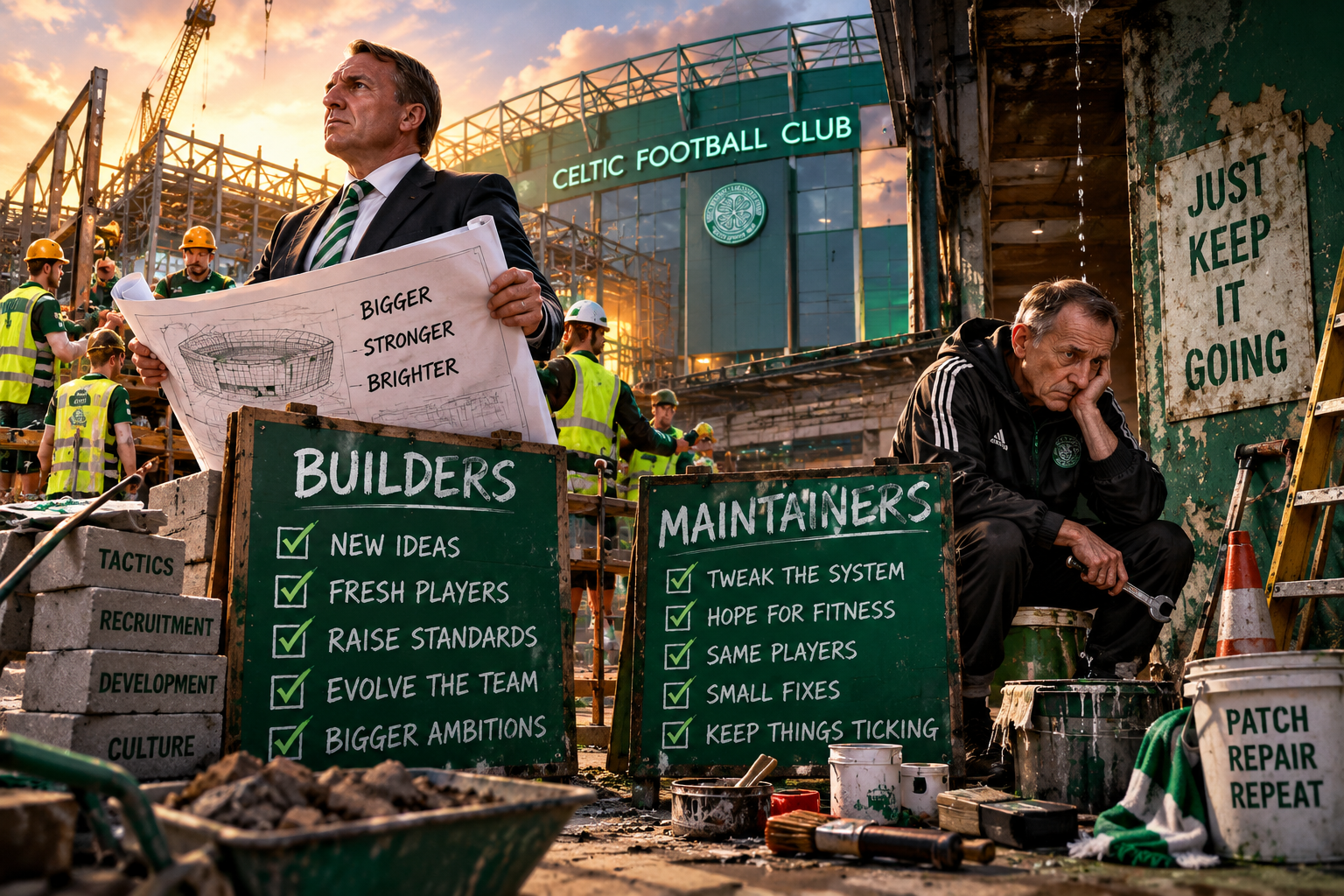
There are maintainers and there are builders.
The difference is obvious.
Maintainers begin by asking: how do I make what I already have as strong as possible?
They do not immediately chase every opportunity. They do not aggressively expand. They tend their little corner of the map, build up the treasury, improve the land, strengthen the army and make sure the dynasty is secure before worrying about what lies beyond their borders.
There is absolutely nothing wrong with that. It is a perfectly logical way to play.
In the early game, it can be extremely effective.
You tend your garden. You build slowly. You marry well. You have children. You protect your inheritance. You avoid stupid wars.
The builders think differently.
Builders look at the map and ask: what could we become?
Their objective is expansion. Every decision is made with the next step in mind. They are thinking about which neighbouring territory strengthens them, which alliance opens another route, which rival can be weakened and which opportunity might accelerate their next conquest.
They are trying to build an empire.
And there are obvious dangers in that.
Builders can overextend. I have done it myself. I have rushed into wars I had no business fighting, picked battles with neighbours who were stronger than I realised, watched my sons get imprisoned and suddenly found half the map concluding that I was a reckless bastard who needed to be dealt with.
That is the price of bad expansion.
But good builders do not simply rush around grabbing everything they can like contestants on Supermarket Sweep. They take calculated risks.
They understand that the purpose of expansion is not simply to own more land. It is to make every future move stronger.
That is where the real distinction lies.
The maintainer’s nightmare is causing the crisis. The builder’s nightmare is missing the opportunity.
Playing as a maintainer the other day, I suddenly realised that this describes Celtic far better than my old theory about gamers deliberately increasing the difficulty.
Our club is run by maintainers.
There is no question about it.
These people see themselves as custodians of an institution. Their overriding instinct is to protect what already exists, and they have repeatedly spoken in the language of maintainers. Do not move too quickly. Do not overextend. Build up the reserves. Keep money in the bank for the rainy day.
Protect the institution. Strengthen the walls. Do not enter wars you might lose.
That is the Celtic Board to a T.
They are happy to fill the bank account against a crisis which may never arrive, because what they fear most is being accused of creating one.
They do not want to be responsible for overspending. They do not want to be responsible for gambling.
They do not want to extend too far. They do not want to be responsible for trying to become more and discovering that the attempt failed, and so expansion itself becomes something they view primarily through the language of risk.
That is where I think Celtic have gone badly wrong.
Because expansion is not merely risk. Expansion is also opportunity.
A builder looks over the garden fence and thinks: if I controlled that territory too, my treasury would be twice as strong ten turns from now. A maintainer looks at the same territory and thinks: what happens if I go for it and lose?
That difference in mentality explains an enormous amount about Celtic.
We do not spend money to increase our chances of reaching the Champions League because the money going out is treated as the danger.
The builder looks at Champions League qualification and sees the potential return. Spend intelligently, strengthen the team, reach the competition, increase revenue, strengthen again. It’s a progression towards ever greater flexibility to operate.
The maintainer sees the expenditure first, and conclude that it may not be worth it. Too often our board acts as if the real danger is in doing something, when in fact it lies in doing nothing at all, although those of us who criticise Celtic for excessive caution are not asking the club to gamble recklessly.
Quite the opposite.
Look across the city. The Ibrox club spent a huge amount of money in the summer without European football to backstop that spending. If Celtic get their act together and win this title, their financial position could become extremely uncomfortable.
Nobody sensible is asking Celtic to behave like that.
I certainly am not. I would be appalled if we did.
But there is a vast middle ground between reckless gambling and refusing calculated risk. That is where Celtic should be operating.
If we had spent around £6 million on the defensive midfielder this team so clearly needed, I do not believe we lose by four goals in normal time, five after extra time, in Linz and suffer the humiliation which might have derailed our season.
If Brendan Rodgers had been properly supported when he was asking for a striker last season, I do not believe Celtic go out to Kairat Almaty. We needed one goal across those two games. One. A striker capable of putting the ball in the net with reasonable consistency might have completely changed the landscape of the season.
The board can tell itself that by refusing those risks it protected Celtic.
I think the opposite is true. It cost Celtic opportunity. Those decisions have actually brought on the very things they sought to avert; crisis. Upheaval. Multiplying problems and a whole different risk calculus.
And that is the forever the fatal flaw in the maintainer strategy.
It only works perfectly if the rest of the map stays still.
But the rest of the map never stays still.
Even while you are sitting behind your walls developing your land, the game is happening around you. Somebody else is expanding. Somebody else is building alliances. Somebody else is acquiring resources. Somebody else is becoming stronger.
The landscape you begin with is not the landscape you will face five or ten cycles later.
Football works exactly the same way.
While Celtic maintain, everyone else changes.
Hearts are not maintaining. They are building.
Ibrox never really maintains. It builds, collapses, rebuilds and starts again. That approach has cost them repeatedly, but if you give them enough opportunities eventually they will get one cycle right.
The wider game is changing too.
Clubs are becoming more sophisticated with analytics. Sports science has developed enormously. Directors of football and specialist recruitment operations are commonplace. Football departments are increasingly separated from the wider business operation, with football people making football decisions.
Clubs are building systems.
And Celtic remain remarkably resistant to doing the same.
This is where maintenance becomes dangerous. Because you can maintain your own position perfectly and still decline relative to everybody else.
Transfer fees have exploded while Celtic’s spending has either remained broadly static or gone backwards in real terms. We barely operate with a net spend at all. Money going out is expected to be balanced by money coming in.
Lose a player of real quality and we frequently seek a cheaper replacement.
That may look optimal from the perspective of maintenance.
But the rest of football is moving in another direction, and standing still in a changing world is simply another form of going backwards.
This is what worries me most about the people running Celtic. They appear to believe that preservation creates safety. It does not.
Sometimes it creates the sort of disaster you were attempting to avoid.
There is another term strategy gamers use for maintainers in certain games; turtlers.
They build walls, strengthen their defences and sit behind them.
Again, it can work. For a while. But every experienced strategy player knows the danger.
If you allow opponents to acquire territory, resources and strength while you remain behind your walls, there is every chance that eventually those walls stop protecting you. The enemies outside become stronger than the defences inside.
And then the game starts happening to you rather than being played by you.
There is no safety in the bunker.
That is the point Celtic have to understand.
Properly arming ourselves for expansion does not endanger domestic security.
Done intelligently, it strengthens it.
Champions League qualification produces resources. Resources improve the squad. A stronger squad makes domestic dominance easier. Domestic dominance creates another route into Europe. That is how successful expansion compounds.
Every strategy gamer knows the point at which you become so strong that the game has bent to your will rather than bending you to its; we call it steamrolling.
Celtic should be steamrolling Scottish football. We possess advantages which should make that possible. Instead, we have become so obsessed with what we regard as protecting those advantages that we are slowly reducing them.
That is the great contradiction at the heart of this board’s philosophy. They believe they are preserving Celtic for the next generation. But if they refuse to adapt while the game changes around them, what exactly are they preserving?
They may hand the next generation an institution with money in the bank. They may also hand them one which is structurally weaker, less competitive and further behind the football world than the one they inherited.
That is not preservation. That is managed decline.
Both strategies contain risk.
Builders can destroy themselves quickly. Maintainers can destroy themselves slowly.
The difference is that builders understand that sometimes you have to move in order to remain secure.
If you are not happening to the game the game is happening to you.
Football will not wait for Celtic. The market will not wait. Europe will not wait. Hearts will not wait. Ibrox certainly will not wait. The rest of the game is unfolding around us whether we are ready for it or not.
If Celtic genuinely want to protect Celtic’s status, then eventually they have to understand something very simple. We need people willing to expand, grow and build, and yes, that comes with a degree of risk.
But no-one can look at where we are right now and claim that strategy is optimal. Maintaining is not going to save us.
Choose The CelticBlog as a ‘Preferred Source’ on Google News for quick access to the news you value.