
Yesterday I wrote about Chris Sutton and why he repeats the same message over and over again. Repetition is an incredibly effective tool in political communications because eventually everybody starts talking about the same handful of points. The message becomes familiar, easy to repeat and, eventually, part of the accepted conversation.
This morning, I wrote about Stephen McGowan’s contention that we are in a “forever war” and that this conflict will burn until one side is exhausted. But that betrays a complete misunderstanding of what The Collective is trying to achieve.
So I pointed out that The Collective has actually put its proposals up on its own website, and I said that they basically boil down to six things; Stadium. Growth. Communication. Europe. Governance. Engagement. That’s what we need to be repeating over and over again until the lazy caricature of “entitled fans” loses its power.
But repetition is only one tool in what might broadly be called asymmetrical campaigning. Messaging plays one role. Publicity plays another. Direct action plays another still.
And it is direct action I want to talk about today, because there is a fascinating example unfolding in Spain involving Rayo Vallecano and a supporter base which has been fighting its club president, Raúl Martín Presa, for years.
Rayo supporters got their latest game called off after thousands of paper aeroplanes and other lightweight objects were thrown onto the pitch.
There are people inside and outside the club who think that was a tremendously stupid thing to do and a complete waste of everybody’s time.
There are legitimate arguments about disrupting football matches, and I am certainly not suggesting Celtic supporters should be trying to get games abandoned.
But something else happened at Vallecas.
People started looking. People started asking questions.
Suddenly the dispute between Rayo supporters and the people running their club was being discussed far beyond Madrid and far beyond Spain itself. People wanted to know what these supporters were so angry about, why the dispute had lasted so long and why fans were willing to disrupt their own football matches simply to make themselves heard.
Direct action is not always about the immediate act itself.
Sometimes the real objective is attention.
Rayo supporters have understood this for years. Their protests have often been theatrical, visual and deliberately designed to make people look.
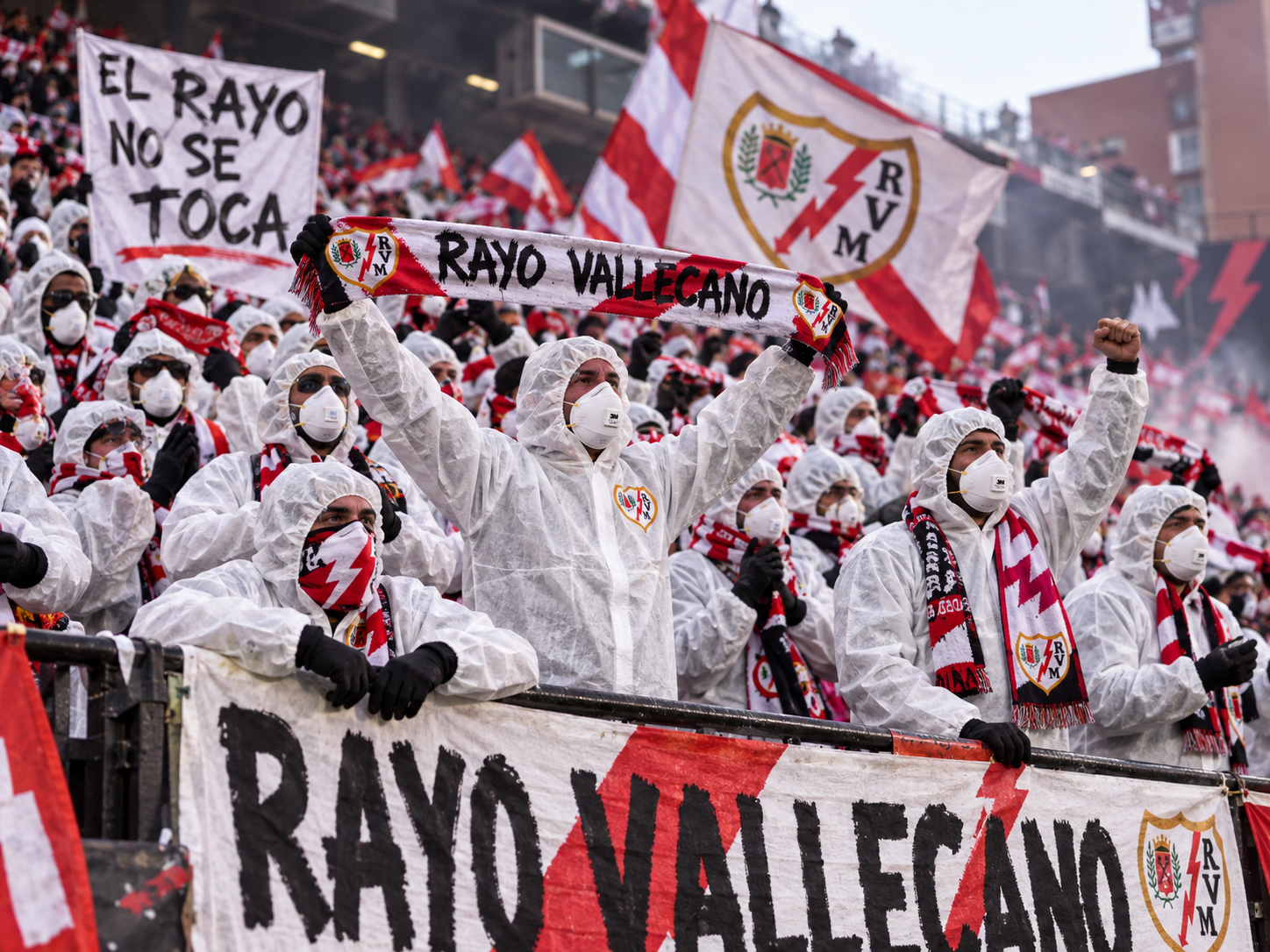
One of the most memorable came after figures associated with Spain’s far right were welcomed around the club. Supporters responded by appearing in protective suits and carrying cleaning equipment, symbolically “disinfecting” the stadium and its surroundings.
Think about the simplicity of that.
They did not need an enormous advertising budget. They did not need a professional public-relations company. They needed protective suits, cleaning equipment and an idea which could be understood from a single photograph.
That is communications genius.
Did it remove the people they were protesting against? No. Did it suddenly transform the relationship between supporters and ownership? No.
Sometimes protests do not immediately move the needle.
But that action became a story. It caused people outside the immediate Rayo bubble to examine the relationship between the club, its ownership and a supporter base which believed the identity of its institution was being disregarded.
The message was simple: you do not use our club this way. This is not who we are.
And that message travelled and Rayo fans found themselves with a lot of new friends. And believe it or not, that will matter one day.
There is a lesson in that which I think Celtic supporters increasingly understand.
The most powerful thing about an imaginative protest is sometimes not the protest itself. It is the publicity which follows it.
And that publicity is free. Think about it in those terms.
In the US, “free media” is one of the most effective political campaigning tools. Those who can harness it have tremendous advantages.
A company can spend hundreds of thousands of pounds trying to shape public perception. It can employ communications professionals, buy advertising, hire consultants, produce glossy material and spend fortunes telling people how it wants to be viewed.
A smart protest movement can sometimes overwhelm all of that with £50 worth of props and one photograph.
That is one of the enormous advantages available to insurgent campaigns.
The media does the distribution for you.
Create something visual, unusual, amusing, provocative or simply impossible to ignore and newspapers publish the photographs. Television discusses it. Radio talks about it. Social media distributes the clips. People who knew nothing about the dispute suddenly know that one exists.
The campaign could never afford to purchase that kind of reach.
It does not have to. The news value supplies it for free.
That is what happened with Rayo’s previous protests. It is what happened again with the paper aeroplanes. A cheap piece of direct action becomes an international sports story.
Celtic supporters have already discovered the same principle.
The protest against Dermot Desmond at the Alfred Dunhill Links was fundamentally a low-impact event. Nobody invaded his home. Nobody attacked him. Nobody prevented the golf tournament from functioning.
Supporters interrupted his comfortable weekend and made their feelings known.
What transformed that protest into something much bigger was Celtic’s own reaction.
The club helped broadcast it to an audience far beyond the one it might otherwise have reached. Suddenly people outside Scotland, who normally have little interest in Celtic’s internal politics, were asking what in God’s name was happening at our football club.
How can the most successful club in Scotland have supporters this angry? How can a club with Celtic’s financial strength be locked in conflict with a significant and growing section of its own fanbase? Why are supporters protesting against the individual widely regarded as the most powerful figure at the club?
That is exactly the kind of attention a protest movement wants.
This is where Sutton has been brilliant. It is where outside voices like Charlie Methven are becoming increasingly important. Once the argument escapes Scotland and becomes part of the wider football conversation, the character of the debate changes.
Celtic no longer controls the narrative.
And this is where I think Dermot Desmond differs significantly from somebody like Presa.
The Rayo president has demonstrated an almost extraordinary capacity to brass-neck his way through years of supporter hostility. He has been protested against repeatedly and simply continued.
Desmond appears much more sensitive to public criticism. Celtic itself certainly reacts strongly when protests are directed at him, and some of those reactions have done far more to amplify the original action than to diminish it.
That matters because pressure does not usually work through one gigantic event which transforms everything overnight. Campaigns accumulate. One story becomes another. One embarrassment becomes another. One television discussion becomes ten. The issue becomes harder and harder for the people responsible to ignore.
That is what asymmetrical campaigning is really about.
You do not fight a vastly more powerful institution on its preferred battlefield. You choose your own.
Celtic has money. Celtic has lawyers. Celtic has a communications department. Celtic controls access to Celtic Park. Celtic controls its website and decides who it speaks to.
None of those advantages allows Celtic to completely control the wider public conversation.
And that is the battlefield where supporters have substantially more power than the Board sometimes appears to understand.
Yesterday I wrote about Celtic’s Stock Exchange governance disclosures and the questions arising around the Nomination Committee and recent Board appointments. Shareholders are putting pressure on the club from that direction.
That is another form of pressure altogether.
Shareholders can ask questions. Regulatory obligations can be examined. Corporate governance structures can be scrutinised.
That is another avenue. But there are plenty of them.
Some will be serious and technical. Some will involve media appearances. Some will involve boycotts. Others will be symbolic protests which look silly, childish or pointless to people who do not understand what they are designed to achieve.
But the test should not always be whether an action immediately changes something.
Sometimes the test is whether anybody noticed.
Did it generate attention? Did it make journalists ask questions? Did it expose another audience to the underlying argument? Did it force Celtic to respond? Did it put another spotlight on the people running the club?
That is why I supported the tennis-ball protest during the European game.
It is why I supported the action at the Dunhill.
Neither protest was supposed to overthrow the Board by lunchtime the following day. The purpose was to broadcast the fact that something at Celtic is badly wrong.
And the smartest campaigns understand something else as well.
You want people outside the immediate dispute asking questions.
You want sponsors wondering why their brand is repeatedly appearing beside stories about supporter unrest. You want institutional investors asking why relations between Celtic and its supporters have deteriorated so dramatically. You want shareholders seeking explanations. You want regulators examining issues where legitimate regulatory questions exist. You want influential figures in football asking why one of the game’s great institutions appears permanently engulfed in a governance crisis.
Eventually somebody with influence asks Michael Nicholson or somebody else around Celtic a very simple question.
How much longer can this continue?
That is when attention begins becoming pressure, and after a while fans don’t even have to do anything at all. The firestorm is raging, and the rest of the world is asking the questions for you and the noose tightens around these people a little bit at a time.
Again, I am not advocating attempts to have Celtic matches abandoned. That creates its own problems, including consequences for the team and for supporters who simply want to watch football.
But look at what the Rayo supporters demonstrated.
Their president gets through one crisis and perhaps thinks the pressure has eased. Then suddenly paper aeroplanes are flying across the pitch and the entire argument is back in the headlines. You cannot easily suppress that kind of creativity.
You can punish people afterwards. You can condemn them. You can issue statements.
But once the photographs are on television screens and websites around Europe, the message has already escaped. That is the force multiplier.
The protest itself might cost almost nothing. The media coverage it generates could be worth hundreds of thousands of pounds if somebody attempted to purchase comparable exposure commercially.
That is why supporter movements can sometimes outperform institutions with infinitely greater resources in a communications battle.
The institution has to buy attention. The insurgent campaign merely has to create something newsworthy enough that everybody else distributes it for free.
And Celtic’s Board has repeatedly compounded that problem by responding in ways which extend the lifespan of the story.
Some sections of the media will condemn supporter action. Of course they will. Some Celtic supporters will condemn it too.
That does not automatically mean the action failed, which is what some on our board seem to be believe. But direct action is not a popularity contest. The question is whether it produced attention, pressure and scrutiny.
There are obviously lines which should not be crossed. Violence, threats or genuinely dangerous behaviour would damage the movement and hand the club precisely the diversion it would want.
But imaginative, peaceful and legitimate pressure is different.
Keep finding it. Keep making the story travel. Keep moving the argument into places where Celtic has no control over it.
Because the club is already angry with sections of the support. It already publishes statements attacking supporters. It already refuses to recognise the Celtic Fans Collective.
The threat that the Board might disapprove of protest therefore carries no weight at all, it has lost all its force and effect.
And that is the central lesson I take from Rayo Vallecano. They understand that the protest itself is only half the action. The other half begins when somebody points a camera at it.
That is where a supporter movement suddenly becomes much larger than the number of people physically involved. That is where paper aeroplanes become international news. That is where a handful of people in protective suits can tell a story to millions.
And that is where Celtic supporters should continue to think creatively.
Not chaos for its own sake. Not disruption because disruption feels satisfying.
Pressure with a purpose. Attention carrying a message. Publicity which creates scrutiny. That is how asymmetrical campaigning works.
And when the institution on the other side continually demonstrates that it does not know how to respond without making the story bigger, the asymmetry becomes even more powerful.
Choose The CelticBlog as a ‘Preferred Source’ on Google News for quick access to the news you value.




The mood amongst the Celtic support is now at an all-time high.
Since the vile attack on the Green Brigade and the fans collective it is clear to see that the intentions of DD&Son MUTE MIKE, WEASEL Wilson and the muppets in the boardroom never was and never will be honorable.
The boycott of the Middlesbourough and AC Milan games was a warning of what was to come.
It was more than the North Curve that supported that boycott.
When question about this Martin
waffled on about the cost of living crisis.This was his chance to get behind the fans.He chose to back the board.
Every man and his dug new the reason behind the protest.
At that time I got the impression that the vast majority of the fans actually hated DD&Son ,Mute Mike , WEASEL Wilson and the muppets in the boardroom.
Since the Great Tennis Baw disruption at “the home of Golf ‘
The mood is no longer that of hatred it has now moved to the final stage the majority of Fans are now INDIFFERENT to the Horrible one & his son Mute Mike, WEASEL Wilson and the muppets in the boardroom.
INDIFFERENCE is when One party to a dispute neither loves or hates the other party.
It is liberating too the Spirit of the mood of the campaign.
We no longer needed to tip toe around because we are frankly indifferent to (could not care less) as to the condition of the Tyrant in charge.
Our focus has to be the 100% removal of the offense individuals who are destroying our club.
The Green Brigade, BHOYS,and collective need full solidarity in the actions about too come!