
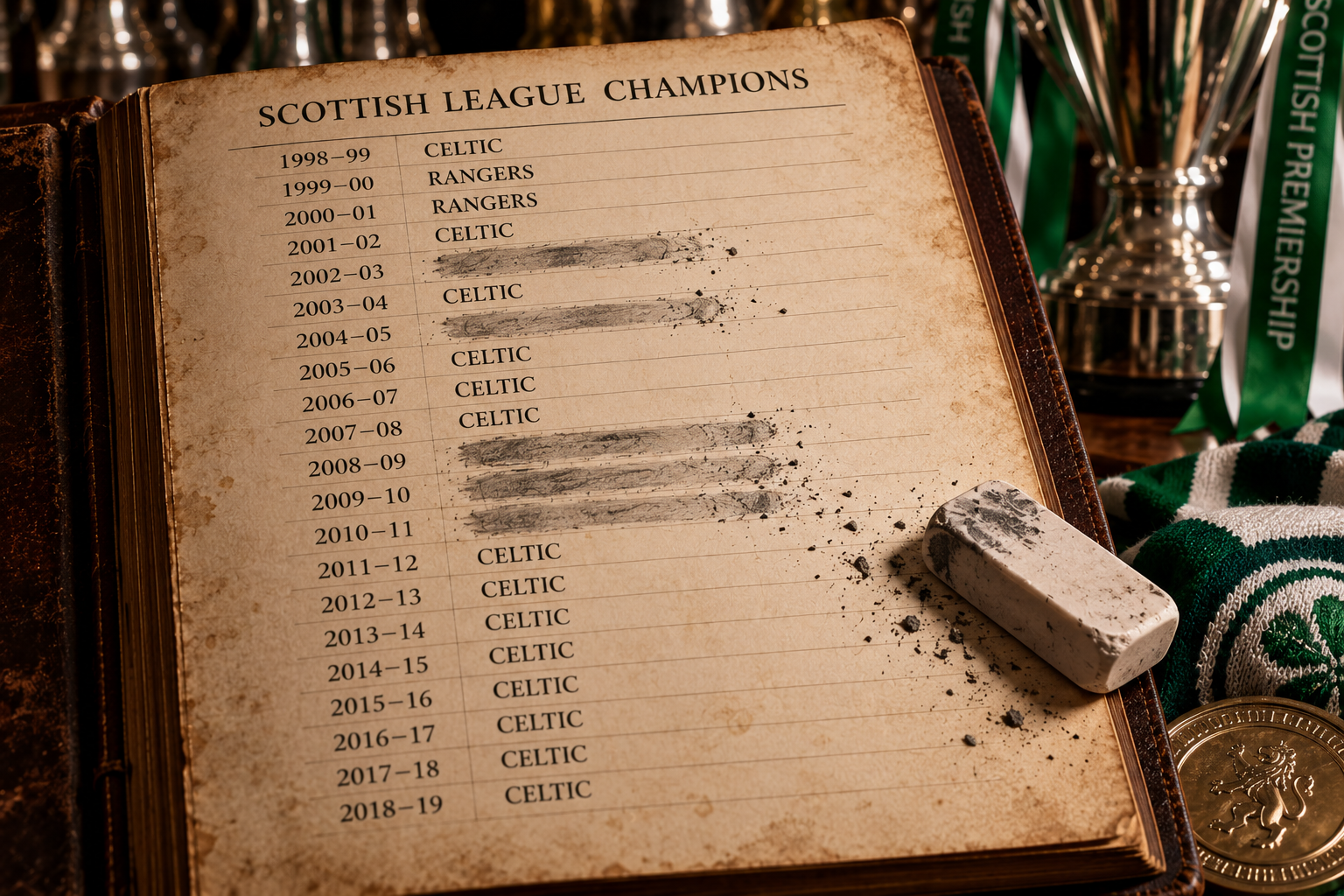
It is obvious that a large number of Celtic supporters are following the Manchester City story very closely indeed. There are aspects of it which inevitably make you wonder what Scottish football might look like today had Celtic and other clubs been more aggressive in pursuing what happened after Rangers went into liquidation in 2012.
Because the consequences of financial rule-breaking do not begin and end with trophies. That is what increasingly interests me about the Manchester City case.
An independent Premier League commission has now found City guilty of serious breaches of the league’s financial rules across nine seasons, including the use of sham commercial arrangements, misstated accounts and breaches of spending limits. City have appealed that decision, so the process is not yet concluded.
But already the debate has moved beyond fines, points deductions and what happens to individual titles. It has moved into history, and history is where the real damage lies.
When you listen to people who competed against Manchester City during those years, or consider the careers of managers such as Alex Ferguson and Arsène Wenger, you begin to understand the wider implications. This was never simply about who finished first and who finished second.
Financial rule-breaking potentially changes careers, reputations and what managers are able to accomplish. It affects bonuses, transfer decisions, sackings, contracts and the way entire eras are remembered.
Wenger is now rightly regarded as one of the great transformative figures in English football, a manager whose ideas changed training, nutrition, recruitment and the way the game itself was played. Yet the latter part of his Arsenal career is commonly remembered through the prism of what he failed to win rather than the environment in which he was trying to compete.
That is why this matters. These things do not merely steal from the present. They steal from the future.
The same principle applies to what happened in Scotland.
During the years when Rangers operated the EBT scheme, more than £47 million was paid to players, managers and other employees through trusts.
The Supreme Court ultimately ruled that those payments were employment income and therefore taxable. Side letters connected to those arrangements were not disclosed to the football authorities, and a 2013 commission found breaches of player-registration rules, although it declined to strip titles.
We can never know what Scottish football would have looked like without that environment. That is precisely the point.
Maybe Martin O’Neill leaves Celtic that first time with an even greater legacy. Maybe Gordon Strachan does too. Maybe clubs which lost cup finals win them instead. Maybe players who finished their careers without certain medals retire with completely different memories, and maybe managers elsewhere earn bonuses, keep their jobs longer or move on to bigger opportunities.
We cannot recreate any of that, and that is why I have never been particularly interested in Celtic being retrospectively handed Rangers’ titles.
You cannot give me Black Sunday back. You cannot recreate the emotion of that day, briefly believing Celtic had done enough, only for Scott McDonald to score and then score again and rip the title away.
If somebody decided tomorrow that Celtic should technically be recorded as champions that season, what exactly would that give me? A line in a record book?
It would not give me the moment. It would not give us the thrill of it, the players their day or the supporters the experience of actually winning it.
The same applies in England. If titles are ultimately stripped from Manchester City after the appeal process is exhausted, I do not think simply moving another club’s name one line upward properly captures what happened.
Manchester United supporters would not suddenly experience Sergio Agüero’s goal differently. Ferguson himself would not feel that sick sensation in his gut. Nothing changes the moment and nothing restores what was lost.
That is why I increasingly think the answer lies somewhere else.
If a title is removed because the competition itself was fundamentally compromised, do not pretend that history can simply be reconstructed by awarding it to somebody else.
Leave the space blank.
Record that there was no champion. Record that the title was withheld. Record that the competition for that season was subsequently judged illegitimate.
Whatever terminology is eventually chosen, make the absence visible, because then somebody looking at the record in fifty years sees the gap and asks why there was no champion that year rather than seeing just a name and passing over it.
Then they learn the story. They learn that something extraordinary happened, that the competition was distorted, and that careers were altered, opportunities disappeared and an entire sporting history developed differently because rules which everybody else was expected to follow were not followed.
That, to me, is a more honest form of justice.
Scottish football should have done exactly that with the titles Rangers won during the EBT period. They should have gone, but not been transferred to Celtic or redistributed among runners-up. Just removed.
The record should have contained blank spaces where champions were supposed to be. The institutional record should have been damning.
It should have preserved the fact that something happened during those years which Scottish football could not simply shrug off.
Instead, the titles remained. I think that was a profound mistake.
Punishment is not only about hurting the offender. Sometimes punishment is about protecting history and making sure future generations understand that the rules mattered and that breaking them had consequences.
Otherwise, you risk reducing everything to an accounting dispute.
An asterisk can be ignored. A footnote can be forgotten. A blank space cannot, because a blank space demands an explanation.
That is why the Manchester City case matters so much beyond England.
If, after the appeals process, the English authorities impose sanctions which properly reflect the scale of the wrongdoing found by the commission, Scottish football is going to find itself confronting some extremely uncomfortable comparisons.
We have already lived through our version of this argument. We already had the warnings and the opportunity to decide what sporting integrity was supposed to mean when rule breaches potentially altered the competitive landscape.
And we chose not to preserve that moment properly in the historical record. If England ultimately does what Scotland would not, that failure will look even worse.
The greatest theft in situations like these is not necessarily the trophy itself. It is the history people were denied.
You cannot give that history back, but you can at least make sure the record never allows anyone to forget why it disappeared.
Choose The CelticBlog as a ‘Preferred Source’ on Google News for quick access to the news you value.










That’s a great point James. It will be like the war years when the title winners table is left blank. In fact think Man City’s cheating years are longer than the two world wars combined! How long did rangers cheating years go on for?
Speak for yourself James, but I would have been very happy for us to be awarded the tainted titles. Anything that punished them more, and added quite considerably to their misery, would have been an added bonus for me.
The durty cheatin’ bastards!