
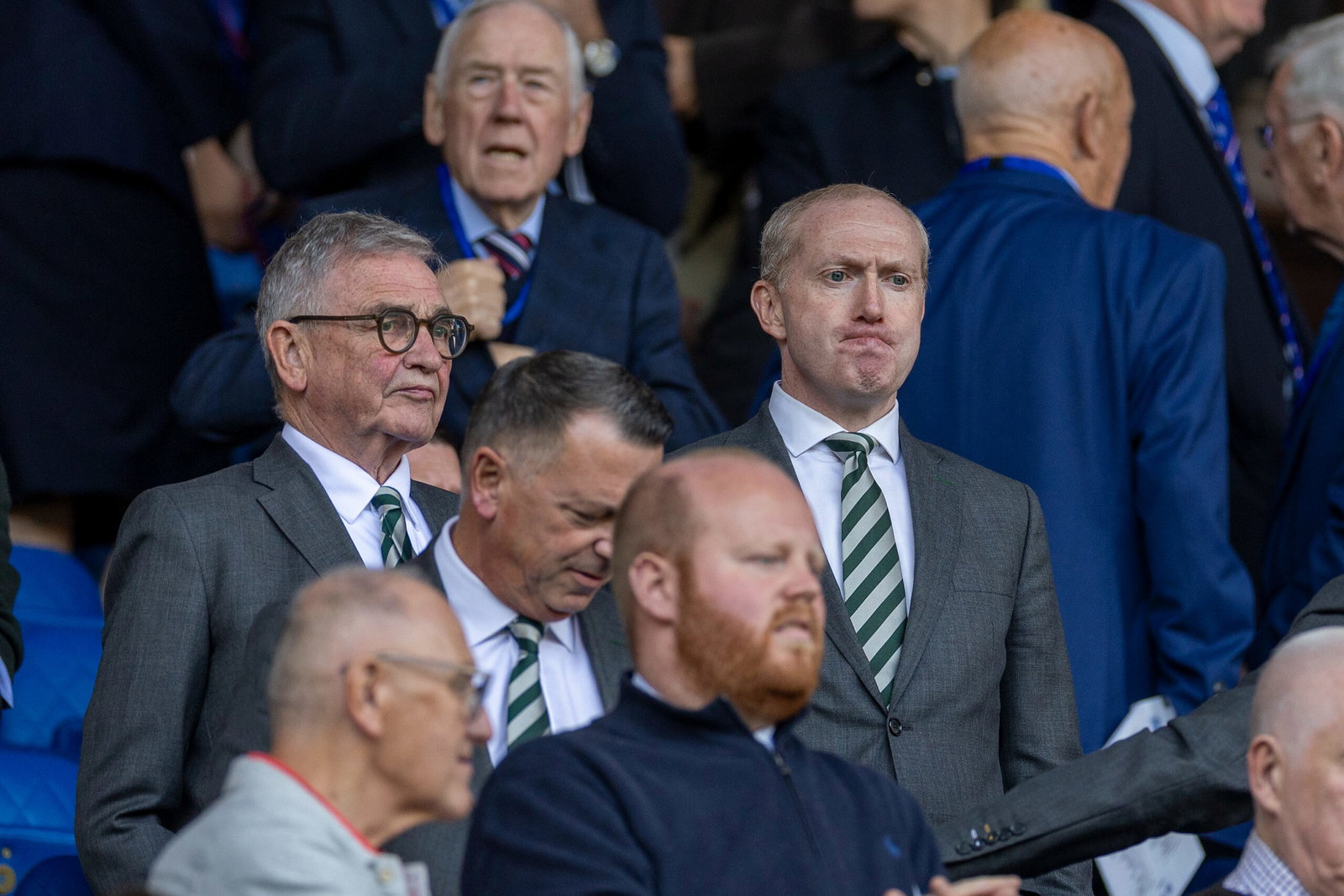
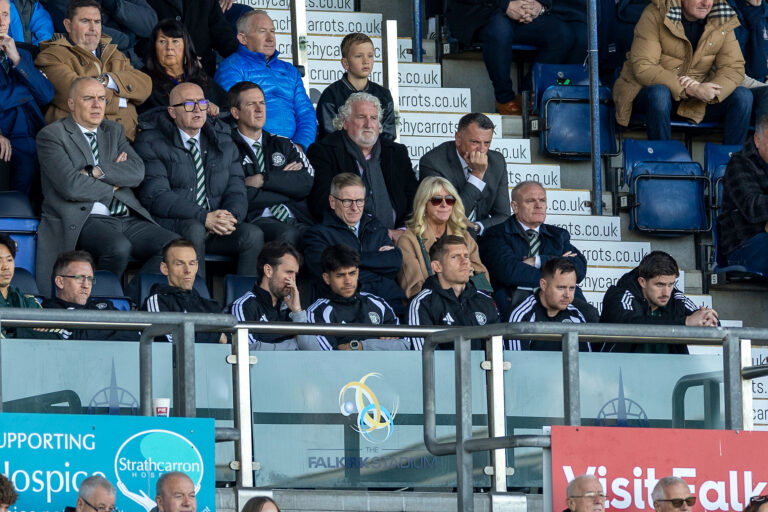
13th September 2026; Ibrox Stadium, Glasgow, Scotland; Scottish League Cup Football, Rangers versus Celtic; Brian Wilson and Michael Nicholson of Celtic
All of us should still be buzzing after what Celtic did to Hearts. Of course we are, even if we’ve come off a bad result in midweek.
A 7-1 victory against the team which pushed us all the way last season should make every supporter feel good. It should remind us what this football club can look like when everything clicks.
But there is a danger in games like that, and Thursday night has brought it home to us.
The danger is believing that because something went right on the football pitch, everything else has somehow become all right as well. It has not and Thursday reminds us of it.
Because Celtic’s biggest problem is no longer simply results. It is institutional trust. And once an institution loses that, changing one or two people does not automatically restore it.
I was thinking about this while reading Tom Nichols recently. He wrote an article with one of those headlines which does almost all of the work before you even reach the first paragraph: “America Is An Ally Of Russia.”
Not Trump. America.
That distinction matters, because there will be people who believe that whenever Donald Trump finally leaves office, everything simply returns to normal. The old alliances return. The old assumptions return. The world collectively decides that it was all one strange aberration and carries on as it did before he came along.
But institutions do not work like that.
When somebody acts in the name of an institution for long enough, the consequences of those actions attach themselves to the institution itself.
Trust is damaged. Reputation is damaged. Expectations change. People who deal with that institution start asking whether the behaviour they witnessed was an aberration or whether it revealed something deeper about the organisation and that damage does not disappear because the nameplate on an office door changes.
And Celtic supporters need to understand that this is now where our own club stands.
The problem is no longer simply Michael Nicholson. It is no longer simply Dermot Desmond. It is no longer simply whoever occupies whichever chair in the boardroom this month.
The problem is Celtic. Or, more precisely, what Celtic as an institution has allowed itself to become. That distinction is important because it changes what genuine reform would actually mean.
There is a comforting theory that all we need is a change at the top.
Dermot Desmond eventually goes. Somebody from within his own family takes his place. Michael Nicholson leaves. A new chief executive arrives. A few directors disappear. Everybody shakes hands, announces a fresh start and suddenly the supporters are supposed to trust Celtic again.
If the same structure remains, if the same culture remains, if appointments are still made in the same way, if the same absence of scrutiny remains and the same philosophy still dominates the building, then all we have done is change the personnel.
A change of personality does not necessarily represent a change of system. And this is where another recent American political argument becomes relevant.
Tim Miller has written and spoken repeatedly about the so-called “adults in the room”. The people around Trump who told themselves they were providing restraint. The people who believed that staying close to power allowed them to prevent worse things from happening. The people who explained their own presence as a public service.
Maybe some of them even believed it.
But there comes a point when staying stops being restraint. There comes a point when your presence does not limit the system. It legitimises it. At some point, you are no longer the adult in the room. You are simply part of the room.
And that is exactly how I look at Celtic now.
For years we have heard versions of the same argument. There are good people on the board. There are people behind the scenes who understand the supporters. There are directors who privately know that things need to change. There are executives who supposedly disagree with this decision or that one.
There is always somebody who is apparently horrified by what is happening but somehow remains in the building while it continues.
At what point do we stop calling these people moderating influences? At what point do we simply call them enablers?
Because there are no more adults in the room now at Celtic.
There are only enablers.
If you sit on that board while Celtic repeatedly fails to modernise, you own part of that failure. If you support a governance structure in which meaningful accountability barely exists, you own part of that failure.
If you watch supporter trust collapse and still believe the solution is better messaging rather than better leadership, you own part of that failure. If you remain silent while the institution you are supposed to protect becomes smaller, more defensive and less ambitious, then your silence is itself a choice.
This is why replacing individuals is no longer enough.
The entire structure has been contaminated by the failures it tolerated.
People can be replaced. Institutional memory cannot simply be erased. Supporters remember. Employees remember. Agents remember. Players remember. Potential managerial candidates remember. Other clubs remember. The media remembers.
Every decision becomes interpreted through the history which preceded it.
That is what happens when trust disappears.
A new appointment is no longer automatically viewed as a new beginning. It is viewed with suspicion. A statement is not accepted at face value. People look for the catch. A promise is not treated as reassurance. Supporters ask when they have heard it before.
That is the cost of institutional failure. It changes the burden of proof and Celtic is no longer in a position where supporters have to prove that something is wrong. The club has to prove that something has changed.
And that is a much harder job.
Because trust is not restored through one transfer window. It is not restored by one managerial appointment. It is not restored by one good set of results. It is not even restored simply by removing the people most closely associated with the failures.
Trust comes back through repeated proof. Different behaviour. Different standards. Different processes. Different outcomes.
It means accountability when things go wrong. Honesty when mistakes are made. Communication which does not treat supporters as idiots. A football operation which has clear lines of responsibility. Appointments made because people are the best available rather than the safest available.
It means a board which understands that governance is not about protecting itself from criticism. It is about protecting the institution from failure.
That is the scale of what Celtic now needs.
Not cosmetic change. Not succession. Renewal.
Because this club cannot simply wait for Dermot Desmond’s son to inherit influence and pretend that represents transformation. It cannot replace one chief executive with another product of the same system and pretend the culture has changed. It cannot rotate directors through different chairs and claim that accountability has been delivered.
That is continuity with different stationery. And continuity is exactly what has brought us here and so the objective cannot simply be to remove the people who have failed Celtic. It must be to build a Celtic in which the same failures cannot be repeated.
That means changing how decisions are made. Changing how people are appointed. Changing how performance is measured. Changing how supporters are treated.
It means changing the assumption that longevity is evidence of competence. Changing the idea that stability is automatically virtuous even when what is being stabilised is mediocrity.
Because sometimes stability is simply another word for inertia.
And Celtic has been inert for far too long.
There are still people who think the supporters’ anger will eventually burn itself out. That a few victories will calm everybody down. That a successful run will make people forget. That time itself will repair the relationship.
It will not. Time does not rebuild trust. Behaviour does.
And that is why even something as magnificent as putting seven goals past Hearts does not solve the underlying issue. It makes us happy for a day. It reminds us why we care. It gives us hope for the football team.
And then Thursday comes along and reminds us of the reality we’re in and in that reality we are not going to suddenly trust the people who run Celtic.
This football club possesses enormous advantages. It possesses history, scale, support, revenue, infrastructure, cultural power and a worldwide identity.
It should be one of the great modern football institutions. Instead, too often, it behaves like a private members’ club which happens to own a football team.
That has to change.
Not because supporters demand vengeance. Not because everybody on the board is uniquely wicked or incompetent. But because the institution itself now needs protection from the culture which has grown inside it.
It requires the whole thing to change. The whole structure. The whole philosophy. The whole concept of what accountability looks like at Celtic.
Because the damage no longer belongs only to the people who caused it. It belongs to the institution they represented while causing it.
Notice what the reports we’ve had to contend with these last few days actually say; not “The Celtic board has failed” or that “Dermot Desmond is mediocre.” It is “Celtic has failed.” It is “Celtic has become mediocre.” The sins of the directors are now being felt by the institution itself. Real, quite possibly long term, harm is being inflicted on us now every day.
And the rest of football will not suddenly change its mind about where this club ought to be. Fans won’t either. Not unless we clean house in a big, big way. Trust has to be restored. Faith has to be rebuilt.
Those are not quick jobs. The critical ones never are.
Choose The CelticBlog as a ‘Preferred Source’ on Google News for quick access to the news you value.




There are 3 issues James. Firstly there is DD who has no emotional interest in the club. He bought his shares with the hope that we would gain entry to the EPL. An investment he hoped would multiply significantly. Secondly aided and abetted by Lawwell he has been allowed to gain control of every major decision at board level. Resulting in the club having a boardroom full of tailor’s dummies. Thirdly and in my opinion the most important issue currently is the management team. No matter if we are playing Auchinleck Talbot or Barcelona the zoomers in the dugout will set the team up to play the exact same way. We are so predictable as a team that any manager with a single braincell knows what to expect. Last Sunday we were all ecstatic. We seen some fantastic pockets of football through brilliant teamwork and great individual ability. However in the cold light of day the reality is a team from the SPL had 28 shots on our goal. That’s almost one every three minutes ffs. This has been happening all season and the manager and coaches have done F*** All to address it. Its been happening all season. Dundee Utd hit our woodwork 5 times. LASK had 40 odd shots on our goal. That’s just a couple of examples of how easy it is to play against us. They say nothing changes if nothing changes. Sadly we are in free fall and nothings changed.
The trust you speak of James will never be restored, if it was ever truly there in the first place. The Institution and it’s hierarchy will as usual ride out the consequences of, what they see as a temporary glitch in Europe, and a result at Easter Road will see them back on a perceived even keel. All will be well again with the board as they take comfort from the old adage that today’s news is tomorrow’s fish and chip wrappers.
Spot on!
Superb quality analysis there.
You may have drawn a parallel with an article on the current far right westboro Baptist Church US admin but it does represent a huge swathe of indoctrinated Americans. As for their use of Russia to maga that was all planned by people above Trump and will continue to be after Trump. Creating constant wars and threats of war in distant lands is very good for your economy when your countries main industry is military. Incidentally using the same “enablers” designated to be the “adults in the room” to make sure Trump follows the orders ? Maybe.
.
I like the “private members’ club” analogy but I’d like to go a bit deeper, because I can’t help but see a parallel to the old school tie mob in the English establishment, where certain public school boys would automatically get the high earning jobs in the city or equivalent.
.
I wonder if we see a bit of that to an extent at CP and more importantly I also wonder if there is an inbuilt protective structure born of age old generational trauma at CP
.
Trauma created in Ireland in the 19th century and brought over by its people to a hostile, bitter land, who were a part of the country (UK) that created the trauma in the first place.
A left over generational trauma like all PTSD which to protect itself, sees potential danger everywhere and creates a mistrust of those who are deemed outsiders ie a potential threat, in a still (to a certain degree) hostile land.
.
Could that be why we favor Irish managers or coaches ? Could it be why excellent servants to Celtic be they Catholic or protestant, Scottish or Irish are brought back or kept on ? Because they are one of us and we can trust them over an unknown who could cause damage ?
Could it be why we when we seek out new staff members the net covers such a small diameter which is close to home ?
.
Just some food for though on a grey Autumn Saturday with no Celtic playing.