
The fantastic movie The Big Short, based on Michael Lewis’s book of the same name, opens with a quote attributed to Mark Twain:
“It ain’t what you don’t know that gets you into trouble. It’s what you know for sure that just ain’t so.”
There is actually some doubt that Twain ever said it, which is almost too perfect for a quote about being absolutely certain of something that isn’t true. But the sentiment is the important thing, and it sits at the heart of the whole movie.
People’s certainty is what gets them into trouble.
It isn’t just that they’re wrong. It’s that they become convinced that they cannot possibly be wrong. And that movie should make every one of us stop occasionally and ask ourselves a question: how much do I actually know for sure about the things I think I know?
I have written repeatedly about the Celtic board being blinded by its own arrogance and certainty. So, it would be intellectually dishonest if I wasn’t willing to turn that question back on myself.
We believe this club is fundamentally broken.
But could we be wrong?
We have looked. We have looked under the hood. We have looked through success to what lies beneath it, and we have done our best to make sure the analysis is sound.
But maybe it isn’t.
Because the contrary argument is not completely ridiculous. Celtic wins trophies. Celtic has been consistently successful domestically. There is still an enormous cash reserve. Even European failure can be explained away as the inevitable consequence of playing in a financially weak domestic league.
Those arguments have foundations.
That is what makes the question worth asking.
In The Big Short, Michael Burry did the thing almost nobody else bothered to do. He examined what was actually inside the American mortgage market. He looked beneath the ratings, beneath the rising prices, beneath the confidence of Wall Street, and concluded that the structure underneath it all was rotten.
And even Burry had moments when events appeared to contradict him. House prices kept rising. The market continued operating. The ratings agencies kept stamping securities as safe. Eventually even he asked himself whether he might be wrong.
At a crucial moment the kid in his office asks him if he could possibly be wrong. And Burry answers in a voice loaded with weariness and despair, after admitting that he has searched his own soul and gone over all his own work over and over again.
“I could be wrong,” he says. “I just don’t know how.”
That is the test.
So, let’s apply it to Celtic.
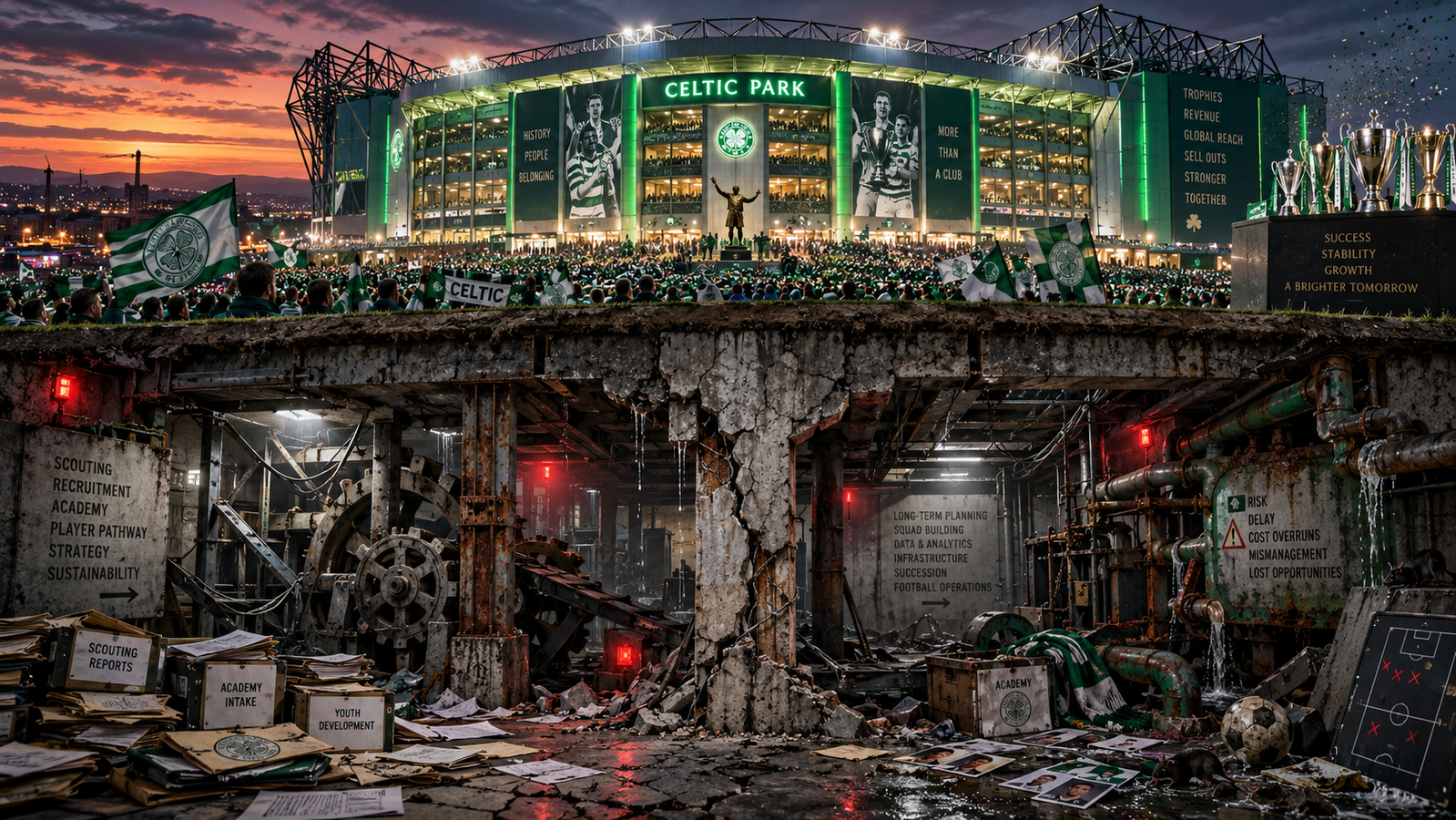
Look beneath the trophies and the league tables and there are problems everywhere.
The academy still exists and Celtic quite rightly points to an impressive historical record of producing first-team players.
The club says 72 academy graduates have reached the senior side since 2000/01. But the real question is what the pathway is producing now and whether it is consistently creating players capable of improving the modern Celtic first team.
Look at the B team. It finished third in each of its first two Lowland League seasons, sixth in 2023/24 and second the following year. Last season it finished tenth. It has never won the competition. That is not evidence that everything is broken, but neither does it scream elite developmental pathway.
Then look upwards.
Celtic created a Head of Football Operations role and appointed Paul Tisdale. He left alongside Wilfried Nancy in January. Nine months later, there is still no announced permanent replacement.
That matters because Celtic’s own published strategy says its football model depends on player recruitment, player trading and the creation of players capable of competing in the Champions League. The club itself describes those things as fundamental to its self-sustaining model.
So, this is not some side issue. It is the machine.
And we have watched that machine malfunction repeatedly.
We have seen transfer windows characterised by dithering when decisive action was required. We have watched managers asked to compensate for weaknesses that recruitment should have solved. We have watched Celtic repeatedly reach the point where obvious problems become emergencies before somebody finally acts.
We are maintainers rather than builders, and sometimes it is difficult to argue that we are even maintaining particularly well.
Look at the finances. Celtic should be fundamentally strong. The latest accounts show £66.4 million sitting in cash and cash equivalents. Celtic Park holds around 60,000 people and season tickets for this season sold out again with a 99.5 per cent renewal rate. These are extraordinary advantages in Scottish football.
Yet those same accounts show revenue falling by 22.7 per cent to £111 million and the club recording a £4.8 million loss after tax. The principal reason given for the revenue decline was the difference between Europa League and Champions League participation.
There is the problem in numbers. Celtic’s model relies heavily on European income and player trading, while the football operation responsible for maximising those things repeatedly looks improvised.
I asked after the summer window closed what our signing policy was worth if we junked it the second we went out of the Champions League. If those weren’t just signings but signings chosen because they could become valuable assets, wasn’t ditching them all doubly self-destructive? This is what we do as a club though.
That is not a contradiction invented by critics. It is contained within Celtic’s own accounts and its own stated strategy.
So, could I be wrong? Yes, but I don’t know how.
See, I have been here before.
Years ago, when a small handful of Celtic writers were warning about what was happening across the city, people used to ask how we could possibly be so confident. There was no magic trick involved. Nobody had secret information.
We simply looked beneath the surface. On the surface, that club was still spending money and winning trophies. Underneath, the financial structure was impossible to sustain.
People asked me all the time, “Are you right about this? Could you be wrong?” And I would have offered up a variation of that answer; “Yeah, but I don’t know how.”
The point is not that Celtic faces the same outcome. It plainly does not. The point is that visible success does not automatically prove institutional health.
That lesson should have been burned into Scottish football forever.
And still, I ask myself the question, because I’m a Celtic supporter and I would quite genuinely love to be wrong about all of this.
Where is the flaw in the analysis?
Show me the coherent long-term football strategy. Show me the elite recruitment operation. Show me the succession planning. Show me the academy pathway producing a steady stream of first-team players. Show me the Head of Football Operations. Show me the structure that ensures the success of Celtic does not depend disproportionately on whether the club happens to appoint an exceptional manager.
Because that has been our saving grace too often.
Great managers have pushed Celtic forward even while institutional failures pulled in the opposite direction. Ange Postecoglou did it. Brendan Rodgers did it. Martin O’Neill has done it more than once.
But you cannot build an organisation around hoping the next manager will overcome everything the organisation gets wrong, and especially not when those at the top of the club act in ways which could almost be designed to dissuade any top class boss from coming and working here. Eventually your luck runs out.
Celtic may win this league. Celtic may win another double. The bank balance may remain enormous and the trophies may continue to arrive. None of those things, by themselves, answer the underlying questions.
That is one of the great lessons of The Big Short. The fact that everybody agrees something is strong does not necessarily make it strong. Sometimes consensus is merely the story everybody has agreed to tell themselves.
So yes, I keep asking the question.
Am I wrong about Celtic? I hope I am. I could be wrong.
I just don’t know how.
Choose The CelticBlog as a ‘Preferred Source’ on Google News for quick access to the news you value.






As a business Celtic is being run relatively well, they certainly get pass marks in that context. However, we all know that those priorities are wrong, for we are football fans and our number one priority has got to be a successful, but also an entertaining team, and we pay through the nose for both of those products. There is of course, a happy medium, for we cannot afford to have a rampant football team, but ending up in serious debt in getting to that happy state either. The reasons for our dissatisfactions have been done to death over the last couple of years, we all know the story, we are being exploited and taken for granted by custodians of our club who are merely Dermott Desmond’s compliant and misguided flunkeys. There isn’t anyone there with any integrity and the paying customers are having to suffer the consequences of their weak inactions.
No, you are not wrong James, if you are, I just don’t know how you can be either.
So keep on keeping on.
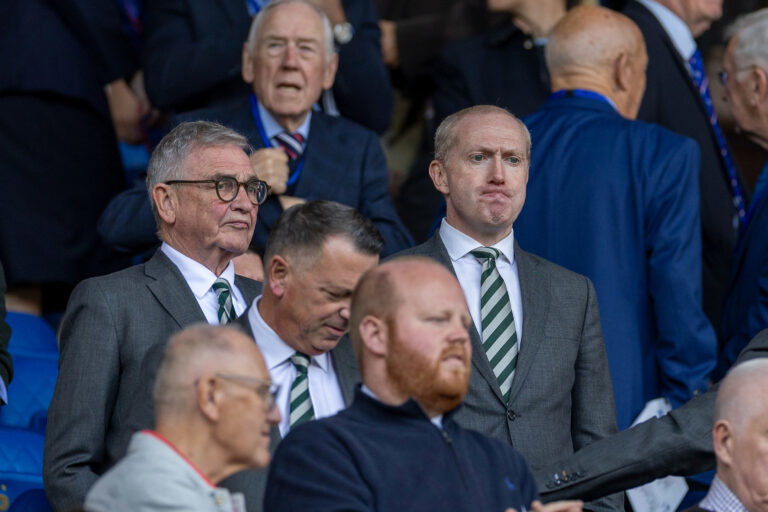
A fine article James. I think there has to be a balance. Ive been trying to look at it from an outsiders perspective. What would the golfers playing with DD have been thinking?
I guess most of them know little about Celtic. If I was on that golf course impartially, I would have been looking on with mild amusement, maybe bemusement.
I would have asked DD what the fuck is that all about?
Here is our issue. DD is going to point out he has presided over the most successful domestic sides in our entire history. We can say that has been down to good football managers..but the folk running the club are responsible for the management team also.
James, last year you compared losing the title as a disaster, finishing 3rd you compared to an apocalypse we might take years to recover from. This type of thinking is unsustainable. The fans no longer consider winning every league title as success. Not another club on the planet is there this sort of unrest with unprecedented domestic success. It’s like Bayern fans tearing the place apart because they haven’t won the UCL since 2020 or because little Leverkusen took the title off them or poundland Celtic nearly took them to extra time. Bayern have resources which blow us out of the stadium. Even if we are run in an exemplary fashion they should be putting 4 or 5 at least past us.
What if we get our wish and DD and co pack their bags. How much slack do we give the new custodians? If the Ibrox entity wins a treble in their first season do we shower them with abuse and stick their heads on tennis balls?
I’m all for change but despite our socialist roots we win because of capitalism. We thrive domestically because we are rich and everyone else (bar the basketcase) live in relative poverty. We have a dreadful league were teams like St Johnstone have to give away all sporting advantage in their home games v us and the Ibrox entity. They practically give away these points to concentrate on survival.
In europe the tables are turned. We are the paupers getting battered about the arena because of the untold riches of the opposition. You were suggesting we throw the game v Stuttgart …we are that far off the pace.
We do not belong in the UCL and all we are there for is the cash and the odd giant killing act. Even then it is not giant killing. When was the last time we actually knocked a proper team out of the UCL /european cup? Wins against Barca. Man U etc we never knocked them out. The results were not crucial to them progressing.
How much are you willing to sacrifice to change things James?
Brilliant article James, and it’s a brilliant film.