
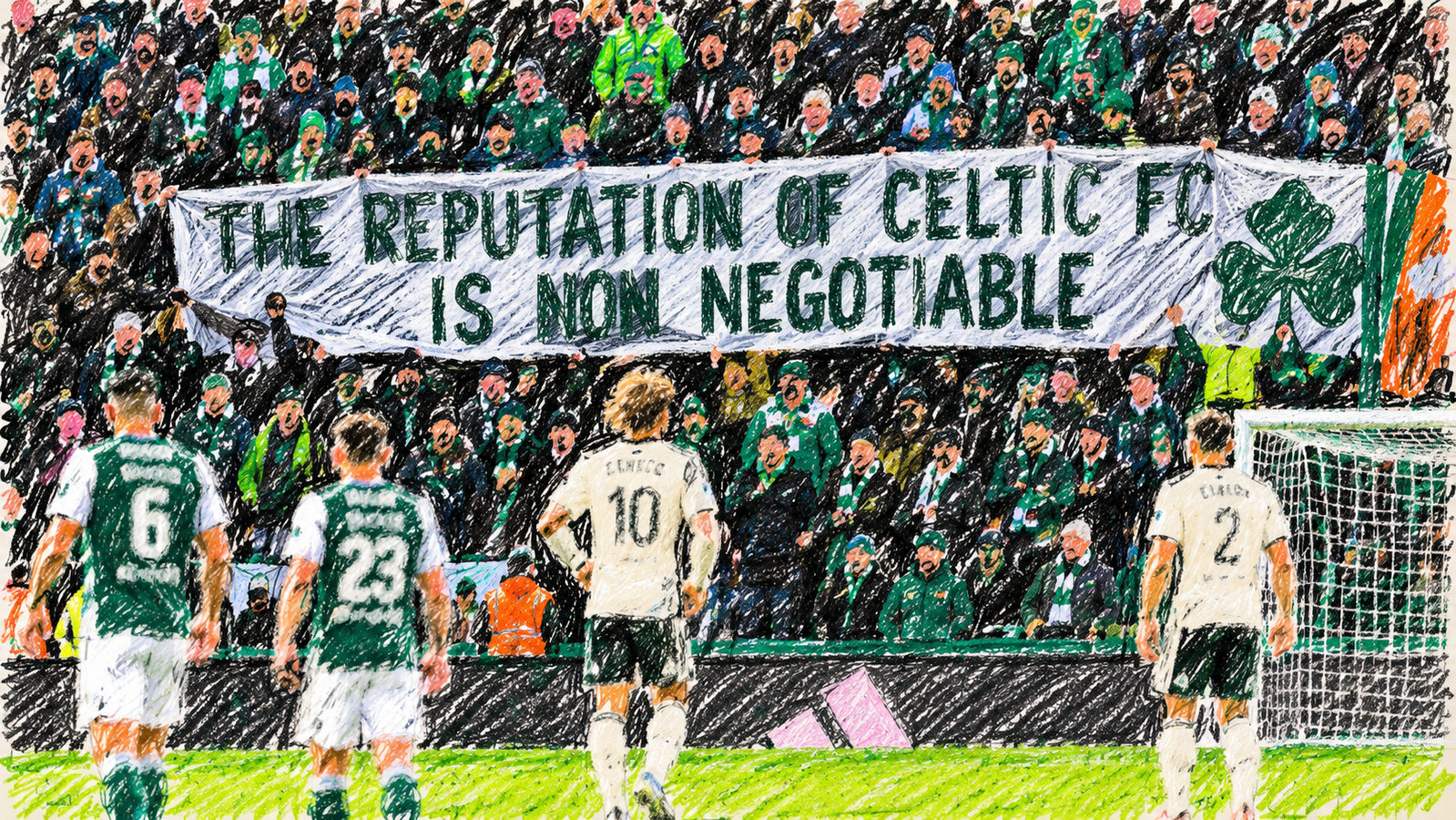
So last night, as many of you may be aware, we on the Trinity Tims podcast invited one of the pro-board guys on for a chat about the club, where he thinks it is, and where he thinks we have gone wrong in our criticisms of it.
Someone in our team has called it “the great debate”; I like the vibe it gives, but in terms of substance I’d have to disagree, although I certainly thought the show was excellent and it was a credit to Eric, in particular, for moderating it perfectly.
One day there will be a great debate between those of us on our side of the fence and those on the other side about the future of this club.
But that wasn’t it last night, and it was not because myself, Joe and Eric didn’t have our guns loaded. It was because the other guy didn’t even bother to bring his guns to the table.
In short, it wasn’t a real debate, and he never intended it to be one.
His plan was to come on, make ridiculous points without backing any of them up with a shred of evidence, and keep his answers as detail-free as possible, making blank assertions and hoping that somehow that would get him through it.
At the same time, he sought to position himself as a voice of reason and moderation, somebody who only wanted all the sides to come together and discuss things rationally. And I’m afraid that was the giveaway because that’s the furthest thing from his mind.
The problem is that the guy has an extensive social media record of calling fellow Celtic fans every vicious name under the sun, something I took pointed out as I read some of his spicier comments back to him towards the end of the show.
That came after he had asked whether we would condemn a recent podcast comment about Dermot Desmond which may have been a little off-colour, but which in no way graduated to the level of moral outrage he seemed determined to suggest it did. I wrote about that comment, and the way I viewed the dishonesty of the debate around it just the other day.
And that, more than anything else, summed up one of the problems with the whole exercise. You cannot arrive presenting yourself as the reasonable man in the room whilst carrying around a public record which shows that you are perfectly comfortable dispensing abuse when it suits you.
I’ve been in debates. I enjoy debates. I find them exhilarating and interesting.
I don’t regard myself as a particularly polished debater because I never got seriously into the craft. There were debating societies at Stirling University when I was there, but I never joined one. I only ever got involved in one formal debate, and in that debate, I was arguing against my own beliefs.
Why did I do that? Because no one else was willing to that night.
And I think arguing against your own opinion helps you construct arguments better. It forces you to think about what the other side actually believes rather than what you imagine they believe. Sometimes it even lets you see the world through someone else’s eyes.
And that, to me, is part of what debate is supposed to be about.
But he didn’t come on the show last night to do any of that.
He didn’t come on to have his mind changed or even opened a crack. He didn’t come on to have a discussion about what ails the club or how to fix it. He came on to tell us that all of our criticisms were wrong, and that as far as he was concerned there was no problem to fix.
So, it doesn’t leave a hell of a lot of room for a debate to go to. It doesn’t leave any position in which you can meet in the middle.
He came on to take the view that Celtic is a well-run club because it makes profits and consistently wins things. There was no nuance to his argument, and because there was no nuance to it, there was not the slightest hope of changing his mind in any way that mattered at all. And whether he believes it or not, if he had come with a solid and coherent case and backed it up properly, he may not have got us to come down off our own positions, but he may have made us question some of them all over again.
That is what a proper debate can do.
But of course, that was not his intention at all.
Right from the start, he set himself up by talking about being “an outcomes man” which sounds reasonable until you strip it down to its fundamentals.
He doesn’t believe that it matters how you get to a place, just so long as you get there.
But of course, it matters.
The outcome isn’t the whole story, and nor should it be treated as though it is.
The analogy that I’ve often used for where we are as a club is this: if your significant other came home and told you that they had taken out a second mortgage and put every penny of that money on red or black at a Vegas casino and got the result, would you be expected to congratulate them on a risky gamble for which they did not involve you or consult you, but which still subjected you to an enormous level of risk?
You wouldn’t accept that. You would pack their bags, throw them out in the street, and you would be right to.
Of course it matters how you arrive at a place.
That extra money sitting in the bank might be nice, but I would never quite be able to shake the feeling that my partner was a maniac for ever having gone down that road.
Last night there was a spell where I talked about my recent 50th birthday and my 25th. On my 50th, where I did a bit of reflecting about where I was at 25.
I was at university getting my media degree, and our manager at the time was Martin O’Neill. Twenty-five years later, the manager is Martin O’Neill again.
In between times, we’ve hired Rodgers twice, we’ve hired Lennon twice, we’ve hired the guy who was supposed to be Lennon’s assistant. We hired Gordon Strachan on the evidence of a meeting he had with Desmond at a horse racing event. We spent a summer pursuing Eddie Howe, didn’t get him, and then took one of those wild Vegas-type risks. Ange Postecoglou turned out to be the lottery win of all time.
We may have had success, but we had it in spite of the chaotic way in which key decisions were arrived at and the complete lack of strategic thinking that underpinned some of those calls. Celtic is not professionally run in the ways that matter. Our “global searches” are restricted to a small section of the football world.
When the guy asked us to name the best thing that the Celtic board had done in the last 10 years, my answer was immediate and obvious: appointing Brendan Rodgers as manager the first time.
But I had to caveat that by pointing out that there has long been a story that the only reason we ended up with Brendan Rodgers in the first place was that Dermot Desmond felt personally slighted in an encounter with Ibrox directors at the Scottish Cup semi-final the season before, when they knocked us out on penalties and so incensed him with their strutting egotism that he immediately decided Celtic were going to inflict genuine pain on them.
Now, I’m grateful for the outcome.
But that we arrived there because of one man’s personal feelings being hurt doesn’t inspire confidence in the process.
That we hired the guy who was intended to be Lennon’s assistant when Lennon left, doesn’t give me confidence in the process.
That we arrived at Ange Postecoglou after the entire summer had been wasted in pursuit of Eddie Howe doesn’t inspire faith in the process.
How can it be argued, then, that the only thing that matters is where we are, and that it doesn’t matter at all how we got here?
And that was just one of the problems I had with this guy’s so-called logic.
I genuinely thought we were being trolled when he defended the transfer strategy.
He said he had no problem at all with the transfer policy.
He didn’t even, as I thought he might, point to the big sales that we have made. He just offered a blanket defence of something without going into any detail at all.
Not only did I find that bizarre, I found it insulting.
Because no one believes the transfer policy works.
No one. Not even the managers who have to work under it, all of whom have expressed their frustrations with it one way or the other.
The entirety of the Scottish media has questioned it. The entirety of the fan base has questioned it. We have gaping holes all over this team.
We have loanees in about six different positions, just as we did after the January window closed last season.
And in Rodgers’ first campaign after his return, he trusted our directors to get him the players he needed, and instead they gave him a group of players he could not use because nobody bothered to ask him what his requirements were.
We have Balikwisha, who has barely kicked a ball and cost us £5 million. Tounekti, £6 million of waste. How can anyone defend a strategy which is so wasteful?
He talked about how the club is careful with what it spends, and then defended a policy that has resulted in so much of it being spent badly.
It was staggering.
We have players signed that managers cannot use because they don’t fit the system those managers want to play.
There appears to be no meaningful consultation whatsoever between the people doing the signings and the people who actually have to use them. And we have signings being made who clearly had no planned role in the team in the first place.
That is an especially noteworthy one. Because bad recruitment is one thing. Every club makes bad signings.
But signing players without a clear idea of where they fit, what role they are supposed to perform or whether the manager even wants that type of player is something else entirely.
That is not merely getting transfers wrong. That is evidence of a football operation which is not joined up. And that takes us back to the central problem with the defence he mounted.
It was all outcome and no process.
We win trophies, therefore the club is well run. We make money, therefore the club is well run. We have sold players for enormous profits, therefore the transfer strategy works.
But none of those statements, by themselves, tells you whether the organisation is being run as intelligently, strategically or effectively as it could be.
Success does not retrospectively make every decision which preceded it a good one. Sometimes you win because of good planning. Sometimes you win because somebody makes a brilliant decision. Sometimes you win because somebody else makes a terrible one.
And sometimes you put everything on black and the ball lands exactly where you need it to. The fact that you got away with it does not suddenly make it a sensible way to run a football club.
So overall, I found this guy’s performance very poor indeed.
He came with a very simplistic set of arguments, and he did not make a single point that made any sense to me. He opened the debate by talking about the board having made sacrifices; I think that’s where he lost his audience straight away. I didn’t even bother to address that point on the night; what was the point?
It wasn’t even the daftest thing he said all night.
And yet, in a sense, I almost felt sympathy for the guy. His defence of a board of directors that has not grown the economy of the club, that has not sufficiently backed the managers who have worked under it, and that has no strategic vision for how this club progresses gave him almost nothing to work with.
In the end, he was defending a ragbag squad which some are describing as one of the worst they have watched, a 74-year-old manager, a stadium in disarray, an academy system that does not produce the goods, and a board of directors which has failed so spectacularly in terms of its communication with the fans that virtually the whole support is on edge.
But then, he didn’t come on to convince us of his argument, because he has no argument. He didn’t come on to listen to anything that we had to say, because he has no interest in that. The guy who accused us of self-promotion was clearly bent on doing a little self-promotion of his own.
And that’s fine. That’s okay, if you’re honest about it, if you’re upfront.
I don’t think he was either of those things.
There will be a great debate on the future of Celtic. There has to be. There should be people on both sides of this argument willing to come together with facts, evidence and serious ideas about where this club is, what has gone wrong and what Celtic ought to become.
I would genuinely welcome that discussion. I am sure I would even learn something from it.
But as I said at the top of this piece, this was not it, and it was never going to be. A real debate requires goodwill and mutual respect; his past conduct, and the way he framed some of his questions made it clear that those terms don’t apply.
For those who want to see it, nevertheless, the debate can be watched below.
Choose The CelticBlog as a Preferred Source on Google News…





Calling this “The Great Debate” rivals Poundland for breaking the trades description act.
It would be best to source a Celtic shareholder, preferably close to the board, who holds a balanced view and a genuine desire to see all sides come together,
The entire podcast was a car crash from start to finish. Only Eric came out of it with any dignity or goodwill. It’s all over social media. You lot have just handed over the baton to the Huns to start their very own banter years.
Joe McHugh reminded me of Donald Trump mocking that disabled guy on one of his rallies. What a PRICK.
What the hell possessed you 3 to even think this would work. Joe should hang his head in shame. And then you came at the bloke about his american president! Wtf for? Glad Eric shut you down when he did or christ knows where you end up.
Here is an opinion to chew on, you 2 can never nor ever go near a debate again, both of you are way to emotional.
You made a criminal mistake as podcasters. In the end you made the pod about you 2 instead of the debate!! , thats all the huns will need ,thats all the happy clappers need, you both became the memes that the board thinks all fan media are.
Ffs! Stick to what your good at, and joe? Mate,you really need to take a break and take stock of your contribution then come back the better for it.
All imo james.