
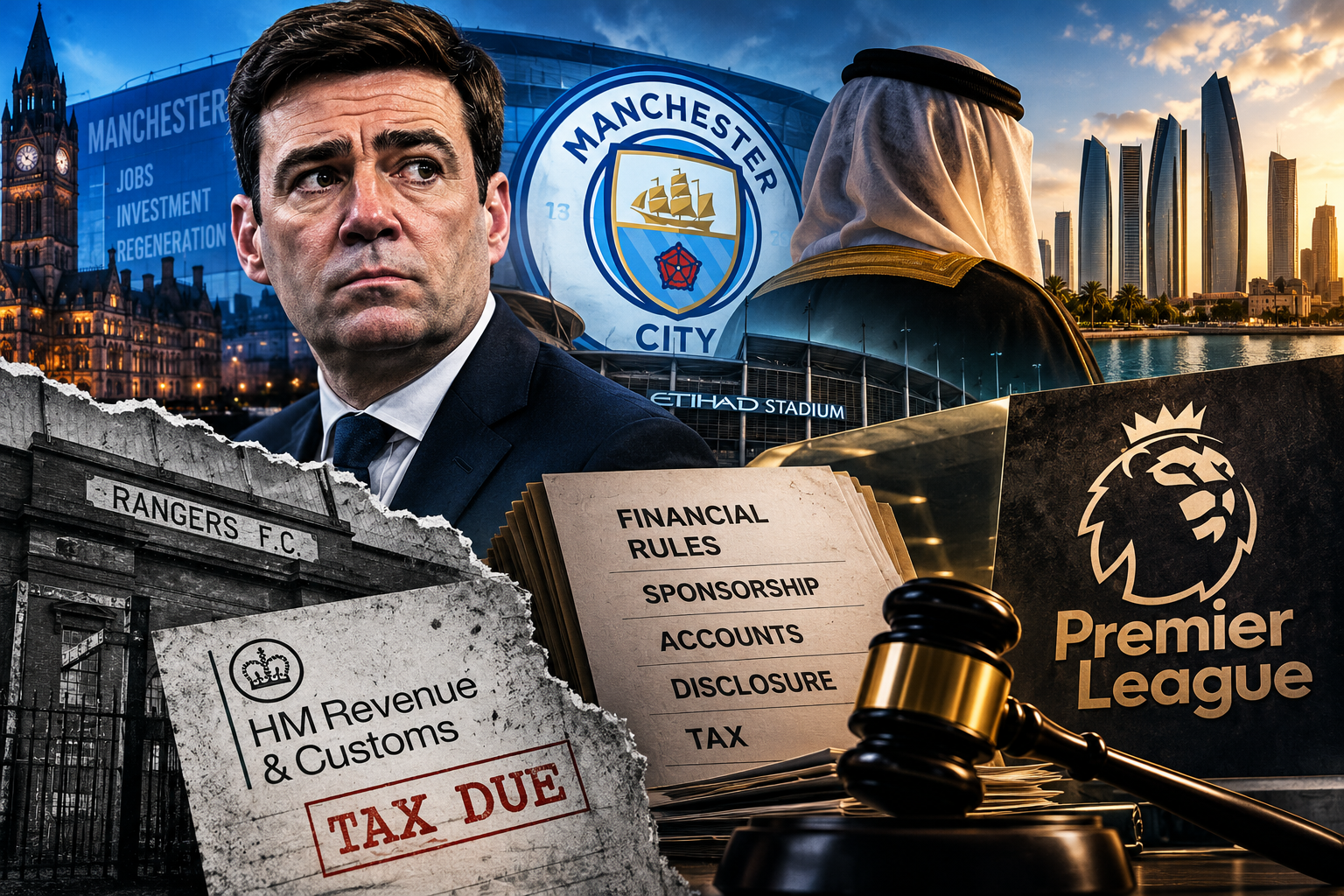
The Manchester City situation has been one of the godsends of the last half-week for anyone trying to write about football during an international break.
Even going into the final week of this break, there has been no shortage of material. But what is happening at City shines a light through the events of 2012 and the scandal which erupted at Ibrox.
That scandal had been developing for years by the time Rangers went into administration. Questions about the club’s tax affairs and use of EBTs had been circulating long before liquidation arrived. I have always wondered why the football authorities did not move harder and earlier once those issues began emerging.
Perhaps part of the explanation was that Rangers was already visibly crumbling under David Murray and desperately needed a buyer. Perhaps nobody wanted to put another obstacle in the way of that process. I cannot prove that, and I am not pretending I can.
In the end, of course, they did find a buyer. It turned out to be Craig Whyte.
But that is not really what I want to talk about here.
It is just another light being shone into a dark place. What interests me is the very brief flirtation our political class had with the Rangers crisis in 2012, and the danger inherent in some of what we are now seeing around Manchester City.
Andy Burnham has only recently become Prime Minister and, so far, he has done reasonably well in connecting with the public and making Labour look as though it has some political purpose again. He comes across as a straightforward, plain-speaking politician, which is precisely why the Manchester City situation is potentially dangerous for him.
Burnham’s political identity is heavily tied to Manchester and its regeneration. The Abu Dhabi ownership of Manchester City has invested billions in the club, the surrounding area and wider development projects, and Burnham has publicly described the City Football Group as a “huge partner in the building of modern Manchester”.
He has also said he would be “really concerned” if the owners were ultimately forced out. At the same time, he has insisted that he will not interfere with the football process.
That is already an uncomfortable place for a Prime Minister to be standing.
I have some sympathy with him. Manchester’s regeneration is intimately connected with investment from Abu Dhabi-linked interests, and Burnham’s record in the city helped make him credible nationally in the first place. But that is exactly why this was a political problem waiting to happen.
During 2012, some politicians in Scotland were willing to take risks which looked ludicrous to me at the time.
Alex Salmond intervened publicly in the Rangers situation and appealed for an agreement between the club and HMRC which would allow Rangers to continue operating. He explicitly said that Scottish football needed Rangers and that HMRC should be part of finding a solution which allowed the club to survive.
Salmond, a Hearts supporter, had no obvious football allegiance to Rangers. Perhaps he saw the issue through the prism of jobs, the local economy and the wider significance of a large Scottish institution.
But to many Celtic supporters, the intervention felt wrong.
It also seemed politically risky.
For all the mythology which existed around Rangers at the time, there were limits to its institutional power. I said then that a West of Scotland football club was not going to stop an investigation involving two things which tend to trump almost everything else: money and power.
Whatever Rangers supporters believed about the importance of their club, HMRC was dealing with unpaid tax and the machinery of the state.
That machinery did not care about mythology.
Craig Whyte complained publicly that HMRC had been inflexible. HMRC’s response was devastatingly simple: PAYE and other taxes deducted from employees had to be paid, and any business which treated tax as an optional expense was putting its own survival at risk. Rangers owed around £9 million in unpaid PAYE and VAT after entering administration.
Later, when Charles Green’s proposed CVA required creditor approval, HMRC rejected it. That decision ensured the proposal failed and Rangers plc proceeded towards liquidation, with the assets subsequently transferred to a new company.
Political appeals did not move the needle.
HMRC made its own decision.
That, to me, is the one genuine lesson English football can learn from what happened here.
They are certainly not learning it from Scotland’s football authorities, because they were beyond useless.
Those bodies spent far too much time trying to find a route which might preserve Rangers’ place at the top level after liquidation. The attempts to shoehorn the newco back into the upper reaches of Scottish football would, in my view, have amounted to rewarding the very culture of rule-breaking and financial recklessness which had brought the old company to ruin. No. The lesson does not come from Scottish football’s handling of Rangers.
It comes from what happened outside football.
HMRC ignored the political entreaties. It ignored the social significance of the club. It ignored the noise. It asked the only questions which mattered to it.
What money is owed? What obligations have been breached? What do the rules require?
Then it acted accordingly.
Manchester City is a much more difficult and much more politically radioactive situation.
Whatever Rangers thought it was in 2012, the stakes here are vastly larger. Manchester City’s Abu Dhabi ownership is connected to one of the most powerful political and economic networks in the world.
Critics have described the City project for years as sportswashing: an attempt to use sporting success and global prestige to improve perceptions of Abu Dhabi and the UAE.
Whether one accepts every part of that analysis or not, the reputational problem is now obvious. City and its owners are being branded cheats everywhere.
That is not me making a final legal judgement. It is a description of the public stigma now attached to them.
An independent Premier League commission has found Manchester City guilty of serious financial-rule breaches over nine seasons, including the use of what the Premier League described as “sham” commercial contracts, misstated accounts and concealed financial information. City has appealed and continues to insist that it is innocent and that the commission’s conclusions contain material errors of law, principle and fact.
Nothing in this piece assumes that the current findings are necessarily the final word.
But reputationally, enormous damage has already been done.
If the purpose of owning Manchester City was partly to generate prestige, positive association and international goodwill for Abu Dhabi, then even a successful appeal cannot simply erase years in which the words “Manchester City”, “financial breaches”, “sham contracts” and “cheating” have been fused together in the public imagination.
That is why the sportswashing project, if that is how you understand it, has already malfunctioned.
And worse may yet follow.
Questions have now been raised about possible tax consequences arising from the commission’s findings. HMRC and other authorities are reportedly examining the wider implications, but those matters remain allegations and areas of possible investigation rather than established criminal or tax offences.
If the story moves beyond football regulations into questions of compliance with UK law and taxation, then Manchester City’s owners find themselves in territory which begins to echo elements of what happened at Ibrox, albeit on an incomparably larger geopolitical scale.
This is where the political danger becomes enormous.
The Abu Dhabi ownership has done far more than put money into Manchester City. The relationship between the UAE and Britain reaches into investment, infrastructure, trade and diplomacy.
That means the people responsible for deciding City’s football fate may eventually find themselves operating under pressures which have very little to do with football.
Pressure from government. Pressure from business. Pressure from diplomatic channels. Pressure from people warning about investment, jobs and wider economic relationships.
The temptation to say, “Yes, rules were broken, but look at what might happen if we punish them too severely,” could become immense.
That is exactly where football has to be strongest.
Burnham is already caught in the tension. He has publicly praised City’s owners and spoken about the importance of their investment while also saying that he cannot interfere in the independent disciplinary process.
That line has to hold.
Everyone’s line has to hold.
Because if rules apply differently according to the economic importance of the person or institution accused of breaking them, then they are not really rules at all.
The football authorities in England have to learn the lesson HMRC demonstrated in Scotland.
Ignore the noise. Ignore the prestige. Ignore the size of the club. Ignore the political consequences. Ignore whether the owners are important investors.
Most importantly, perhaps; ignore whether politicians are nervous.
Ask what the rules say.
Ask whether those rules were broken.
Then impose whatever punishment the rules and evidence justify. That is all.
The current findings against City are serious. The club has appealed them, and until that appeal is resolved nobody should pretend the process is finished. Possible sanctions have ranged in public discussion from enormous fines and points penalties to relegation or even expulsion, but no final sanction has yet been determined.
There may also be ownership consequences if findings ultimately upheld raise separate questions under English football’s ownership rules.
Again, that is a possibility, not a certainty.
But imagine the scale of it.
If the eventual process resulted in City’s Abu Dhabi ownership being required to sell, we would be talking about something far bigger than the forced departure of a football owner. We would be talking about a potential year-zero moment in a relationship between Manchester, British football and one of the world’s most powerful investment networks.
What would Abu Dhabi do then?
Would it continue investing at the same level elsewhere in Britain?
Would the relationship cool? Would projects disappear?
Would the political relationship be damaged?
Nobody can know those answers now.
But these are precisely the kinds of questions which will make politicians extremely nervous if this case continues moving in that direction.
That is real money. That is real politics. That is real power.
And somehow football has to find a way to ignore all of it.
I do not envy the people who eventually have to make those decisions.
But this is the job.
HMRC did not exist to protect Rangers. The Premier League does not exist to protect Manchester City. The regulator does not exist to protect Britain’s relationship with Abu Dhabi. The rules exist to protect the integrity of the competition.
The people responsible should focus on the most basic questions possible.
What do the rules say? Were those rules broken? If the findings survive the appeals process, what punishment properly reflects their seriousness and discourages anyone from trying the same thing again?
If English football can answer those questions without allowing politics, economics or institutional power to contaminate the process, it will have done more for the integrity of the sport than almost anything in the modern era.
But if it bows to pressure because Manchester City is too big, too valuable or too politically connected to punish properly, then English football will poison itself.
We know what that looks like in Scotland. We have lived for years with the arguments about survival, continuity, victimhood and whether the rules should somehow bend because one institution regarded itself as indispensable.
Once you allow that poison into the bloodstream of a sport, it stays there.
There is no un-ringing that bell.
Choose The CelticBlog as a ‘Preferred Source’ on Google News for quick access to the news you value.







Right on cue James, Abu Dhabi appear to have interpreted Burnham’s words as a weak link worth holding to ransom:
https://www.telegraph.co.uk/news/2026/10/02/uae-threatens-burnham-over-man-city-pull-billions-out-of-uk/
HMRC’s determination to hold Rangers to account in the same manner as Gretna, Clydebank, Airdrie and the individual self-employed worker like myself, completely changed my outlook towards them. Until that point I had thought “it’s one rule for us and another rule for them”.
The English authorities need to bravely take the same path.
It will be a good thing for English football and England if the sportswashing projects are held to account. In this country we ignore the horrors committed by the regimes in the middle east because of the money. It’s not just Man City and Newcastle. Not even the managers and players in saudi who we applaud filling their pockets.
Ordinary citizens think it is perfectly acceptable to go to these countries for tax free inflated wages while half the population is persecuted.
Folk going on holiday to Dubai ffs.
Dubai is a false facade where human rights abuses and slavery is off the scale. Complete homophobia in all these arab countries we brush under the carpet while we are sipping pina coladas in the desert sun.
It’s horrific behaviour!
Man City were an honest club with a great fan base. Fans who were not entitled, not expecting glory every year. Villa is a great example of how a club like Man City could have operated.
A total reset is needed and if the Abu Dhabis threaten to go…..good riddance…it’s a toxic culture we can do without.