
Last week the SPFL released its latest financial figures, and you could almost hear the champagne corks popping at Hampden.
Nearly £50 million distributed to clubs. Record-breaking. Historic. Two years ahead of schedule. Everybody involved apparently deserves a hearty slap on the back.
What a joke. What a mess we are. Few things sum up the shambles of the game here in Scotland than the idea we should be excited over this. The SPFL league champions got £5 million. It’s chump change in the modern game and we all know it.
So, when you actually look at what £50 million means in the context of modern European football, I am not sure this is very obviously not the triumph they think it is.
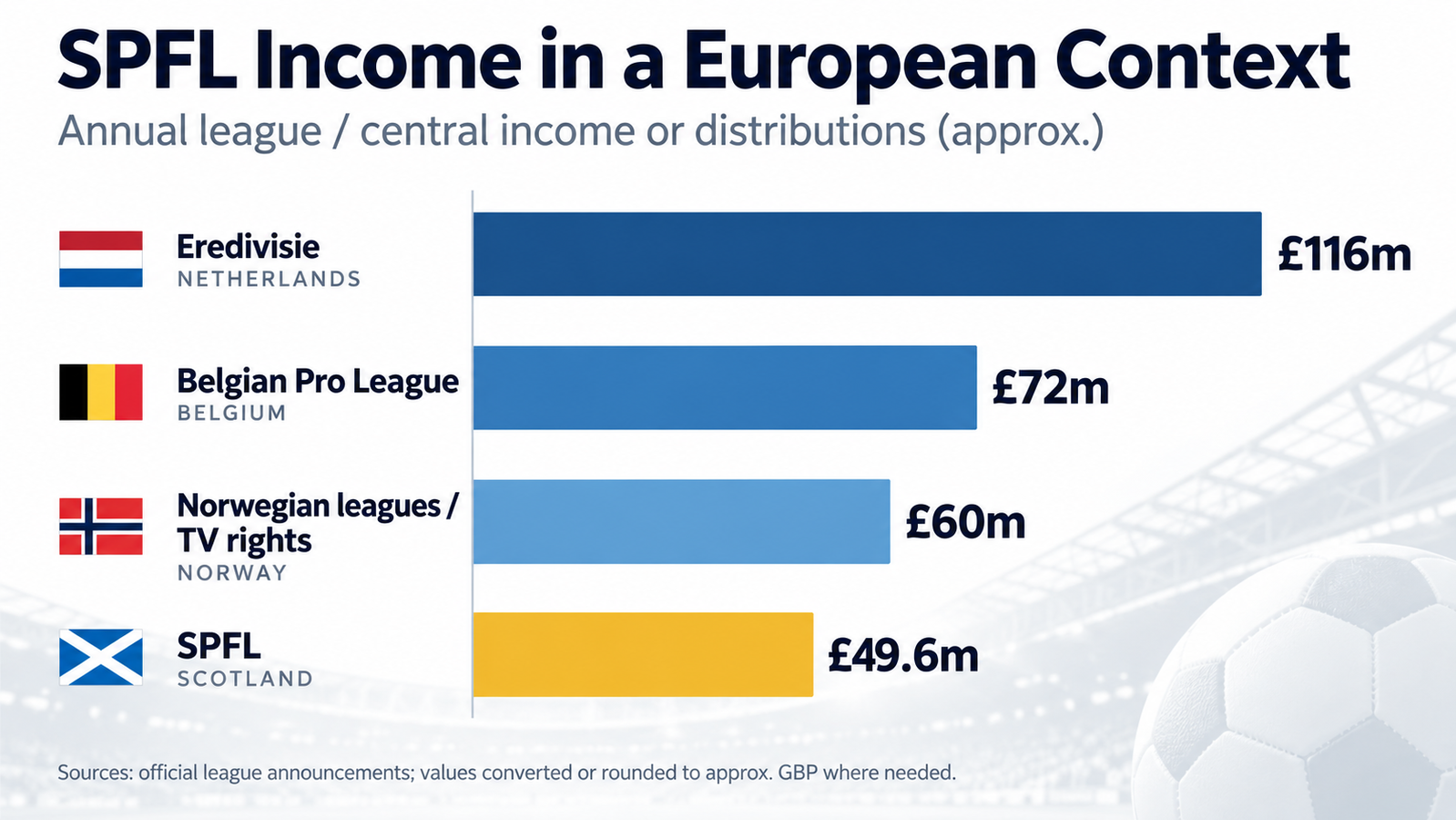
The official figure is £49.6 million in total group distributions, up £7.6 million on the previous year. Group income reached £58 million, while fees paid directly to clubs rose to £41.2 million. The SPFL had set itself a target of reaching £50 million in distributions by 2029 and now expects to get there two years early.
Progress is progress, I suppose, and an 18 per cent rise is obviously better than an 18 per cent fall. Nobody should sneer at more money flowing into Scottish football.
But this is where perspective matters and in those terms … I really don’t know what we’re celebrating about. This whole league is amateur hour.
Remember, too, that £49.6 million is not a television contract for the Premiership alone. It is the total distribution across the SPFL group. It covers payments through the league ladder, parachute payments, women’s football, League Cup prize money, Evolution Trophy money and television facility fees.
In short, it’s a joke. We’re still lagging behind almost league in Europe and that’s because we have people like Doncaster and others who think this represents success.
In other words, this is the number the organisation itself has chosen as the great measure of commercial progress across the Scottish professional game. And it is pitifully small.
Look at Belgium. The Belgian Pro League’s current domestic media agreement guarantees at least €84.2 million every single season from DAZN, VRT and RTBF before international rights are added. That package covers the professional leagues, cup, Super Cup and women’s competition, and runs from 2025 to 2030.
Look at the Netherlands.
The Eredivisie’s deal with ESPN runs for five years from 2025, and reporting around the agreement put its value at roughly €750 million across the cycle, with Dutch clubs receiving around €135 million per season from the arrangement.
Look at Norway, a country with a population not wildly different from Scotland’s.
Its current football rights agreement with TV 2 is worth 4.5 billion Norwegian kroner across six years. A new package beginning in 2029 is worth 820 million kroner per year. And then, just for the sheer comedy value, look south.
In the 2024/25 Premier League season, Southampton finished bottom and still received £109.2 million in central payments.
One club. Bottom of the league. More than twice what the entire SPFL group has just congratulated itself for distributing around Scottish football.
Liverpool received £174.9 million.
Now, obviously, nobody sensible expects Scotland to compete with the Premier League financially. That would be ridiculous.
The English league is a global commercial monster. Its clubs play in another financial universe. Belgium and the Netherlands are bigger countries too, so these are not perfect like-for-like comparisons.
But that is not really the point. The point is that when the SPFL tells us that almost £50 million is evidence of how brilliantly Scottish football is doing commercially, somebody really should ask a more important question.
Compared with what? Compared with where we were last year? Yes, it is better. Compared with what this league ought to be capable of generating? That is a very different conversation and we don’t even want to have it.
Scottish football has enormous advantages which are constantly undersold.
We have extraordinary attendances relative to population. We have clubs with genuine history and identity. We have one of the most famous rivalries in football. We have packed grounds, passionate supporters and an atmosphere which broadcasters themselves constantly use to sell the product.
The SPFL itself was boasting this year that Premiership attendances were heading beyond four million in a season for the first time.
So why does the commercial value of the product remain so modest?
That is the question. And it is why I find these triumphant announcements slightly irritating. We all know our game’s leadership is a joke, but the longer clubs tolerate it the longer this third rate thinking will continue to dominate our game.
The SPFL has a habit of setting itself targets which are based largely on its own previous performance, achieving them and then presenting the result as evidence of exceptional success. If I set myself the target of running 100 metres in 45 seconds and eventually manage it in 42, I am technically ahead of schedule.
I am still not getting selected for the Olympics.
Scottish football should stop measuring itself only against Scottish football. That is how mediocrity becomes normal, and mediocrity is now built into our DNA.
The benchmark should be what comparable football markets are achieving, how aggressively they sell their product, how widely they distribute it and how effectively they turn supporter interest into commercial value.
The £49.6 million figure is welcome. Of course it is.
More money into clubs is a good thing.
But it is not something I would be parading around as proof that the commercial job is done. Quite the opposite. I would look at that number, look around Europe and ask why Scottish football, with all of its history, passion and extraordinary supporter engagement, is still generating so little.
That seems like a more useful conversation than congratulating ourselves for nearly reaching £50 million. Because if this is success, our ambitions remain far too small, but then this is the consequence of small-minded leadership and weakness at every level.
Choose The CelticBlog as a ‘Preferred Source’ on Google News for quick access to the news you value.







Disagree with “ We have one of the most famous rivalries in football”
We lost one of those clubs in 2012 to liquidation.