
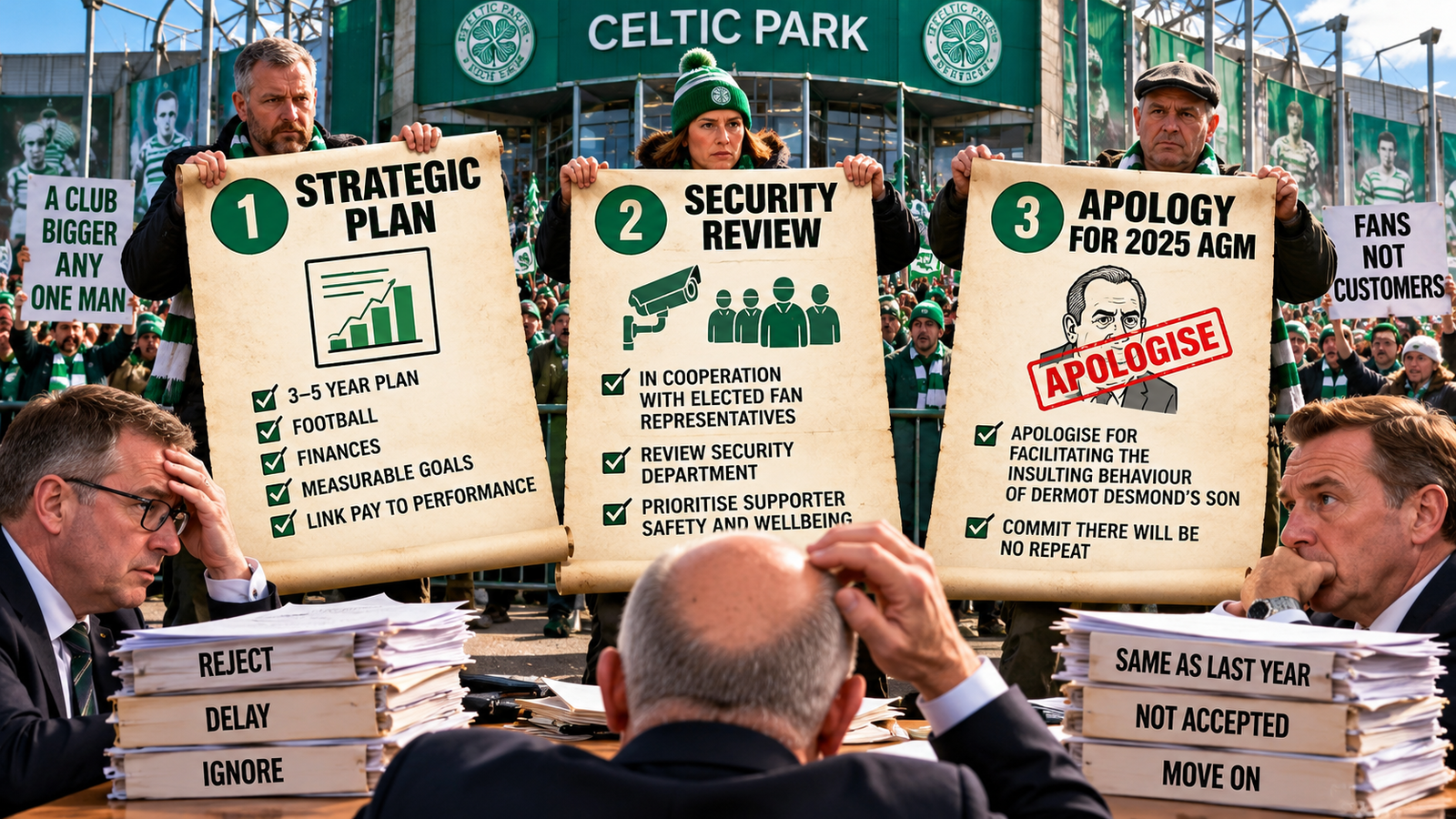
The Celtic Trust has now published the three resolutions it wants placed before this year’s Celtic PLC AGM, and the first thing that struck me when I read them was just how modest they are. That is important.
Because none of these proposals is revolutionary.
None of them asks the Board to surrender control of Celtic. None of them demands that Dermot Desmond hand over his shares, that Michael Nicholson be frogmarched out of Celtic Park or that Brian Wilson be made to stand outside the front door wearing a sandwich board saying, “I promise to listen to supporters.”
They are, in fact, remarkably restrained.
And that is exactly why they are so clever.
The first resolution calls on Celtic PLC to prepare and publish a three-to-five-year strategic plan covering football, finance and the general direction of the company, with measurable goals attached to it. The Trust also wants remuneration linked to the achievement of those targets.
This should be one of the least controversial propositions ever placed before the shareholders of a major football club.
Seriously, how is this even an argument?
A football club the size of Celtic should be able to produce a medium-term strategic plan almost automatically. In fact, plenty of major clubs and companies publish versions of precisely this kind of thing as a matter of routine.
It is not radical governance. It is basic governance.
Where are we trying to be in three years? Where are we trying to be in five? What does success look like? What are the financial targets? What are the football targets? What are the infrastructure targets? Who is responsible for delivering them?
That is not an unreasonable set of questions.
It is astonishing that shareholders should even have to force the issue.
And here is the really extraordinary bit: they already tried.
Almost exactly the same proposal went before the AGM last year as Resolution 16. It asked the Board to produce a strategic review and a published three-to-five-year football, financial and strategic plan containing clear aims and measurable goals.
It was rejected. Not narrowly either.
It received 937,393 votes in favour and 81,376,138 against. That means 98.86 per cent of votes cast went against it.
Think about that. Celtic shareholders were asked whether the club should publish a proper medium-term strategic plan with measurable targets, and the controlling voting bloc effectively said no.
That was absurd last year. It will look even more absurd if they do it again.
Because what exactly is the objection?
“We prefer not to tell anyone what the plan is”?
“We do have a plan, but you cannot see it”?
“We do not wish our performance to be measured against specific goals”?
None of those answers is particularly flattering.
The second resolution is even more interesting because of what has happened over the last few days. The Trust wants a review of Celtic’s Security Department, carried out in cooperation with elected fan representatives, with supporter safety and wellbeing prioritised.
Now, everybody knows what the politically explosive bit of that sentence is.
“Elected fan representatives.”
Because the most obvious body capable of providing that kind of democratic representation is the Celtic Fans Collective.
And Celtic has just publicly announced that it no longer recognises the Collective as representative of the support and will cease engagement with it.
So, I think we can make a fairly educated guess about how warmly that wording is going to be received.
The problem for the club is that this exposes the absurdity at the heart of its position.
The Collective is not simply a couple of guys who created a Twitter account on Tuesday morning and declared themselves the voice of Celtic supporters. Its structure incorporates representatives from the Celtic Supporters Association, the Celtic Trust, the Disabled Supporters Association, fan groups, fan media and supporter clubs from Scotland, England and Ireland. It is an enormous fan movement.
More importantly, the Collective has been arguing for supporter representatives to be selected democratically rather than effectively chosen by the football club itself. At its September meeting with Celtic, it explicitly proposed supporter nominations and democratic elections as the basis of a Fan Advisory Board.
That is the awkward thing for Celtic.
The club may refuse to recognise the Collective.
It cannot simply wish away the representative mandate of the organisations inside it.
If you want supporter representation, then at some point you have to deal with people supporters actually choose.
Otherwise, it is not supporter representation.
It is management consultation.
And then we reach Resolution Three.
Oh boy.
The Trust wants the Board to apologise for facilitating what it describes as the “egregiously insulting behaviour” of Dermot Desmond’s son at last year’s AGM and to give a commitment that there will be no repeat.
I actually laughed when I read that one.
Not because the Trust is wrong to ask.
Because the chances of this Board apologising for it must be somewhere between remote and the second coming.
Ross Desmond was permitted to use last year’s AGM to deliver an extraordinary attack on supporters. The Trust’s position is that the Board facilitated it, allowed the AGM platform to be used in that manner and should now accept that it damaged already strained relations with the fanbase.
Do we seriously think they are about to say sorry?
At this point I would not be remotely surprised if they invited him back this year and gave him another microphone.
After Golfgate, perhaps he can do a follow-up.
A sequel.
Ross Desmond II: This Time It’s Personal.
The very idea of this Board issuing an apology to supporters over what happened last year is almost comic.
And yet once again that is exactly why the resolution works.
Because these motions are not really about expecting the Board to approve them.
That is not the game here.
The game is making them reject them.
That is the trap.
Reject the strategic-plan motion and the Board has to explain why Celtic should not publish a coherent three-to-five-year plan with measurable goals.
Reject the security motion and it has to explain why genuinely elected supporter representatives should not have a meaningful role in reviewing supporter safety.
Reject the apology motion and it sends the clearest possible message that it does not regret allowing last year’s AGM to descend into what it became.
That is the cleverness of all three.
They force the Board to put its position on the record. There is no need for extravagant demands. No need for impossible conditions. No need to ask for things which allow the club to say, “Well, obviously that is unreasonable.”
These are basic propositions.
That is what makes rejecting them look so bad.
And I suspect that is precisely the point.
The Trust surely knows the voting arithmetic. Last year’s strategic-plan resolution received just 1.14 per cent support among votes cast. Nobody seriously expects this Board suddenly to wake up on AGM morning, experience a Road to Damascus conversion and declare that supporters have been right all along.
That is not what this is about. This is about laying out three propositions which ordinary supporters can read and think: what, exactly, is objectionable here?
A plan? Independent supporter representation? An apology for insulting the support? Then the Board gets to vote them down. Again.
And every rejection becomes evidence. Evidence that the problem is not that supporters are asking for too much. It is that the people running Celtic are willing to give them almost nothing. That is why these motions matter.
Not because they are likely to win. Because losing them may tell us far more.
If the Celtic Board wants to reject a strategic plan, reject democratically chosen supporter representation and reject the opportunity to apologise for last year’s AGM, then let them.
Let them do it publicly. Let them put the numbers beside their names. Let everybody see it. Because sometimes an AGM resolution is not designed to win the vote.
Sometimes it is designed to reveal who is prepared to vote against it. And these three could do exactly that.
Choose The CelticBlog as a ‘Preferred Source’ on Google News for quick access to the news you value.







Good article Paulina …this AGM will be about whether there are any surprises then ? Or a surprise if anything really changes !!
Don’t hold your breath lol!