

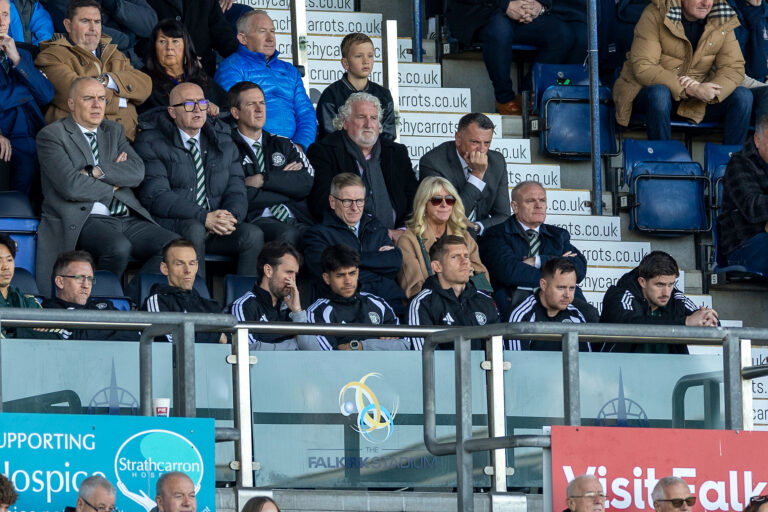
25th January 2026; Tynecastle Park, Edinburgh, Scotland: Scottish Premiership Football, Hearts versus Celtic; Hearts owner Tony Bloom
Tony Bloom is in the news again today, and I have to say that I find this guy increasingly fascinating. He is still doing a little bit of whinging over last season’s title, but honestly, I can live with that. His side lost it on the final day.
What interests me much more is the broader view he is taking.
Bloom is not talking like a man obsessed with one lost title. He is talking like somebody thinking ten years ahead. He has said that if Hearts have not won the Scottish Premiership within that period, he will be majorly disappointed.
That is a very different kind of statement.
It is not about revenge for last season. It is not about one game, one refereeing decision or one campaign.
It is about building something which can eventually break the existing order.
Bloom thinks he has a real shot at this.
And on paper, he probably should not.
Competing with a Celtic that has many, many times Hearts’ resources should be almost impossible. Competing with the club across the city, which also has many times their resources, should be almost impossible too.
But that club has been making structural mistakes for years, the kind of mistakes which naturally give a club like Hearts confidence.
And increasingly, of course, we are making major structural mistakes of our own.
See, two things have to happen before there is a serious challenger from outside Glasgow.
First, that club has to improve massively. It has to establish itself firmly as the biggest club outside the traditional top two. It has to start putting up 80-plus-point seasons on a regular basis and prove that one great campaign was not a glorious one-off.
Second, both Glasgow clubs have to have a terrible year at exactly the same time.
That freakish confluence of events is what gave Hearts their opening last season.
I have no idea what Bloom thinks of the club across the city, because he hardly ever talks about them. To be honest, he rarely talks much about us either, except in the obvious context that Celtic are the champions.
We have been champions for the past five years in a row. We have won 15 of the last 16 league titles.
Bloom knows that if Hearts are ever going to get where he wants them to go, eventually they have to beat us.
What he can see across the city is what all of us can see.
They spend an awful lot of money in the hope that sheer expenditure will eventually unlock the door and get them across the line as champions.
The problem is that it is not remotely clear they spend that money intelligently.
It is not clear they are building around coaching, analytics, sports psychology, recruitment science and all the other marginal gains which can allow a club to punch above its financial weight.
Their spending often suggests the opposite. It suggests a club looking for the quickest possible answer rather than trying to build the smartest possible structure.
And Bloom’s entire approach to football is based on the belief that structure matters.
That is where Celtic should start paying attention.
Because if Bloom does not regard the club across the city as the main long-term obstacle, then that effectively leaves Celtic standing between Hearts and the title he wants within the next decade.
And that is what makes his confidence interesting.
Because if you looked only at Celtic as an institution, at our financial strength, at the value of the squad and at the sheer scale of the club, you would not be remotely cavalier about the challenge.
But Bloom will not only be looking at Celtic’s structural strength.
He will be looking at how Celtic is run.
The ownership. The leadership. The decision-making. The recruitment. The coaching structure. The kind of manager we are likely to appoint next.
And that is where the gap between Celtic’s potential and Celtic’s reality becomes enormous.
If Celtic actually brought all of its advantages to bear, if we recruited top continental coaches, brought in elite analytics and sports-science people and properly utilised every tool available in the modern game, we would be almost unassailable domestically.
We would not be talking about scraping into the 80-point range.
We would be talking about 90-plus points every year.
That, as I have always said, is the baseline for winning this league.
Ninety points is 30 wins from 38 games. Put another way, you could lose four times to the Ibrox club and four times to Hearts and still finish on 90 points if you won every other match.
That sounds ridiculously difficult until you remember that Celtic managers have routinely produced seasons in that territory.
We have even broken the 100-point barrier.
A Celtic built on the right foundations and properly exploiting every advantage available in modern sport would be virtually untouchable.
Hearts are not catching that Celtic. Nobody in Scotland is.
Which means Bloom’s confidence tells us something.
He must believe there is a realistic chance that Celtic will not operate anywhere close to its full potential over the next decade.
And looking at the way this club is run right now, I find it difficult to say that is an unreasonable assumption.
Celtic has been bailed out time and again by good managers.
Those days may be coming to an end.
We have also been bailed out repeatedly by having the best squad in the country. I wonder whether that advantage is beginning to erode too.
Look at some of the players who will leave Celtic over the next few years and ask yourself whether you trust the current people to replace like with like.
Take Carter-Vickers.
We are not getting the kind of eight-figure fee for him now that we once might have imagined. If he runs his contract down, we get nothing.
Then there is Callum McGregor.
How do you replace him? He is not just the captain. At times, he is the glue that holds the football operation together. He carries institutional memory. He understands the standards. He understands what Celtic is.
When he goes, this becomes a different team.
A lesser team.
And under the people currently running the club, I have very little confidence that they will identify and recruit a genuine long-term replacement.
Because that is not how they think.
Too often, every player is regarded first as a saleable asset rather than as part of the bricks and mortar of the football club.
And that is where Bloom sees his opening.
A club which thinks in ten-year cycles can exploit clubs which think six months at a time.
The long and short of it is that Bloom has confidence because we are giving him confidence.
He has hope in this project because we are inspiring hope.
If Celtic were run properly, I do not think this guy would be talking quite so confidently about winning the league within the next decade.
He believes the opportunity is real because the Scottish football landscape is giving him reasons to believe it.
The club across the city keeps making short-term decisions.
Celtic keeps failing to maximise its enormous advantages.
That is Hearts’ opportunity.
Maybe Bloom will ultimately do us some good.
Maybe he will be the thing that finally shakes Celtic out of its complacency and arrogance.
That remains to be seen.
But I know this. Bloom is not going anywhere.
He is not in this for the short term. He thinks in decades. And on that timeline, yeah, Hearts have a chance.
Because on our timeline, things do not get better any time soon.
Not under these people.
Choose The CelticBlog as a ‘Preferred Source’ on Google News for quick access to the news you value.









Celtic does not get bailed out by good managers James. We get bailed out because the opposition is gash. The good managers you talk of, have presided over all time record defeats home and away in europe in the last few years.
Lenny won 5 league titles 2 trebles and got us to the last 16 in the UCL.
Do you call that getting bailed out by a good manager?
Ps what holds us back is this league being so easy to win that it’s become an irrelevance to the fans. The only club in the world on 5 in a row, 2 points clear and widespread protests about it all!