

Martin O’Neill has revealed that Benfica manager Marco Silva admitted his side were wobbling during Celtic’s second-half fightback in Lisbon.
Apparently, that’s supposed to give us something to feel encouraged about.
Come on, Martin.
We lost 4-1 in Lisbon. Four goals to one. In the Europa League, not the Champions League.
And we’re now discussing whether the opposition manager was a wee bit worried for fifteen minutes?
Is this honestly where Celtic Football Club has arrived?
Marco Silva Was Hardly Going To Tell Martin His Team Were Rubbish
Speaking ahead of the Celta Vigo match, O’Neill explained that Celtic had created opportunities to make the contest more interesting.
He acknowledged Benfica could have scored more goals on the counterattack, but pointed towards the opportunity that struck the post when Celtic were trailing 3-1.
Martin then revealed that Shaun Maloney had spoken with Marco Silva after the match. The pair know each other from their time at Hull City.
According to O’Neill, Silva admitted Benfica were “wobbling at 3-1.”
Martin added: “That might tell you something.”
Ehhhh with the greatest respect, Martin, it doesn’t tell me very much at all.
What exactly did we expect Marco Silva to say?
“Martin, your team were absolutely rotten. We took our foot off the gas, and you’re lucky we didn’t score another four”?
Of course he wasn’t going to say that!
These are experienced football people, familiar with one another and perfectly aware of the pressures that come with management.
It sounds to me like the standard pleasantries exchanged between people who have mutual respect.
I’m not accusing anybody of making things up. Benfica might genuinely have been uncomfortable when Celtic threatened to reduce the deficit.
But there’s a world of difference between feeling uncomfortable for a spell and actually being in danger of losing a football match.
The scoreboard doesn’t record moments of nervousness.
It records goals.
Benfica scored four. Celtic scored one.
That’s the reality.
A Humiliation In Lisbon — And The Anniversary Makes It Worse
I was listening to John ‘Yogi’ Hughes Junior on ACSOM — A Celtic State of Mind today, discussing the reaction to Celtic’s defeat.
He was raising the question of whether supporters should regard a 4-1 loss as humiliating.
And it got me thinking about just how far our expectations have fallen.
We’re approaching the 60th anniversary of Celtic becoming the first British club to win the European Cup.
Lisbon isn’t just another European destination for us.
It’s the city where our football club achieved immortality.
The Lisbon Lions didn’t travel to Portugal hoping to avoid embarrassment.
They went there and conquered Europe.
Almost sixty years later, Celtic return to that same city, lose 4-1 in Europe’s second-tier competition, and we’re apparently supposed to take comfort from the fact that it wasn’t a complete humiliation.
Well, isn’t that a lovely consolation prize?
We got absolutely battered on the scoreboard, but at least somebody reckoned Benfica were nervous for a wee while.
Brilliant. Somebody get the open-top bus organised.
If the best defence we can offer after losing 4-1 in Lisbon is that it wasn’t humiliating, then the acceptance of that argument is humiliating in itself.
Nobody is suggesting the current Celtic team should be expected to replicate the achievements of Jock Stein’s European champions.
But surely to God we’re entitled to expect something better than repeatedly celebrating the fact that a European opponent didn’t completely destroy us.
Celtic Have Raised The Green And White Flag In Europe
Our European reality is quite simple.
Celtic have raised the green and white flag of surrender.
See what I did there?
And I’m not talking about the players deciding they can’t be bothered trying.
I’m talking about the ambitions of the football club being systematically reduced until European underachievement has become something we’re apparently expected to accept.
We’ve decided what our ceiling is.
Not because we’ve exhausted every opportunity to improve.
Not because we’ve invested everything reasonably available and discovered that it simply isn’t enough.
But because the people running Celtic appear more comfortable protecting the balance sheet than strengthening the team sheet.
Profit before product. The balance sheet before the team sheet. Protecting the accounts before protecting our European reputation.
That’s the Celtic way now, apparently.
While the people upstairs congratulate themselves on their financial calculations, the players are being asked to compete against opponents whose clubs appear considerably more serious about European football.
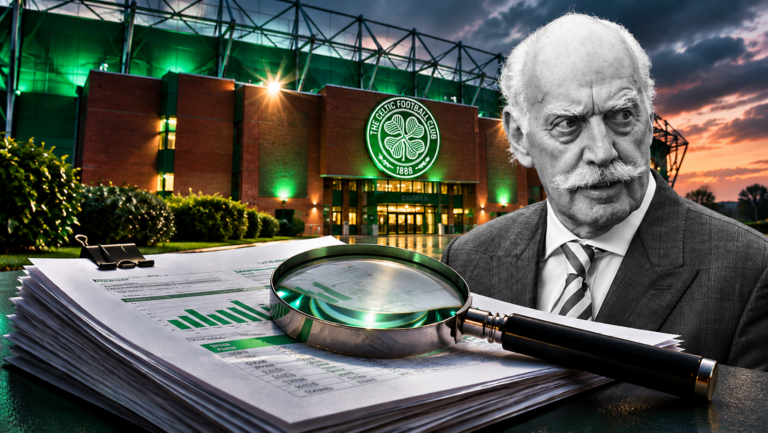
The only tables Celtic’s board seem interested in climbing these days are the ones contained in Microsoft Excel spreadsheets.
Forget the Champions League table.
Forget the Europa League table.
As long as the figures in the spreadsheet keep heading in the right direction, somebody in the boardroom will presumably be delighted.
Unfortunately, the same can’t be said for the supporters watching what’s happening on the pitch.
We Have Money — So Why Won’t We Use It?
Here’s the part that absolutely boils my blood.
Celtic aren’t some financially distressed football club desperately trying to keep the lights on.
We’ve accumulated significant financial resources.
Yet season after season, supporters are left asking why more of those resources aren’t being invested in the football operation.
Why do we repeatedly approach Champions League qualifiers with obvious weaknesses in the squad?
Why are important recruitment decisions allowed to drift until the opportunities we’re supposedly preparing for have already passed?
And why does nobody provide a convincing explanation for this approach?
I’m not asking Celtic to gamble their financial future.
There’s a substantial difference between reckless spending and sensible investment.
What I’m asking is why the financial strength of Celtic Football Club doesn’t translate into a greater determination to improve the football team when it matters most.
We’ve heard enough about the financial gulf separating Scottish clubs from Europe’s wealthiest.
That gulf is real. Nobody disputes it.
But are we seriously suggesting Celtic need the resources of Real Madrid to compete properly against Ferencváros?
The Hungarian champions came to Celtic Park and won 3-1.
Then we travelled to Benfica and lost 4-1.
Seven goals conceded across two Europa League matches.
Zero points.
And we’re supposed to be encouraged because Benfica were wobbling?
At what stage do we stop hiding behind financial disadvantages and start asking whether the people responsible for Celtic’s football strategy are delivering anything remotely close to what the club should expect?
When Did Avoiding A Hiding Become An Achievement?
I find the conditioning of our supporters particularly depressing.
There was a time when Celtic approached European matches believing we could compete.
Of course we lost games.
Sometimes we were beaten heavily.
But the ambition was to improve, to challenge ourselves and to build teams capable of producing memorable European performances.
Now?
We lose 4-1 and spend days debating whether the opposition were worried about us for twenty minutes.
We concede three at home to Ferencváros and hear explanations about individual mistakes.
The following week, another opponent takes advantage of more defensive errors.
Eventually, you have to recognise that repeated failures aren’t simply unfortunate incidents.
They’re evidence of a bigger problem.
And I’ll say something that some people won’t like.
Celtic have become a joke club in European competition.
There. I’ve said it.
Not because our history is a joke.
Not because our supporters are a joke.
And certainly not because our football club lacks the potential to compete at a better level.
It’s because the gap between our reputation, resources and European performances has become almost impossible to defend.
We talk like a major European institution while increasingly accepting the results of a club grateful merely to participate.
That isn’t ambition.
It’s managed decline.
Even Our Supporters Are Competing Over Who Suffered Longer
I saw a post on X recently asking how long Celtic had gone without winning a European knockout tie before the Seville season of 2002–03.
The apparent intention was to suggest that our current European struggles aren’t particularly unusual because previous generations experienced lengthy periods of disappointment too.
What an absolutely bizarre argument.
We’ve reached the stage where supporters are comparing historic periods of underachievement to determine which generation has the strongest excuse for failure.
Are we genuinely point-scoring over who endured the longest European drought?
Is that what it’s come to?
Mismanagement is mismanagement. Underperformance is underperformance. Celtic underachieving is Celtic underachieving.
I don’t care whether it happened in 1985, 1995, 2005 or yesterday.
The fact that things were disappointing before Martin O’Neill took Celtic to Seville doesn’t make today’s situation acceptable.
If anything, that achievement should remind us what happens when the club combines ambition, recruitment and strong leadership.
We’re supposed to learn from the past.
Not use its disappointments to excuse the present.
And I find it incredibly sad that supporters are now using historic European failures as ammunition against one another.
That’s not healthy debate.
That’s the toxicity created when expectations have fallen so far that we’re arguing about which era was less successful rather than demanding a better future.
We deserve better than that.
Martin O’Neill Deserves Support — The Board Deserves Scrutiny
Let me make something absolutely clear.
This isn’t an attack on Martin O’Neill.
The response against Hearts was magnificent.
Seven goals, attacking football and a performance that reminded everyone what Celtic can look like when things click.
Martin deserves enormous credit for that.
But his responsibility is to prepare the players and win football matches.
The responsibility for Celtic’s long-term European competitiveness lies with the people making the strategic and financial decisions.
They decide the recruitment budgets, the planning and they appoint the people responsible for building the squad.
And they must ultimately answer for the results of those decisions.
I fully expect Celtic to endure another season without winning a European knockout tie.
I say that with absolutely no pleasure.
I’d love nothing more than to be proven spectacularly wrong.
But I can’t look at our recent performances and pretend everything is heading in the right direction simply because we created a few second-half chances against Benfica.
Tomorrow, Celtic face Celta Vigo.
I’ll be desperate for us to win.
I want Martin O’Neill celebrating another famous European night at Celtic Park.
What I don’t want is another evening where we’re left searching for small positives in a result that should be setting alarm bells ringing.
Celtic Supporters Deserve More Than Respectable Defeats
We’ve become so accustomed to lowering expectations that even the language surrounding European failure has changed.
A heavy defeat becomes a spirited performance and a brief spell of pressure when 3 or 4 goals down becomes evidence that we almost had the opposition beaten.
This is a competition we should be targeting seriously becomes another exercise in explaining why the financial odds were stacked against us.
Enough is enough.
Celtic supporters understand the realities of modern European football.
We don’t need another lecture about television revenues, transfer fees or the wealth of the Premier League.
What we need is evidence that our own club is doing everything reasonably possible to compete.
Spend intelligently.
Recruit early.
Build a balanced squad.
Give the manager the tools required to succeed.
And stop treating European ambition as something that threatens the financial accounts.
Because Celtic’s greatest European achievement wasn’t built on a spreadsheet.
It was built on belief, courage, footballing intelligence and a determination to be better than the opposition.
Nearly sixty years after Lisbon, we’re still celebrating the men who made that history.
Yet the modern club increasingly appears content to use their achievements as a marketing exercise while accepting standards those men would never have recognised.
Martin O’Neill says Benfica were wobbling.
Perhaps they were.
But Celtic have been wobbling in Europe for years.
And while the board continues to put the balance sheet before the team sheet, I fear we’ll keep falling over.
Keep Your Eyes On The Board.







We win against hearts 7-1 then Mon comes out with what could have been against benfica . If ifs and ands . When someone u admire like Martin Oneil comes out with statements like he has been over the past year , they lose a bit of credibility bit by bit and the respect gets less and less and you stop believing things at face value . We have been getting told some outlandish tales from guys like Lennon , strachan and brown who I will never ever take seriously anything they ever say . Martin Oneil isn’t on their level yet but if he keeps it up he will get there
Really gooid article Bhoycie, sums up our lack of ambition, and acceptance of repeated failures in Europe.
Most Celtic supporters are realists, My expectation of Celtic these days, is for our club to be a regular top 24 club in the Champions League, with ambition to be a regular top 16 club. That position in European foitball should be within our reach.
This board continually handicap us early in the season, by being in a hurry to sell our better players, before finding replacements, leaving us short in the early days of European qualifiers and competitions.
Having a manipulative largest shareholder living in Ireland or the Carribean, and a CEO who seems to be camera shy doesn’t help.
Maloney had a very good press conference yesterday, and in my opinion could make a better job of being CEO or Chairman, than Nicolson or Wilson. Although Shaun would probably rather have a football related job than an admin position.
Martin O’Neill should realise Celtic supporters aren’t wanting elusive answers these days, get the serious hat on Martin, and give straight answers, stop looking so beholden to your boss in Ireland.